Photo: Steve Wilson · CC BY 2.0
Rhinoceros hornbill
Buceros rhinoceros
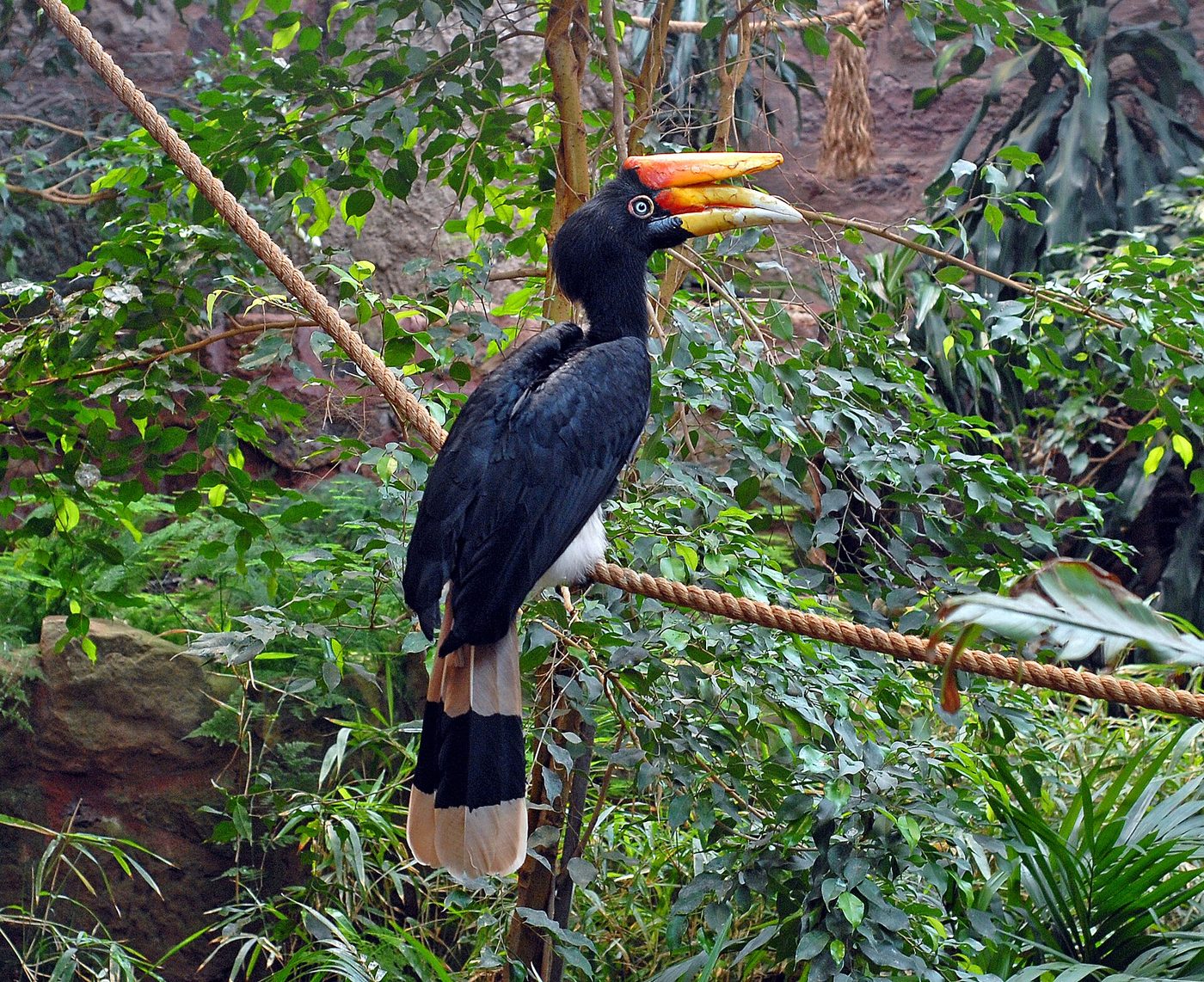
With the showy orange casque curving over its bill like a horn, the rhinoceros hornbill is one of the most majestic birds of the rainforests of Southeast Asia.
Characteristics
Temperament
Arboreal, noisy, forms stable pairs
Diet
Frugivore: fruit, with insects and small animals
The bird with a horn of fire
The rhinoceros hornbill is a large and imposing bird, famous for the structure it carries above its bill: a showy orange and red casque, curving upwards like a horn, from which its name derives. Despite its massive appearance, the casque is hollow and light, and its bright colour is due in part to an oily secretion that the bird smears onto it. The plumage is mainly black, with a white tail crossed by a broad black band. The sturdy, curved bill completes an unmistakable profile.
Habitat and distribution
It lives in the rainforests of Southeast Asia, particularly in Borneo, Sumatra, Java, the Malay Peninsula, Singapore and southern Thailand. It frequents both lowland and montane forests, up to about 1,400 metres in altitude. It spends much of its time among the high canopy, moving between trees in search of fruit.
Feeding and behaviour
It is mainly frugivorous: it feeds predominantly on fruit, especially figs, but supplements its diet with insects, small animals and occasionally eggs. By feeding on fruit and flying over long distances, it plays a valuable role in dispersing seeds and regenerating the forest. It has a fascinating breeding behaviour: the female shuts herself inside a tree cavity, sealing the entrance with mud and debris until only a slit remains. She stays there, protected, to incubate, while the male feeds her by passing food through the opening.
Curiosities and conservation
The rhinoceros hornbill has strong cultural value for several peoples of Borneo, who consider it sacred and make it a symbol. It is classified as a vulnerable species: the destruction of rainforests and hunting, including for its casque, threaten its populations. The protection of the Asian forests is essential to secure its future.
Pros
- Unmistakable orange casque
- Disperses seeds, regenerating the forest
- Fascinating nesting in a sealed cavity
- Very long-lived, up to about 35 years
Cons
- Vulnerable species
- Threatened by deforestation and hunting
- Depends on large rainforests