Photo: Orchi · CC BY-SA 3.0
Stag beetle
Lucanus cervus
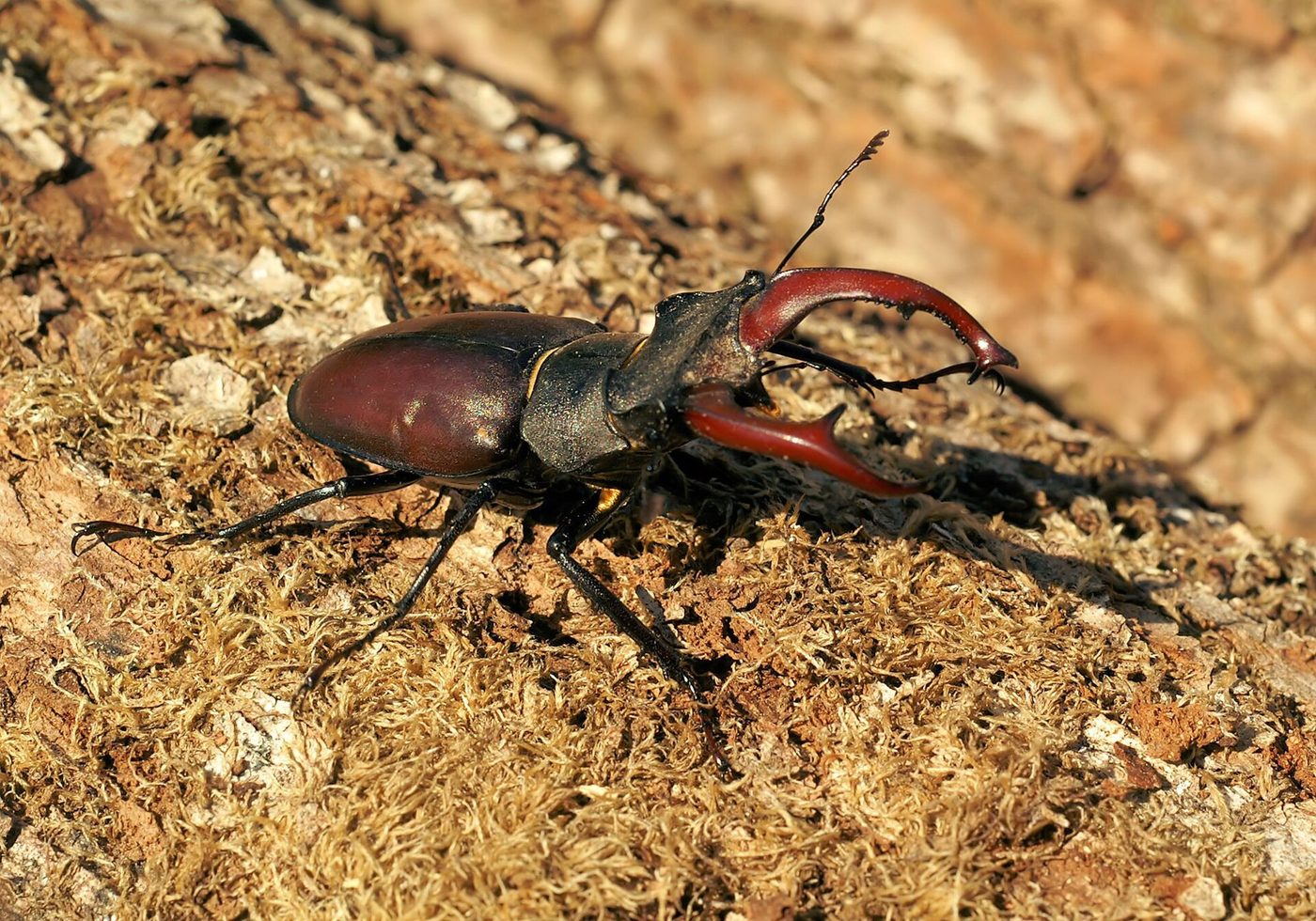
With its imposing jaws like a stag's antlers, the stag beetle is the largest beetle in Europe and a valuable inhabitant of ancient woods.
Characteristics
Temperament
A crepuscular beetle, active in summer. The male uses its large jaws in ritual fights with other males, not to attack; to people it is entirely harmless.
Diet
The adults feed on sap and sugary tree liquids; the larvae feed on decaying dead wood.
The giant of beetles
The stag beetle is the largest beetle in Europe and one of the most spectacular insects of the continent. The male is unmistakable for its enormous branched jaws, which recall the antlers of a stag and give the insect its common name. Despite their threatening appearance, these 'antlers' are not used to bite prey: they are in fact tournament weapons, used in fights between males to contend for females and the best sites. The female is smaller and has normal jaws, far stronger and more functional than those of the male.
The body, armoured and glossy, is brown-black in colour, with the jaws often of a reddish tone.
A life in dead wood
The biology of the stag beetle is closely tied to decaying wood. The female lays her eggs near the stumps and roots of dead trees, especially oaks. The larvae, large and whitish, live for several years digging tunnels in the rotting wood, on which they feed thanks to microorganisms that help them digest it. This long larval development, which can last several years, contrasts with the very brief life of the adult, which lives only a few weeks in summer.
Behaviour
The adults appear in summer, usually at dusk, when the males fly heavily in search of females. In flight they hold the body almost vertical, a curious sight given their bulk. They feed little, mainly on sap and sugary liquids they lick from the wounds of trees. The fights between males, which grip each other with their jaws trying to overturn the opponent, are one of the most fascinating spectacles of the summer wood.
Conservation
The stag beetle is regarded as a species of conservation interest and in many European countries it is protected. Its decline is linked to the disappearance of dead wood and old trees: forest management that removes rotting stumps and trunks deprives the larvae of their habitat. Leaving dead wood in woods and parks is the most effective measure to protect this and many other species tied to decomposition.