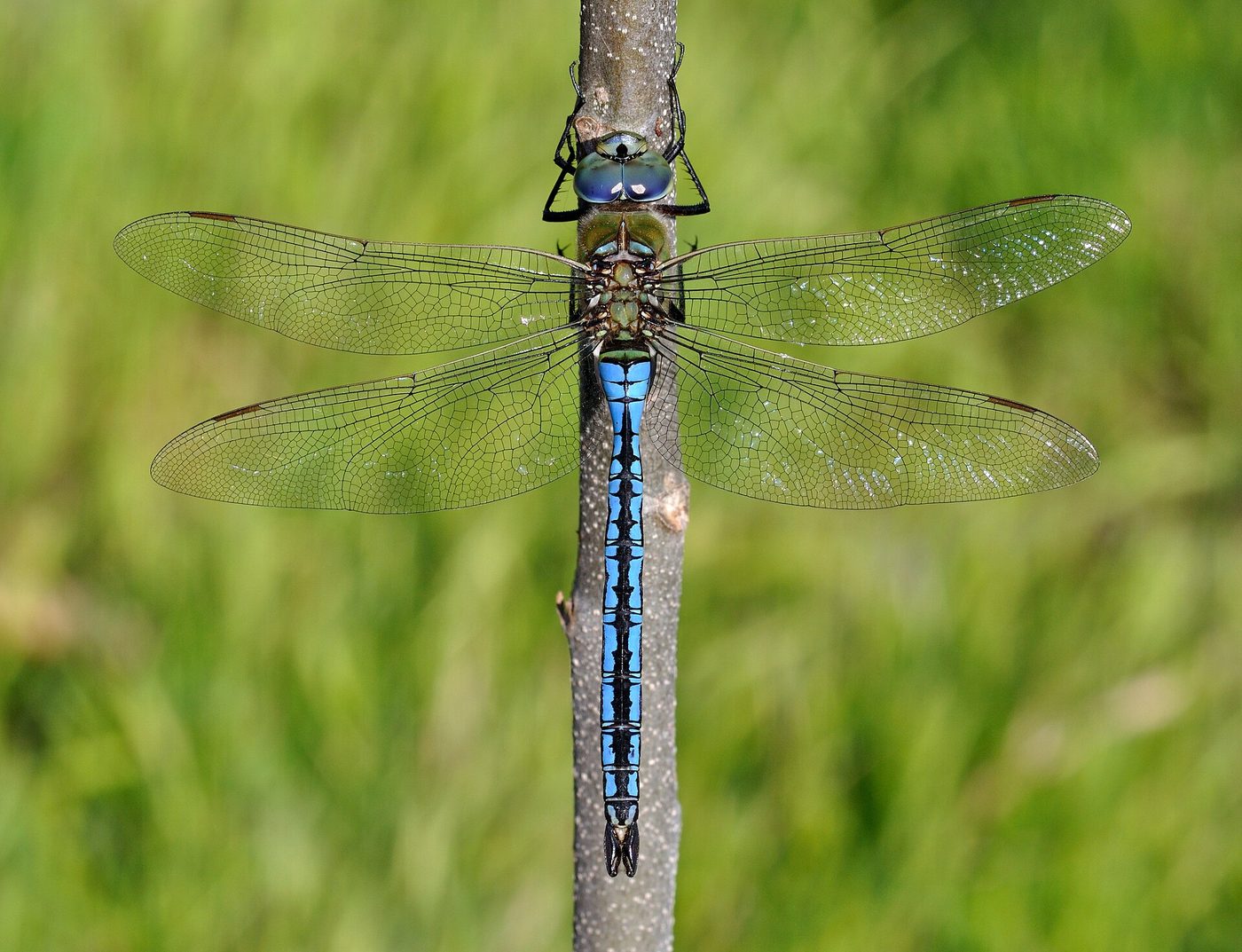
Emperor dragonfly
Anax imperator
With its long blue abdomen and lightning-fast flight, the emperor is one of Europe's largest dragonflies and an aerial hunter of extraordinary skill.
Characteristics
Temperament
A very fast, territorial aerial predator. Males tirelessly patrol their stretch of water; it hunts its prey in flight with acrobatic manoeuvres.
Diet
Predator: it catches midges, butterflies and other insects in flight; as a larva, in the water, tadpoles, small fish and invertebrates.
A large blue dragonfly
The emperor is one of the largest and showiest dragonflies in Europe. The male is unmistakable for its long, bright blue abdomen crossed by a dark line, while in the female the abdomen tends towards green. The thorax is green and the enormous eyes, which cover most of the head and touch in the centre, give an almost complete 360-degree vision. Its four transparent, sturdy wings make it a powerful and tireless flier.
A hunter on the wing
The emperor is an exceptional aerial predator. It catches its prey — midges, butterflies, other dragonflies — directly in flight, seizing them with legs that form a kind of basket. It is capable of acrobatic manoeuvres, of hovering in mid-air and of reaching remarkable speeds. Its very sharp sight lets it spot and pursue insects with precision. Males are territorial and tirelessly patrol their stretch of pond, driving off rivals.
A double life, from water to air
Like all dragonflies, the emperor spends much of its life in the water as a larva. The larva, called a nymph, is a voracious aquatic predator, equipped with an extensible lower lip that shoots out to catch tadpoles, small fish and other invertebrates. After months or years of growth underwater, the nymph climbs up a stem, its skin splits and the adult dragonfly emerges, spreading its wings and taking flight, beginning its brief but intense aerial life.
Where it lives
The emperor frequents ponds, small lakes, canals and still or slow-moving waters rich in vegetation, where the females lay their eggs. It is widespread across much of Europe, Africa and western Asia, and in recent decades it has been expanding its range northwards, favoured by the warming climate.
Conservation
The emperor is a common and unthreatened species. Like all dragonflies, however, it depends on the presence of clean water: it is a good indicator of the health of aquatic environments. Preserving ponds and wetlands is essential to maintain its populations and, with them, the wealth of life these environments harbour.