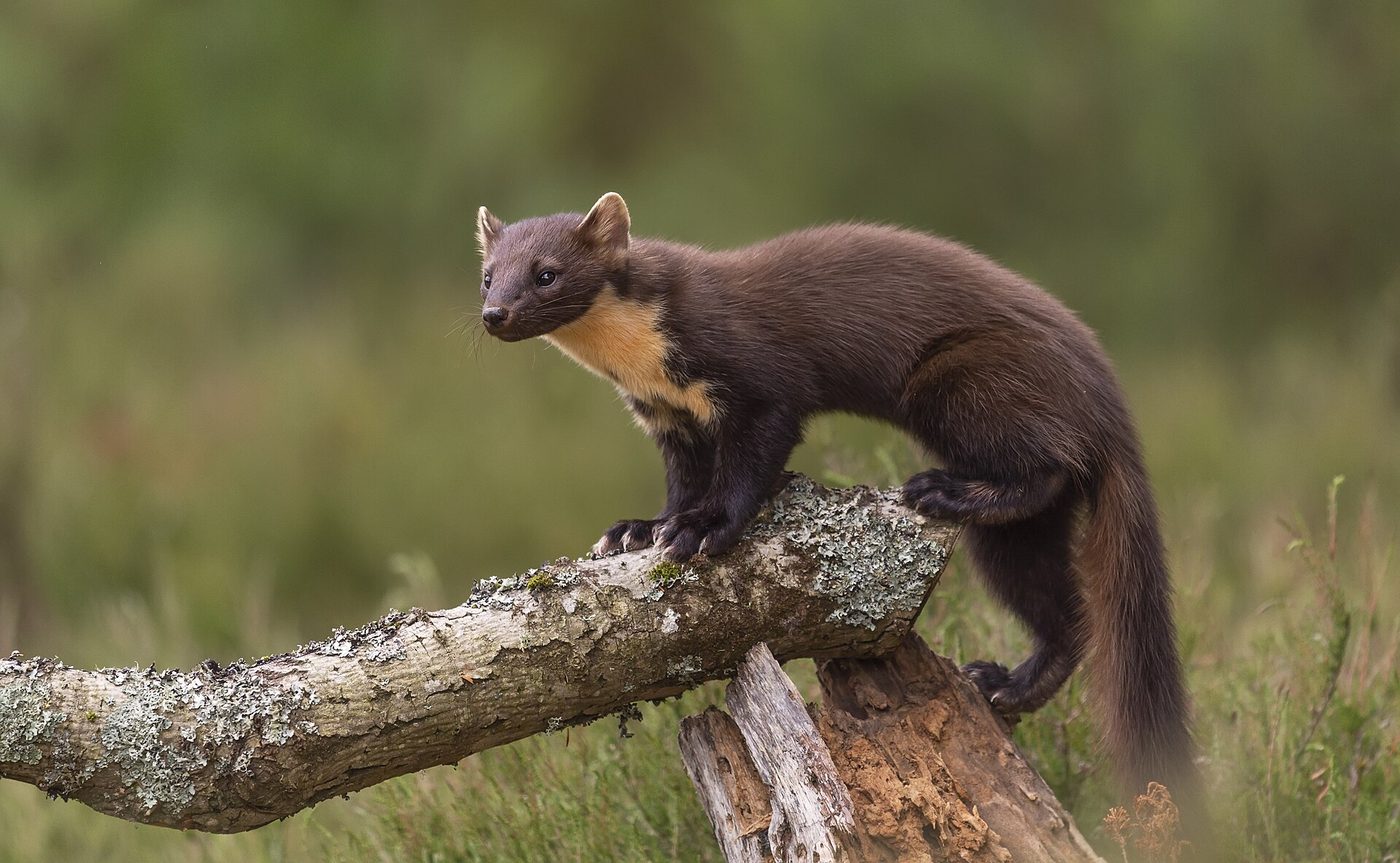
Photo: caroline legg · CC BY 2.0
European pine marten
Martes martes
Agile and slender, the pine marten is an arboreal hunter with a glossy coat, able to chase squirrels by leaping from branch to branch.
Characteristics
Temperament
Solitary, territorial and shy, active at dusk and by night. Agile and curious, it avoids people and disturbed places, favouring wild woodland.
Diet
Opportunistic predator: small mammals, birds, eggs and insects, supplemented by season with fruit and berries.
A mustelid of the trees
The pine marten is a slender mustelid, with a long, supple body and a bushy tail that it carries elegantly among the branches. Its coat is brown and glossy, with a characteristic yellow or cream patch on the chest and throat, irregular in outline, which distinguishes it from the similar beech marten. Its legs are sturdy and armed with semi-retractable claws, true hooks that let it climb with extraordinary ease.
The muzzle is pointed, the eyes large and the ears rounded and pale-edged, giving it a lively, attentive expression.
Where it lives
The pine marten is tied to woodland, particularly mature coniferous and broadleaf forests rich in large trees and cavities. Unlike the beech marten, which readily frequents buildings and settlements, the pine marten favours wild, little-disturbed places, where it finds shelter in hollow trunks and the old nests of birds of prey or squirrels.
A hunter among the branches
The pine marten is an agile, opportunistic predator. It hunts chiefly small mammals such as voles and squirrels, but its diet also includes birds, eggs, insects and, according to season, a substantial share of fruit and berries. Its arboreal skill is legendary: it can chase a squirrel by leaping from tree to tree, something few other predators manage.
Behaviour
Solitary and territorial, the pine marten is active mainly at dawn, dusk and by night. It marks its territory with scent secretions and communicates with its kind through smell. It is a shy animal, hard to observe, which has helped feed its reputation as an elusive creature of the woods.
Conservation
The pine marten is listed as least concern, but its presence is closely tied to the health of forests: woodland fragmentation and the loss of large hollow trees reduce its habitat. In many regions it remains an uncommon animal, an indicator of well-preserved forest environments.