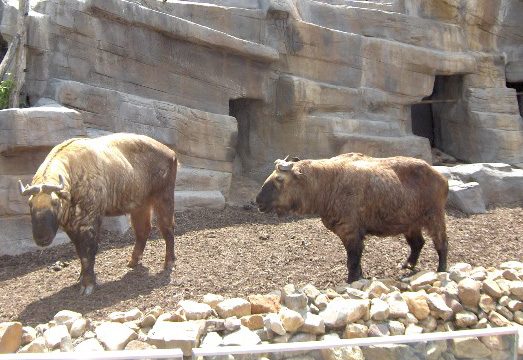
Photo: No machine-readable author provided. JoJan assumed (based on copyright claims). · CC BY-SA 3.0
Takin
Budorcas taxicolor
Massive as an ox and agile as a goat, the takin is a curious mammal of the Himalayan mountains, the national animal of Bhutan.
Characteristics
Temperament
Gregarious, sturdy, agile on slopes
Diet
Herbivore: leaves, shoots, grasses and bamboo
An animal of unusual appearance
The takin is a large mammal of singular appearance, which seems to combine the traits of several animals: its massive, stocky body recalls that of an ox, its arched muzzle that of a moose, while its horns and agility on slopes bring it closer to goats. It belongs, in fact, to the subfamily of the caprines, the same as goats and chamois. Its coat is thick and woolly, varying in colour from golden yellow to dark brown depending on the population. Both sexes carry sturdy, curved horns. A peculiarity of the takin is its skin, which secretes an oily substance that coats the fur and protects it from the moisture and rain of the misty mountains where it lives.
Habitat and distribution
It lives in the mountains of the eastern Himalayas and western China, among bamboo forests, woods and alpine meadows, often at high altitudes. It moves according to the seasons: in summer it climbs to the higher elevations, while in winter it descends into the wooded valleys in search of shelter and food. It is perfectly adapted to life in cold, damp mountain environments.
Behaviour and feeding
The takin is a herbivore that feeds on a great variety of plants: leaves, shoots, grasses, bamboo and shrubs, often standing up on its hind legs to reach higher foliage. It lives in groups, which in summer can bring together numerous individuals, while older males tend to become solitary. Despite its bulk, it is surprisingly agile and sure-footed on steep, rocky terrain.
Curiosities and conservation
The takin is the national animal of Bhutan, where it is tied to local legends and traditions. It is classified as a vulnerable species: habitat loss and hunting have reduced its populations. In some areas it is protected and present in reserves, but the conservation of the Himalayan mountain forests remains essential for its future.
Pros
- Sturdy and agile even on steep terrain
- Fur protected by an oily secretion
- National animal of Bhutan
- Adapted to cold mountain environments
Cons
- Vulnerable species
- Threatened by habitat loss and hunting
- Depends on Himalayan mountain forests