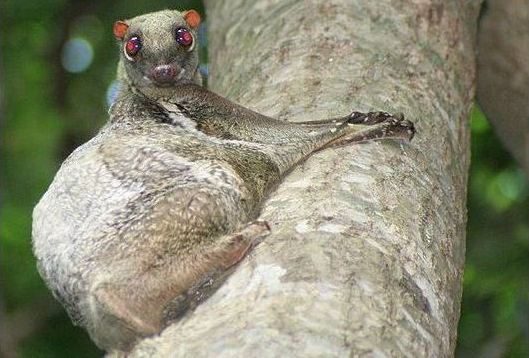
Sunda flying lemur
Galeopterus variegatus
Equipped with the most extensive gliding membrane of any mammal, the Sunda flying lemur silently slides from tree to tree in the nights of the Asian forests.
Characteristics
Temperament
Nocturnal, arboreal, glider
Diet
Herbivore: young leaves, shoots, flowers and fruit
The master of gliding
The Sunda flying lemur is a mammal of unusual appearance, often improperly called a 'flying lemur': in fact it is not a lemur and is not able to fly. Its most extraordinary feature is the patagium, a broad membrane of skin connecting the neck, the four limbs and the tail, forming a kind of great sail. It is the most extensive gliding membrane of any mammal, and turns the animal into a genuine living glider. Its fur is soft and mottled, with camouflaged colours ranging from grey to reddish-brown, perfect for blending in with the bark.
Habitat and distribution
It lives in the forests of Southeast Asia, from southern Myanmar and Thailand to southern Vietnam, from Malaysia to Singapore and Indonesia. It is strictly tied to forest environments, on which it depends completely. It is an arboreal and nocturnal animal, which by day rests clinging to trunks or hidden among the foliage.
The glide
When it has to move between trees, the colugo launches itself into the void and spreads out the patagium, which stretches like a parachute and allows it to glide over long distances, even more than a hundred metres, losing very little height. It is an extremely efficient way of moving through the forest without coming down to the ground, where it is instead clumsy and vulnerable. Females carry their young clinging to the belly even during glides.
Feeding and conservation
It is herbivorous and feeds on soft plant parts, such as young leaves, shoots, flowers and fruit. It is classified as a species of least concern, with still widespread populations, but being totally dependent on the forest, deforestation represents its main threat at the local level.
Pros
- The most extensive gliding membrane of any mammal
- Glides over a hundred metres between trees
- Perfect camouflaged fur
- Still widespread populations
Cons
- Totally dependent on the forest
- Clumsy and vulnerable on the ground
- Locally threatened by deforestation