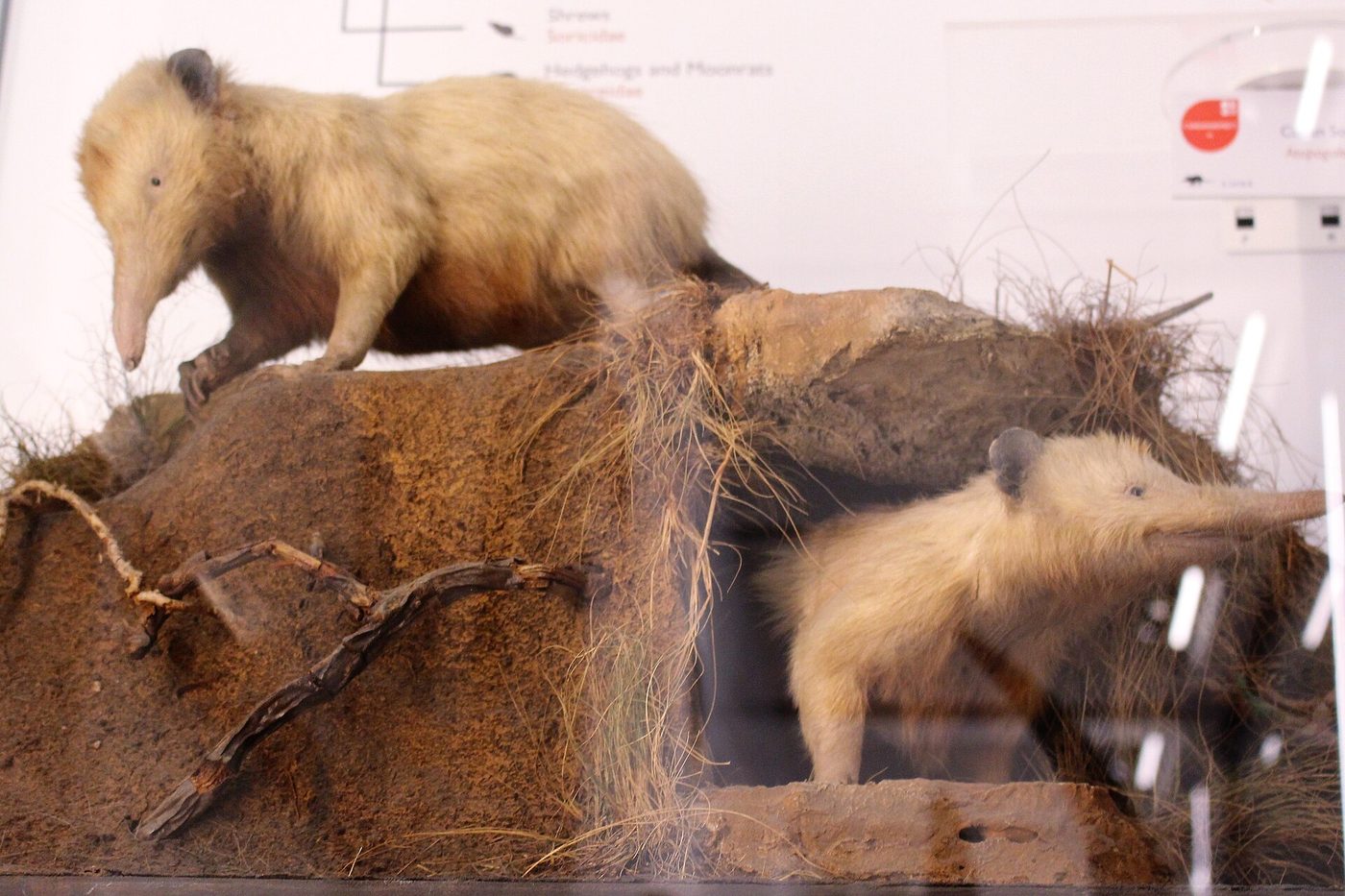
Photo: Emőke Dénes · CC BY-SA 4.0
Cuban solenodon
Atopogale cubana
A rare nocturnal insectivore endemic to Cuba, the Cuban solenodon is one of the very few venomous mammals, injecting toxic saliva through grooved teeth.
Characteristics
Temperament
Nocturnal, solitary, elusive, burrowing
Diet
Insectivore: invertebrates and small vertebrates
A venomous living fossil
The Cuban solenodon, or almiquí, is a small insectivorous mammal that looks like a large, primitive shrew, with a long mobile snout, tiny eyes and a bare, scaly tail. It belongs to the solenodon family, an ancient lineage that preserves archaic traits. Its most remarkable peculiarity is that it is venomous — very few mammals are. Its toxic saliva runs along grooves in the lower teeth — hence the name Solenodon, "grooved tooth" — and is injected into prey with the bite.
Habitat and distribution
It is endemic to the mountain forests of Cuba, where it is extremely rare and elusive. It lives hidden in burrows dug in the ground and among rocks, emerging only at night. It is so elusive that for long periods it was thought extinct, only to reappear.
Behaviour and diet
It is nocturnal and solitary. It feeds on insects and other invertebrates, but also small vertebrates, which it finds by probing the soil and leaf litter with its sensitive snout and strong claws. The venom probably helps it subdue prey. It moves with an awkward, characteristic zig-zag gait.
Curiosities
Together with the Hispaniolan solenodon, it is one of the last two living solenodons, survivors of an evolutionary line tens of millions of years old. They are among the very few mammals in the world able to inject venom with a bite.
Conservation
The IUCN classifies the species as Endangered. The main threats are forest destruction and predators introduced by humans, such as dogs, cats and mongooses, against which this slow, defenceless animal has little chance.
Pros
- One of the very few venomous mammals
- A 'living fossil' of an ancient lineage
- Endemic and extraordinarily rare
Cons
- Endangered species
- Threatened by introduced predators and deforestation
- Slow and vulnerable, not a pet