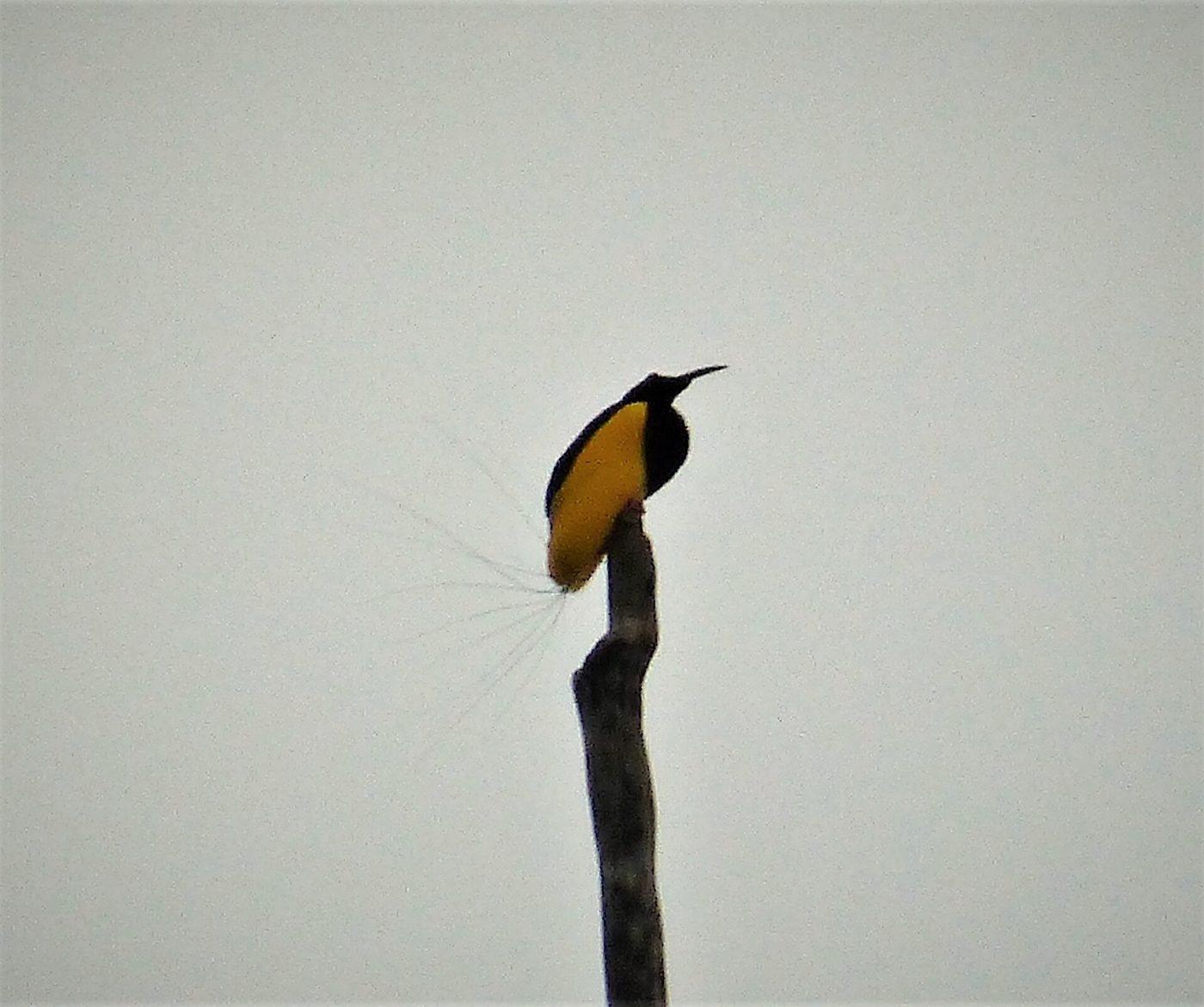
Twelve-wired bird-of-paradise
Seleucidis melanoleucus
A velvet-black and yellow bird-of-paradise, the twelve-wired bird-of-paradise is named for twelve wires the male brushes across the female during courtship.
Characteristics
Temperament
Arboreal, with tactile courtship on vertical perches
Diet
Omnivore: fruit, nectar, arthropods
A bird of twelve wires
The twelve-wired bird-of-paradise is a medium-sized bird-of-paradise, about 33 centimetres long.
(Note: the mass value given by Wikidata, 174 kg, is plainly wrong for a bird of this size; its true weight is around 170–220 grams.)
The male has velvet-black plumage with green-bronze sheen on the head and breast, a bold fan of rich yellow flank feathers and a red iris. From the rear of the flanks emerge twelve slender, stiff blackish filaments — the "wires" that give the species its name — which curve forward over the body. The female is entirely different: brown, with a pale belly barred in dark, a striking case of sexual dimorphism.
Habitat and distribution
It lives in the lowland swamp forests of New Guinea and the island of Salawati. It favours wet habitats, often near watercourses and in areas rich in palms.
Behaviour and courtship
It feeds on fruit, nectar and arthropods. The male courts perched upright on the top of a bare trunk: he displays the yellow flank fan and, approaching the female, brushes her face with the twelve stiff wires, a tactile contact unusual among birds. Its strong pink feet and large claws let it cling firmly to vertical surfaces.
Curiosities
Using the wire-like feathers to physically touch the female is one of the most singular courtship behaviours in the bird kingdom. The stark contrast between the sexes is such that male and female were once easily mistaken for different species.
Conservation
The IUCN lists the species as Least Concern: its range is wide and populations are thought to be stable. Conserving lowland swamp forest remains important for its future.
Pros
- Unique tactile courtship using the twelve wires
- Marked sexual dimorphism, spectacular male
- Wide range and stable populations
Cons
- Not a pet: highly specialised wild needs
- Tied to lowland swamp forest
- Hard to observe in the wild