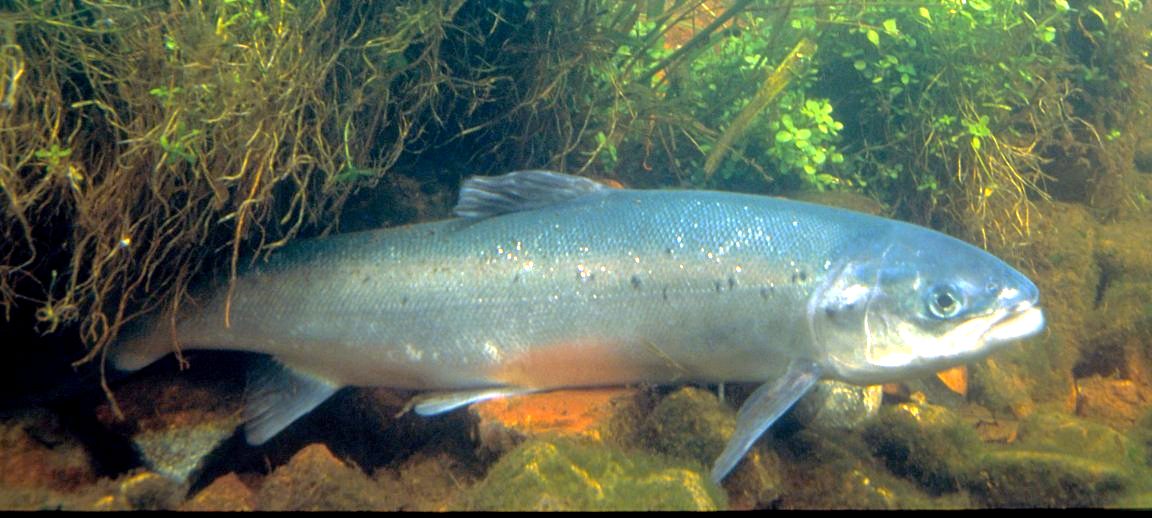
Photo: Hartley, William W. · Public domain
Atlantic salmon
Salmo salar
A tireless athlete of cold waters, the Atlantic salmon is famous for the heroic journey that sends it upstream against the current to its birthplace.
Characteristics
Temperament
A tireless migrant and powerful swimmer. A voracious predator at sea; during the breeding run it stops feeding and tackles rapids and waterfalls with spectacular leaps.
Diet
Carnivore: at sea small fish, crustaceans and marine invertebrates; in rivers, when young, aquatic insects and small invertebrates.
A great salmonid
The Atlantic salmon is one of the best-known and most symbolic fish of the cold waters of the northern hemisphere. It has a tapered, powerful body, silvery and bright when living at sea, with small dark spots on the back and flanks. It belongs to the salmonid family, the same as the trout, and like them it needs clean, oxygenated water. In the breeding phase its appearance changes radically: the colours intensify and the males develop a hooked, curved jaw.
A migratory fish
The Atlantic salmon is an anadromous fish: it is born in fresh water, migrates to the sea to grow, and returns to fresh water to breed. It is the opposite of the eel. Young salmon spend their first years in rivers, then descend to the ocean where they feed and grow rapidly. After one or more years at sea, guided by an instinct still not fully understood, they find their way back to the river where they were born.
The heroic run
The return journey is one of the most famous spectacles of nature. Salmon swim upstream against the current, overcoming rapids and waterfalls with powerful leaps that have made them a symbol of tenacity. During this migration they stop feeding, drawing on the reserves built up at sea. On reaching the shallow, gravelly waters of their origin, they breed; many individuals, exhausted, die after spawning.
Diet
At sea the Atlantic salmon is a voracious predator feeding on small fish, crustaceans and other marine invertebrates. In rivers, when young, it hunts aquatic insects and small invertebrates. Its rich marine diet is what allows it to build up the energy needed for breeding and the long migration.
Conservation
Many wild populations of Atlantic salmon are in decline because of the building of dams that block migrations, pollution and alterations of rivers, overfishing and the effects of intensive fish farming. Restoring river continuity and protecting watercourses are essential to its survival.