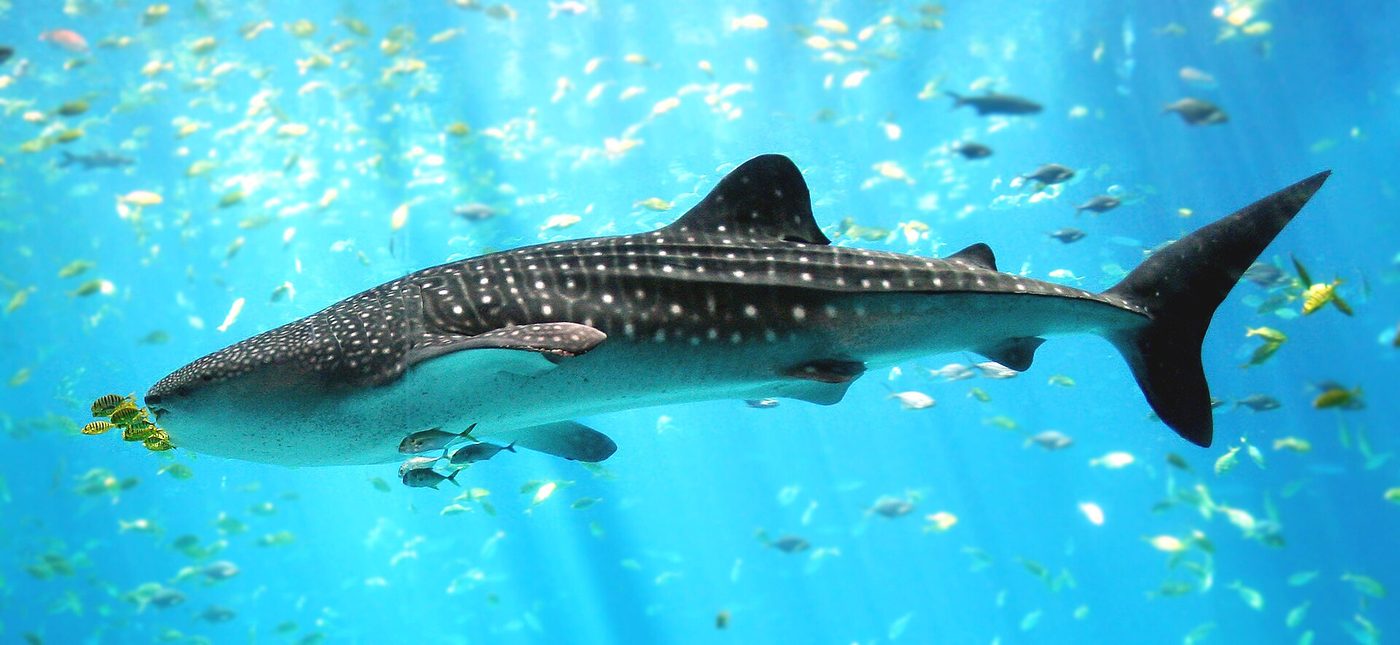
Whale shark
Rhincodon typus
The largest living fish, as long as a bus and covered in white spots, the whale shark is a gentle giant that feeds on plankton.
Characteristics
Temperament
A gentle giant, completely harmless to humans. A slow, solitary swimmer, but it gathers in groups where plankton abounds; a great traveller of the oceans.
Diet
Filter feeder: plankton, tiny organisms, fish eggs and small fish, filtered from the water by swimming with the mouth open.
The largest fish in the world
The whale shark is the largest living fish, able to exceed twelve metres in length. Despite its name and bulk, it is not a whale — which is a mammal — but a true shark, the greatest of all. Its grey-blue back is adorned with a characteristic pattern of white spots and stripes, unique to each individual like a fingerprint. Its mouth, enormous and at the front of the head, can open more than a metre wide.
A giant that filters the sea
Despite its impressive size and its membership of the shark family, the whale shark is completely harmless to humans. It does not hunt large prey: it is a filter feeder, feeding on plankton, tiny organisms, fish eggs and small fish. It swims slowly with its mouth wide open, filtering enormous quantities of water through special gill structures that retain the food, in a way similar to the baleen of whales. A colossal fish, then, that sustains itself on the smallest creatures of the sea.
A traveller of the oceans
The whale shark lives in the warm, tropical waters of the whole world. It is a great traveller: it covers thousands of kilometres following plankton blooms and concentrations of food. In certain areas and at certain times of the year, dozens of individuals gather where the food is abundant, offering one of the most extraordinary spectacles of the oceans.
Slow biology
Like many large sharks, the whale shark grows slowly, reaches maturity late and can live very long, perhaps up to a century. This slow biology, however, makes it particularly vulnerable: populations take a very long time to recover from a decline.
Conservation
The whale shark is classified as an endangered species. It is threatened by fishing, collisions with boats and human disturbance. Its gentle nature and habit of swimming near the surface also make it a popular tourist attraction, an activity that, if well managed, can contribute to its protection, but which must be regulated so as not to harm it.