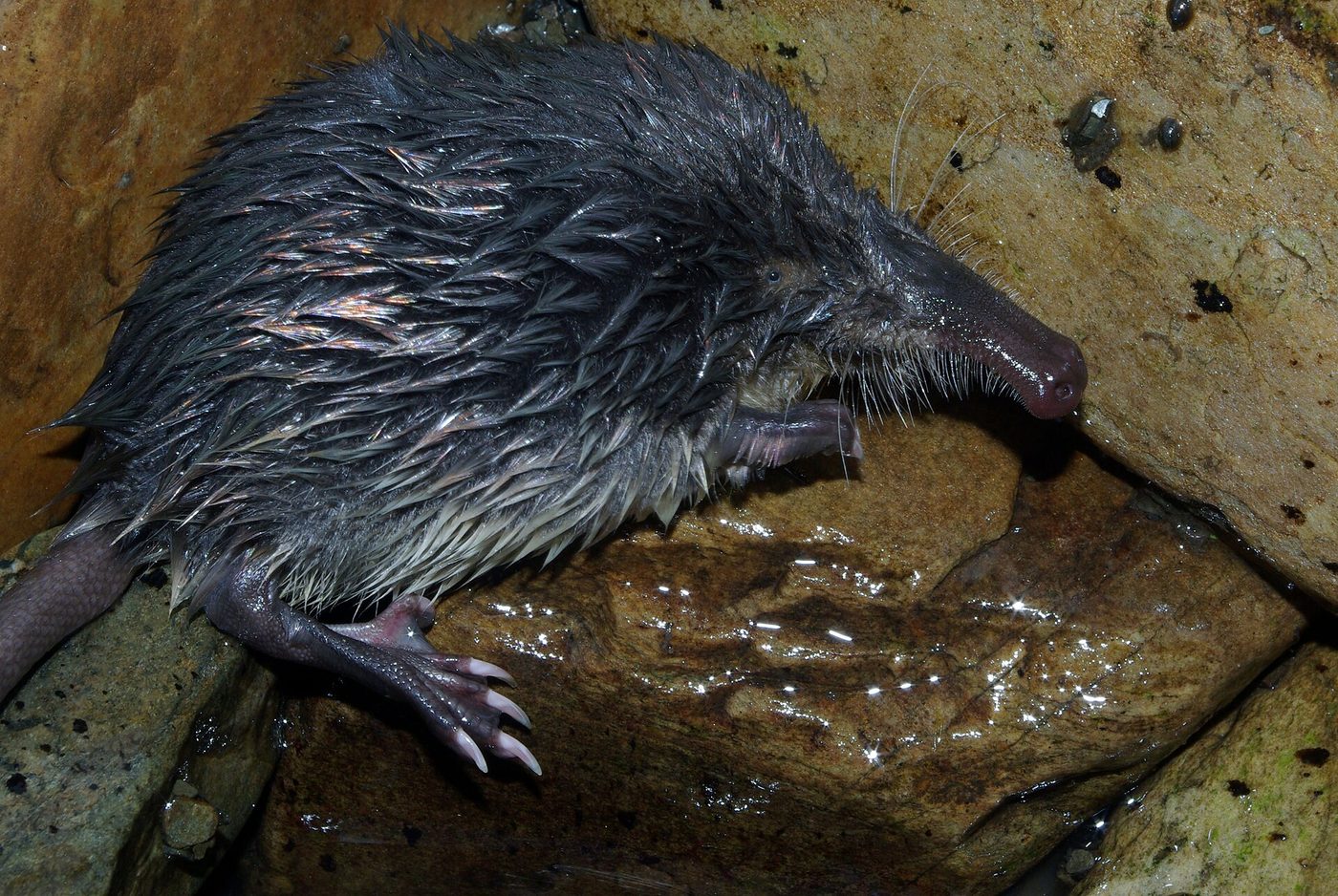
Photo: David Perez · CC BY 3.0
Pyrenean desman
Galemys pyrenaicus
A small aquatic mole with a trumpet-shaped snout, the Pyrenean desman hunts invertebrates in the mountain streams of Spain, France, Andorra and Portugal.
Characteristics
Temperament
Nocturnal, solitary, semiaquatic, shy
Diet
Insectivore: larvae, shrimps and aquatic invertebrates
A mole that lives in water
The Pyrenean desman is a small semiaquatic mammal related to the moles, with an unusual appearance. Its most distinctive feature is the long, highly mobile trumpet-shaped snout, which it uses as a tactile organ to explore the streambed. It has a stocky body, dark waterproof fur, a long tail flattened at the tip and powerful hind legs with webbed toes. Unlike common moles, it does not dig tunnels to hunt but swims.
Habitat and distribution
It is endemic to the Pyrenees and the mountainous zones of the north-western Iberian Peninsula, including the Cantabrian Mountains and the Central System. It occurs in four countries: Andorra, Spain, France and Portugal. It lives exclusively along cold, clean, well-oxygenated mountain streams and small rivers, with rocky banks that offer shelter.
Behaviour and hunting
It is mainly nocturnal and spends much of its time in the water. It feeds on aquatic invertebrates — insect larvae, freshwater shrimps and other small organisms — which it finds by probing the bottom with its sensitive snout and forepaws. It is an agile swimmer, able to move against the current.
Curiosities
Its nickname, "trumpet rat", comes precisely from the comical shape of its snout. It is an excellent ecological indicator: its presence signals healthy watercourses, as it quickly disappears where water is polluted or altered.
Conservation
The IUCN classifies the species as Endangered, and its populations are in marked decline. The main threats are dams and water abstractions that alter stream flow, water pollution and habitat fragmentation. Protecting mountain watercourses is crucial to its survival.
Pros
- Trumpet snout unique among European mammals
- Extraordinary adaptation to mountain streams
- Valuable indicator of clean water
Cons
- Endangered, with declining populations
- Extremely sensitive to water pollution
- Not a pet: highly specialised wild needs