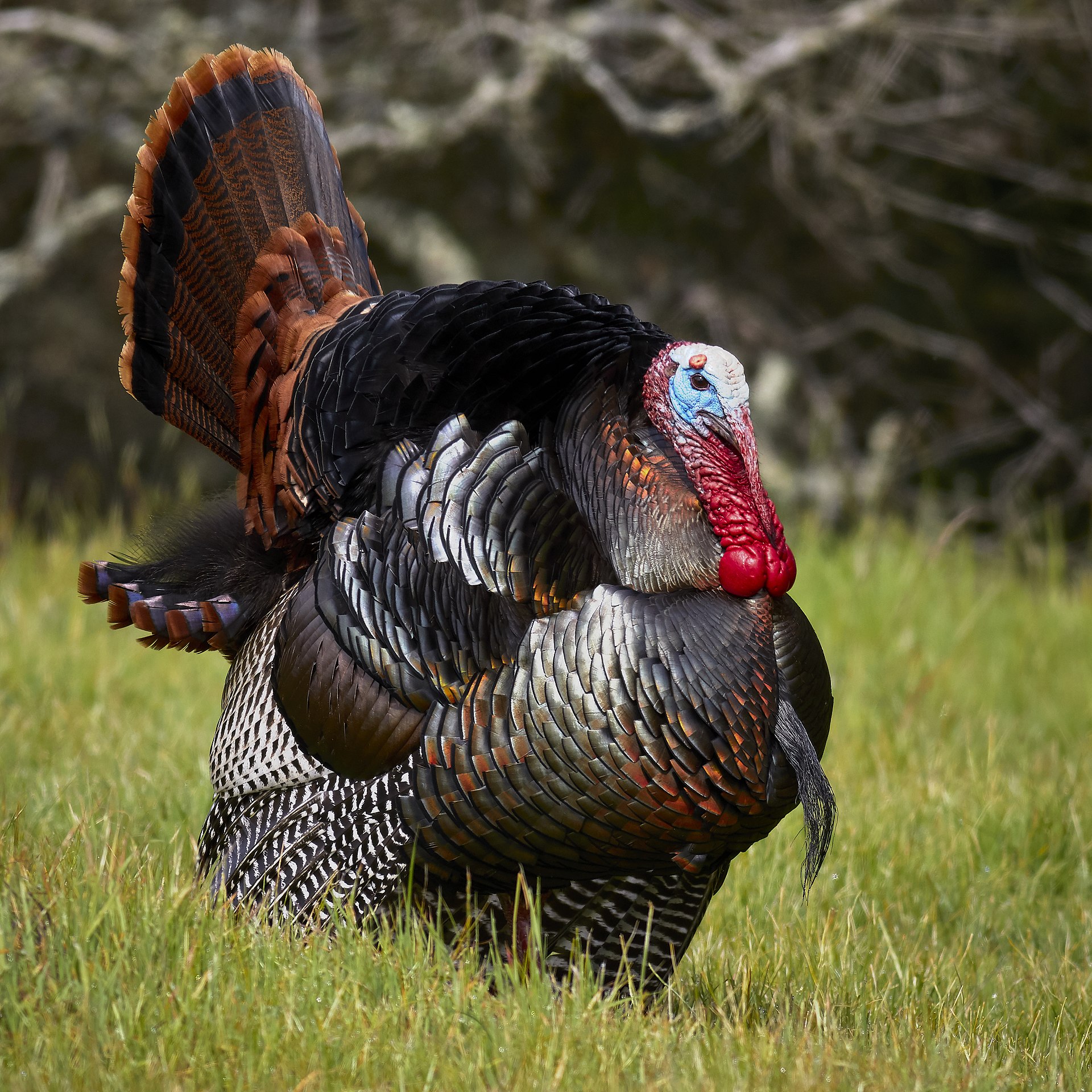
Wild Turkey
Meleagris gallopavo
Characteristics
Temperament
Social and hierarchical: lives in flocks ruled by a strict pecking order, often split by sex outside breeding. Diurnal, it forages on the ground by day and roosts in trees at night. Males are polygamous and compete in spring with displays and gobbling. Sharp-eyed and very wary, it is fast both running and in short flight. Not a pet: the wild turkey is an athletic, wary wild galliform.
Diet
Opportunistic omnivore that almost always feeds on the ground, scratching the litter with its strong feet. Staple: acorns, beechnuts, nuts and seeds (especially in autumn-winter; a great acorn consumer like squirrels). Also berries, fruit, shoots, leaves, grasses and roots, and insects, spiders and snails (vital protein for chicks), plus occasional small reptiles. In flocks, many watchful eyes reduce risk while foraging.
The Wild Turkey (Meleagris gallopavo) is the largest game bird in North America and the ancestor of the domestic turkey. Famous for:
- Its imposing size: adult males can exceed 10 kg and reach 1.25 m in length, among the heaviest birds on the continent still able to fly
- Its iridescent plumage: dark overall but shot through with metallic bronze, copper, green and gold sheens in sunlight
- Its "chameleon" bare head: featherless, it can change colour from red to white to bluish depending on excitement and mood
- The male's "gobble": a loud call audible over 1.5 km away
- The courtship display: the male "struts", puffing his feathers, fanning his tail and showing off to the females
- The ancestor of the domestic turkey: domesticated by Mesoamerican peoples long before Europeans arrived
- The great comeback: nearly extinct a century ago, it once again populates the continent in the millions
IUCN status: Least Concern (LC), abundant and expanding after its recovery. A social, sharp-eyed bird, it feeds on the ground scratching the forest litter — after the same acorns squirrels and the chipmunk love — and is itself prey for North America's great mesopredators such as the Coyote and Bobcat.
Classification and category
Order Galliformes (chickens, pheasants, peafowl and grouse), family Phasianidae, genus Meleagris. That genus holds just two species: the Wild Turkey (Meleagris gallopavo) of North America and the smaller, gaudier Ocellated Turkey (Meleagris ocellata) of the Yucatán Peninsula. There are six subspecies of Wild Turkey across the continent: Eastern (the most widespread), Osceola (Florida), Rio Grande (south-central plains), Merriam's (Rocky Mountains), Gould's (SW USA and northern Mexico) and South Mexican (the subspecies from which the domestic turkey descends). Etymology: "Meleagris" is the Greco-Latin word for the guineafowl, applied by naturalists to the turkey too; "gallopavo" joins gallus (cockerel) and pavo (peacock), "a bird between a cock and a peacock". The English name "turkey" arose from a historical mix-up with the guineafowl imported into Europe via Turkey. Parameters: Length males 100-125 cm, females 76-95 cm. Wingspan up to about 1.4 m. Weight males 5-11 kg (sometimes more), females 3-5 kg. Longevity 3-5 years in the wild (high mortality), up to 10+ in lucky cases. Polygamous: a dominant male mates with several hens; the female lays 10-14 eggs in a ground nest, incubates ~28 days, and the chicks (poults) are precocial, following the mother within hours of hatching.
Habitat and distribution
The Wild Turkey ranges across much of North America: from the USA (most of the country) south into Mexico and north into parts of southern Canada, where it has been successfully reintroduced. Preferred habitats: mature deciduous and mixed forests (its prime habitat, where large oaks provide acorns and tall trees offer safe night roosts); mosaics of woodland and clearings (alternating tree cover with grassland, fields and edges where it forages); and brushland, wooded swamps and farmland (it adapts to varied settings, including rural and suburban areas). The Wild Turkey spends the day on the ground but roosts in trees: at dusk it flies up to sturdy branches to escape nocturnal predators, and at dawn it comes back down to feed. It is largely sedentary, moving on foot over sometimes large home ranges. IUCN: Least Concern; after hitting bottom in the early 1900s, the North American population is now estimated at several million and considered stable or increasing.
Diet
An opportunistic omnivore that almost always feeds on the ground, scratching the litter with its strong feet: acorns, beechnuts, nuts and seeds (the staple, especially in autumn and winter — like squirrels and the chipmunk, it is a great acorn consumer); wild berries and fruit; shoots, leaves, grasses and roots; insects, spiders and snails (vital, protein-rich food for growing chicks); and occasionally small reptiles and amphibians. Feeding strategies: "scratching" (using its strong legs to turn over dead leaves and soil to uncover hidden acorns, seeds and invertebrates); flock foraging (turkeys move in flocks, and many watchful eyes let each one feed with less risk of surprise); and a seasonal diet (greens and insects in spring and summer, the energy "harvest" of acorns and nuts in autumn and winter). Crucially, its dependence on acorn-producing forests ties it closely to oaks, whose yearly fruiting ("mast year") directly affects winter survival and breeding success.
Physical features
A massive, long-necked, strong-legged bird, very different (slimmer, darker and more athletic) from the domestic turkey. Plumage: dark, almost black, but shot with metallic bronze, copper, green and gold iridescence in the light; a broad tail that fans out in display, with a terminal band; females smaller, duller and camouflaged (brownish-grey) to hide while incubating. The male's features (a "tom" or "gobbler"): a bare head and neck rich in caruncles (fleshy growths) that change colour — red, white, bluish — with excitement; a snood (a fleshy appendage drooping over the beak that lengthens in display); wattles under the throat; a "beard" (a tuft of bristle-like feathers hanging from the chest); and spurs on the legs, used in male-to-male fights. Performance: exceptional eyesight (a very wide field of view, near 270°, and colour vision, its main defence against predators); powerful but short flight (bursts over 80 km/h, mainly to reach roosts); fast running (up to ~40 km/h on the ground); and a poor sense of smell (it relies almost entirely on sight and hearing).
Behaviour and curiosities
A social, hierarchical bird. It lives in flocks structured by a strict pecking order, often segregated by sex outside the breeding season. In spring males compete with displays and gobbling to attract females, while the hens incubate and raise the poults alone.
The "gobble": the male's call is one of the most distinctive sounds of the North American spring woods, proclaiming presence and attracting females, audible over 1.5 km away; turkeys have a rich vocal repertoire of some thirty different calls. The colour-changing head: the male's bare head and neck skin is rich in blood vessels and works as an emotional "display" — bluish when calm, flushing deep red during display or a fight, and able to whiten at other times, signalling the bird's state to rivals and females. The ancestor of the domestic turkey: every farmed turkey on earth descends from the Wild Turkey, domesticated by Mesoamerican peoples (including the Aztecs) perhaps 2,000 years ago from the South Mexican subspecies; taken to Europe by the Spanish in the 16th century, it was bred there and then "brought back" to North America by colonists — a curious transatlantic round trip. Benjamin Franklin: famously, the anecdote that Franklin preferred the turkey to the bald eagle as the national symbol; in fact, in a private letter, he criticized the bald eagle as a bird "of bad moral character" (because it steals others' food) and praised the turkey as "more respectable" and courageous — he never officially proposed it as the national symbol, but the story became legend. The great comeback: in the early 1900s, between deforestation and unchecked hunting, the Wild Turkey had nearly vanished, with perhaps only about 30,000 left across North America; thanks to one of history's largest wildlife-management programmes — based on the trap-and-transfer of wild birds to suitable areas — the species has returned to number in the millions, a recovery that closely echoes that of another American woodland dweller, the Bobcat. Flight and roosting: despite its bulk, the Wild Turkey flies very well over short distances, hurtling between trees; every evening at dusk the whole flock flies up to high branches to spend the night safe from ground predators like foxes and coyotes, then drops back down at dawn — the domestic turkey, too heavy and bred for meat, has largely lost this power of flight.
Pros
- Grande galliforme iconico, simbolo del Nord America
- IUCN Least Concern: popolazione di milioni di individui in salute
- Straordinaria storia di recupero faunistico (da ~30.000 a milioni)
- Antenato selvatico del tacchino domestico, importante a livello culturale
Cons
- Non è un animale domestico (galliforme selvatico, va distinto dal tacchino d'allevamento)
- I maschi in parata possono diventare aggressivi/territoriali, anche verso le persone in aree urbane
- Può danneggiare colture e orti foraggiando in gruppo
- Molto cacciato come selvaggina (anche se in modo regolamentato)