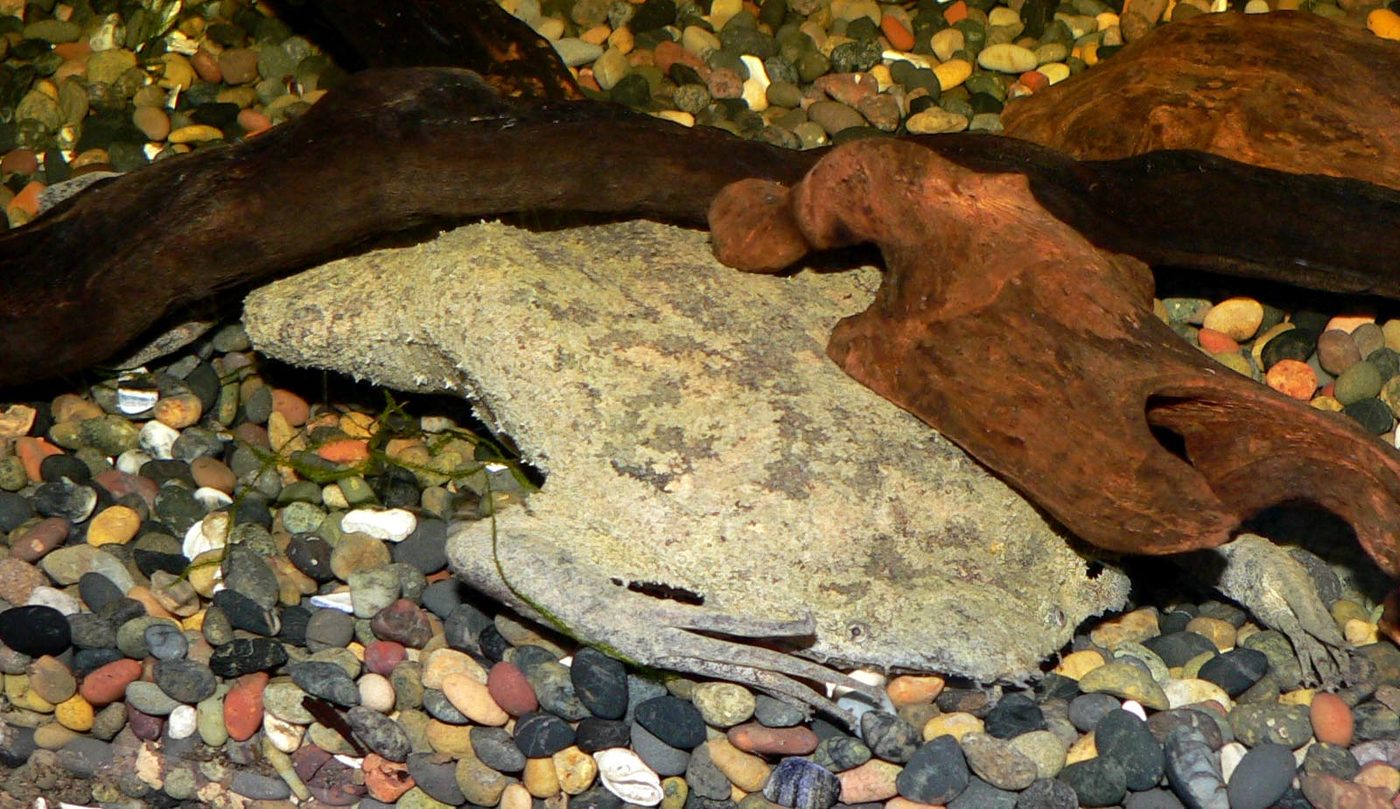
Photo: User:Stan Shebs · CC BY-SA 3.0
Surinam toad
Pipa pipa
Flat as a dead leaf and entirely aquatic, the Surinam toad is famous for the extraordinary way in which the female raises her young beneath the skin of her back.
Characteristics
Temperament
Aquatic, motionless, cryptic
Diet
Carnivore: small fish and aquatic invertebrates
An amphibian flat as a leaf
The Surinam toad is an amphibian of unmistakable, bizarre appearance. Its body is extremely flattened, with a flat, triangular head, and skin of a dull grey-brown colour. This shape and these colours are not accidental: they allow it to blend in perfectly with the dead leaves and fragments of rotting wood on the bottom of the murky waters in which it lives, making it almost invisible. It has no tongue, and its front fingers end in small star-shaped appendages, sensitive to touch, with which it senses prey.
Habitat and distribution
It lives in the tropical and subtropical regions of South America and on the island of Trinidad, where it inhabits slow, muddy waters, swamps and ponds. It is a fully aquatic species, highly adapted to life in water, with powerful webbed hind legs that make it a good swimmer. It rarely leaves the water.
The most extraordinary breeding
What makes the Surinam toad famous is its incredible way of reproducing. During mating, the fertilised eggs are pressed onto the female's back, where the skin engulfs them one by one in small honeycomb-like cavities. The eggs thus remain protected and develop directly in the mother's back. After a few months, not tadpoles but fully-formed little toads emerge from the skin of her back, ready to swim away.
Behaviour and conservation
It is an ambush predator: it stays motionless on the bottom, camouflaged, and when prey passes too close it rapidly sucks it into its mouth with a suction movement. It is classified as a species of least concern, with still widespread populations, although the health of South American wetlands remains important for its future.
Pros
- Unique, extraordinary breeding
- Perfect dead-leaf camouflage
- Well adapted to aquatic life
- Still widespread populations
Cons
- Unusual appearance that unsettles some
- Depends on wetlands
- Sensitive to water degradation