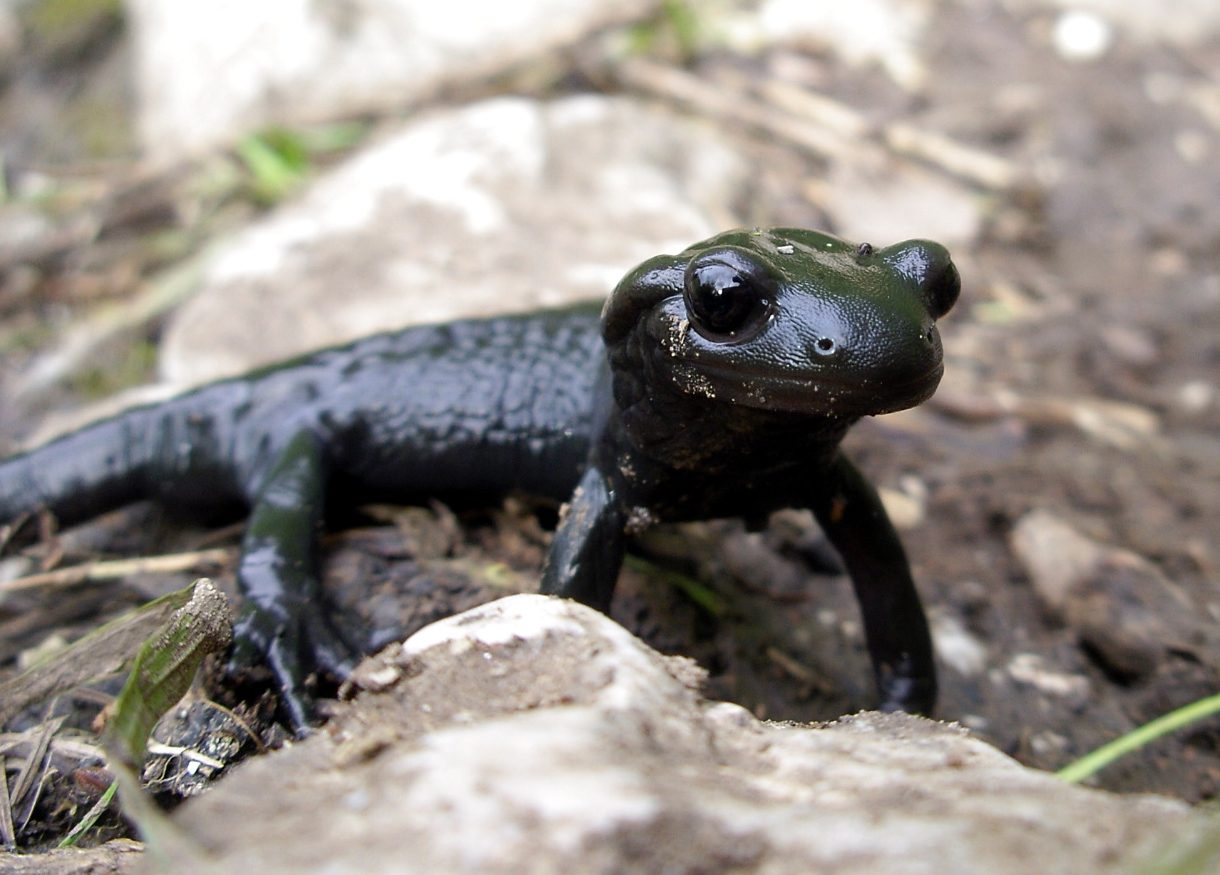
Photo: Zsolt BARNA (Kabóca) · CC BY-SA 3.0
Alpine salamander
Salamandra atra
The alpine salamander is a glossy jet-black mountain amphibian, unique among its kin for giving birth to fully formed young without an aquatic stage.
Characteristics
Temperament
Nocturnal, slow-moving, shy
Diet
Insects, spiders, snails and small invertebrates
Description
The alpine salamander is a small tailed amphibian with a slender body and smooth, glossy skin of a deep, uniform black. Some subspecies show yellow spots or stripes. It has a broad head, protruding eyes and rows of glands along its sides that secrete defensive substances. The species name atra comes from the Latin for "black".
Habitat and distribution
It lives in the Alps and in some isolated populations in the Balkans, at middle and high elevations. It favours damp broadleaf woodland, high pastures, scree slopes and limestone habitats rich in shelters. It likes cool, moist places and appears mainly after rain or at dusk.
Behaviour and reproduction
Unlike most salamanders, whose larvae develop in water, the alpine salamander is fully terrestrial at every stage of life. It is viviparous: it gives birth to one or two fully developed young, ready for terrestrial life. Its gestation is among the longest of all vertebrates and can last several years depending on altitude.
Did you know?
The long gestation is an adaptation to life high in the mountains, where standing water for larval development is not always available. The skin secretion is irritant and defends it against predators.
Conservation
It is classed as least concern, but is protected across much of its range. The main threats are climate change, disturbance of mountain habitats and its very low reproductive rate, which makes it vulnerable to population declines.
Pros
- Live birth independent of water
- Remarkable longevity, over ten years
- Valuable indicator of healthy alpine habitats
Cons
- Very slow reproduction, few young at a time
- Vulnerable to climate change at altitude
- Irritant skin secretion, not to be handled