Photo: Stan Shebs · CC BY-SA 3.0
Bunny ear cactus
Opuntia microdasys
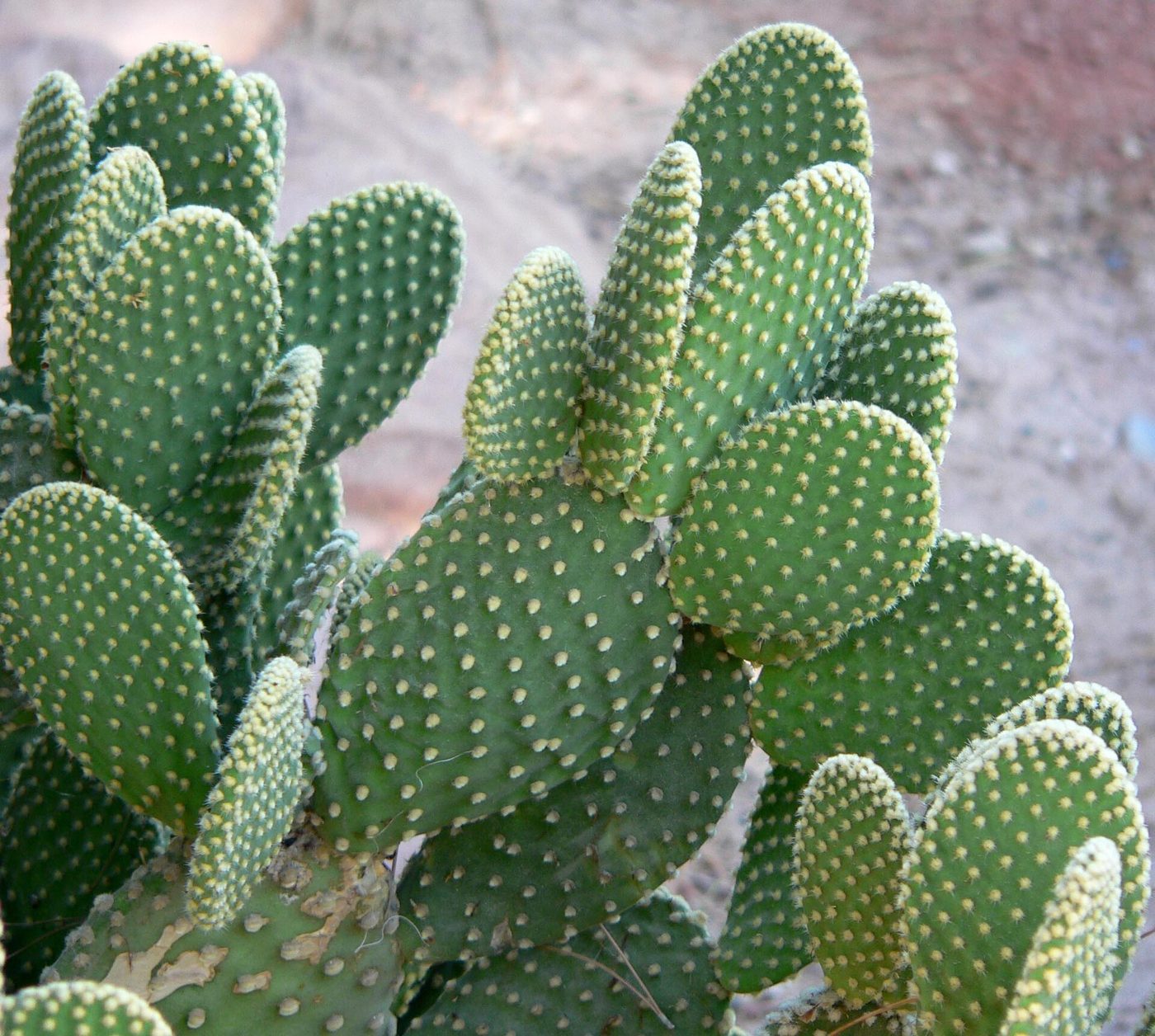
Opuntia microdasys is a charming Mexican cactus with round 'bunny ear' pads dotted with golden tufts of glochids.
Characteristics
The 'bunny ear' cactus
Opuntia microdasys is a small cactus native to Mexico, among the most widely grown in cultivation. It is made of flattened, rounded, soft-green segments (pads) that sprout in pairs, giving the plant its characteristic bunny-ear profile. Unlike many prickly pears, it has no large spines but is covered in dense tufts of tiny, barbed, golden bristles called glochids: lovely to look at, but treacherous to touch.
Origin and habitat
It is endemic to central and northern Mexico, where it grows in arid, sunny environments on stony, well-drained ground. It is adapted to long droughts thanks to its fleshy, water-storing pads.
Cultivation
It is an easy succulent, perfect for beginners. It loves full sun or very bright light and a well-draining mineral mix. Water it sparingly, letting the soil dry out completely between waterings, and keep it dry in winter when it rests. It dislikes frost and should be kept above 8–10 °C.
Beware the glochids
Its most treacherous feature is the glochids: minute bristles that detach at the slightest touch and lodge in the skin, hard to remove and very irritating. Always handle it with thick gloves or tongs, and keep it away from children and pets. In Spanish it is called "cegador" (blinder) precisely because of the risk these bristles pose to the eyes.
Care
With plenty of light and little water it is long-lived and forms dense clumps. It propagates extremely easily by detaching a pad, letting it callus over for a few days and planting it in dry mix. In summer it may bear yellow flowers.
Flowering season
Practical tips
Water needs: Low, soil fully dry between waterings — always check soil moisture before watering.
Prefers Full sun or very bright light: provide the right light and rotate the plant for even growth.
Recommended soil: Very free-draining, mineral cactus mix. Refresh the substrate every 1-2 years.
Dust the leaves with a damp cloth to support photosynthesis.
Feed during the growing season (spring-summer) and stop in winter.
Pros
- Charming 'bunny ear' look
- Very easy to grow and propagate
- Very drought-resistant
Cons
- Glochids lodge in the skin and irritate
- Dislikes frost and waterlogging