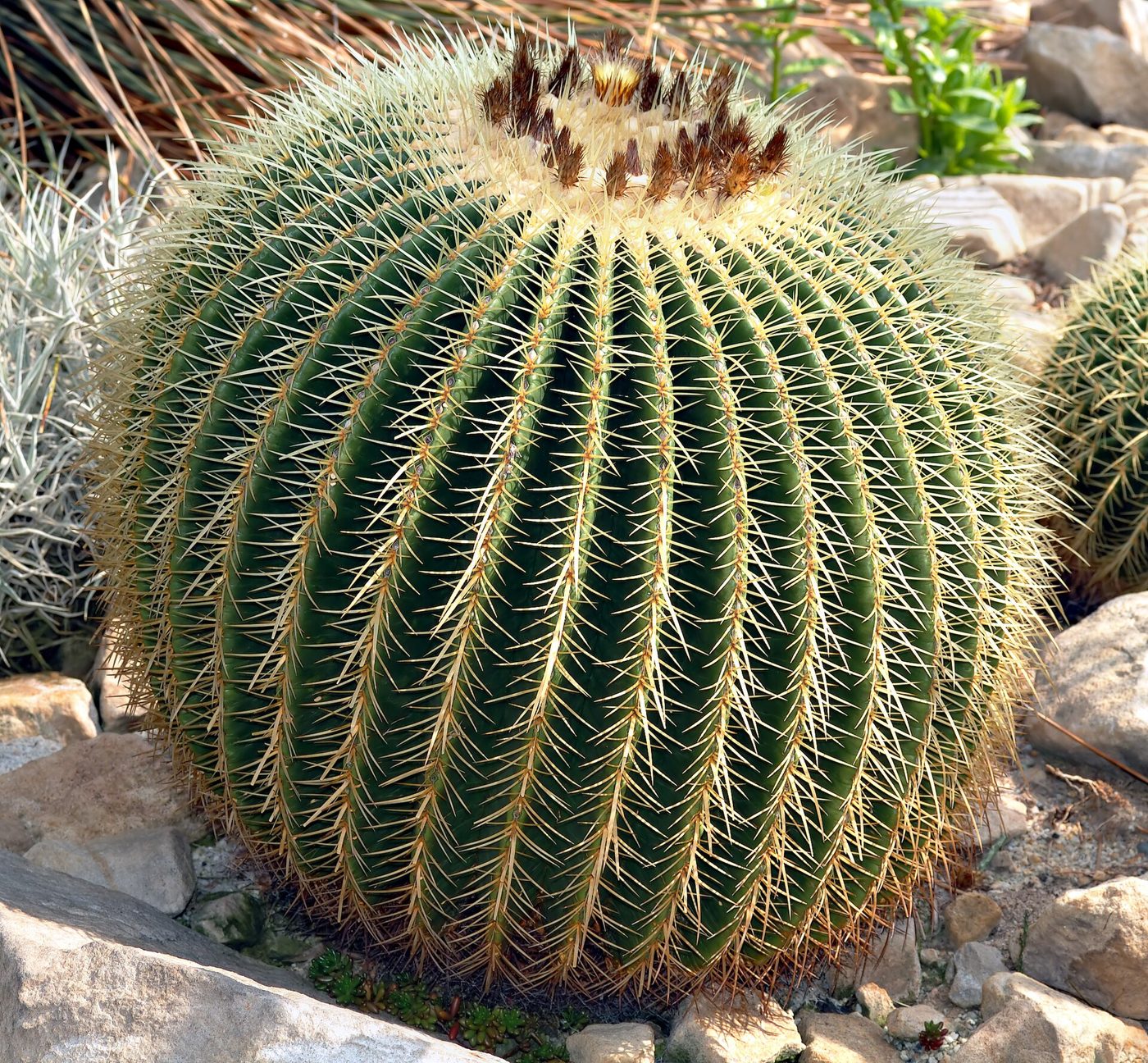
Photo: André Karwath aka Aka · CC BY-SA 2.5
Golden barrel cactus
Kroenleinia grusonii
Globular and covered with golden spines, the golden barrel cactus is one of the most beloved and recognisable cacti, a symbol of deserts and succulent collections.
Characteristics
The golden ball cactus
The cactus known as the golden barrel, for its spherical form bristling with spines, is one of the most famous and cultivated cacti in the world. When young it has a perfectly globular body, which over the years tends to lengthen slightly, becoming almost barrel-shaped. Its surface is divided into numerous well-marked vertical ribs, along which are arranged clusters of sturdy yellow or golden spines, giving it a gleaming appearance in the sun. At the top, in mature specimens, appears a woolly down from which small yellow flowers occasionally emerge.
Origin and habitat
This cactus is native to Mexico, where it grows in arid, rocky, sunny environments. In the wild it is now very rare and the species is considered threatened, but on the contrary it is extremely widespread in cultivation all over the world, where it has become a true classic of rock gardens and succulent collections. It loves heat and intense light and fears frost and excess humidity.
Cultivation and care
It is a relatively easy plant to grow, provided its fundamental needs are respected. It wants plenty of light, preferably direct sun, and a very well-draining soil, typical of cacti, that does not hold water. Watering must be sparse and adjusted to the season: moderate in summer, almost absent in winter, when the plant should be kept dry and cool to let it rest. Its main enemy is waterlogging, which can make it rot.
Curiosities
The large golden spines do not have only a defensive function against herbivores: they also help protect the plant's body from the most intense sunlight and to collect moisture from the air. The cactus grows very slowly, and large collector's specimens may be many decades old.
Conservation
Although very common in nurseries, in the wild this cactus is threatened by the destruction of its habitat. Choosing specimens grown in cultivation, rather than taken from the wild, is the most responsible way to enjoy this splendid plant while contributing to the protection of the wild species.
Practical tips
Water needs: Low; almost none in winter — always check soil moisture before watering.
Prefers Full sun, plenty of light: provide the right light and rotate the plant for even growth.
Recommended soil: Very well-draining, typical of cacti. Refresh the substrate every 1-2 years.
Dust the leaves with a damp cloth to support photosynthesis.
Feed during the growing season (spring-summer) and stop in winter.
Pros
- Spectacular globular form and golden spines
- Relatively easy to grow
- Long-lived, ideal for collections
- Perfect for rock gardens and pots
Cons
- Extremely slow growth
- Fears waterlogging and frost
- The sturdy spines must be handled with care