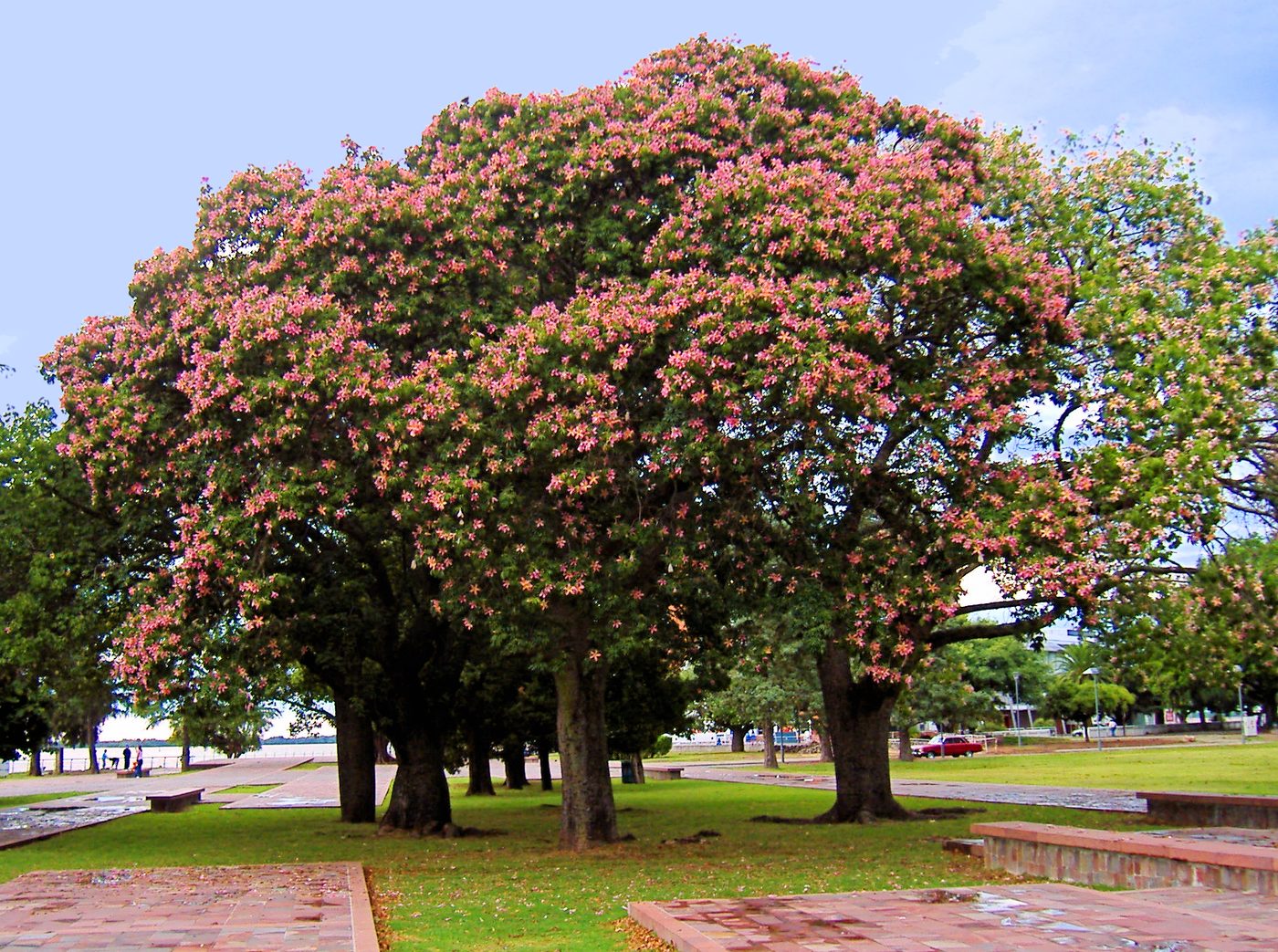
Photo: No machine-readable author provided. Pablo-flores assumed (based on copyright claims). · CC BY-SA 2.5
Silk floss tree
Ceiba speciosa
Ceiba speciosa, the silk floss tree, is a majestic South American tree with a swollen, spiny trunk and a spectacular pink flowering.
Characteristics
A tree with a bottle trunk
Ceiba speciosa, once known as Chorisia speciosa, is an imposing deciduous tree of the mallow family, the same as the baobab. Its most curious feature is the trunk: green when young, it swells at the base into a bottle or spindle shape and is covered in stout conical thorns. In autumn, often on a bare tree, it produces large pink flowers with a paler centre, of great ornamental effect. Hence the South American nicknames palo borracho (drunken stick) and bottle tree.
Origin and habitat
It is native to the tropical and subtropical forests of South America, particularly Argentina, Brazil, Bolivia and Paraguay. It grows fast when young and loves warm climates. In Bolivia it is called toborochi, the 'sheltering tree'.
Cultivation
It wants full sun and deep, fertile, well-drained soil. As an adult it tolerates drought well thanks to the water stored in its trunk. It is grown as an ornamental tree in many mild-climate regions; it dislikes prolonged frost, which limits its cultivation to warm-temperate climates. The trunk's thorns call for care in frequented areas.
Uses and facts
The fruits contain a cottony fibre similar to kapok, which surrounds the seeds and is traditionally used for stuffing; an oil is also obtained from the seeds. It belongs to the same subfamily as the baobabs and kapoks. The conical trunk thorns probably serve to deter large herbivores and to retain moisture.
Care
When young it should be watered regularly to encourage vigorous growth, reducing the supply as the plant establishes. It is little prone to disease and needs little care once mature.
Flowering season
Practical tips
Water needs: Moderate, drought-tolerant when mature — always check soil moisture before watering.
Prefers Full sun: provide the right light and rotate the plant for even growth.
Recommended soil: Deep, fertile and well-drained. Refresh the substrate every 1-2 years.
Dust the leaves with a damp cloth to support photosynthesis.
Feed during the growing season (spring-summer) and stop in winter.
Pros
- Spectacular pink flowering
- Unusual, striking bottle trunk
- Drought-resistant when mature
Cons
- Trunk and branches covered in thorns
- Dislikes prolonged frost