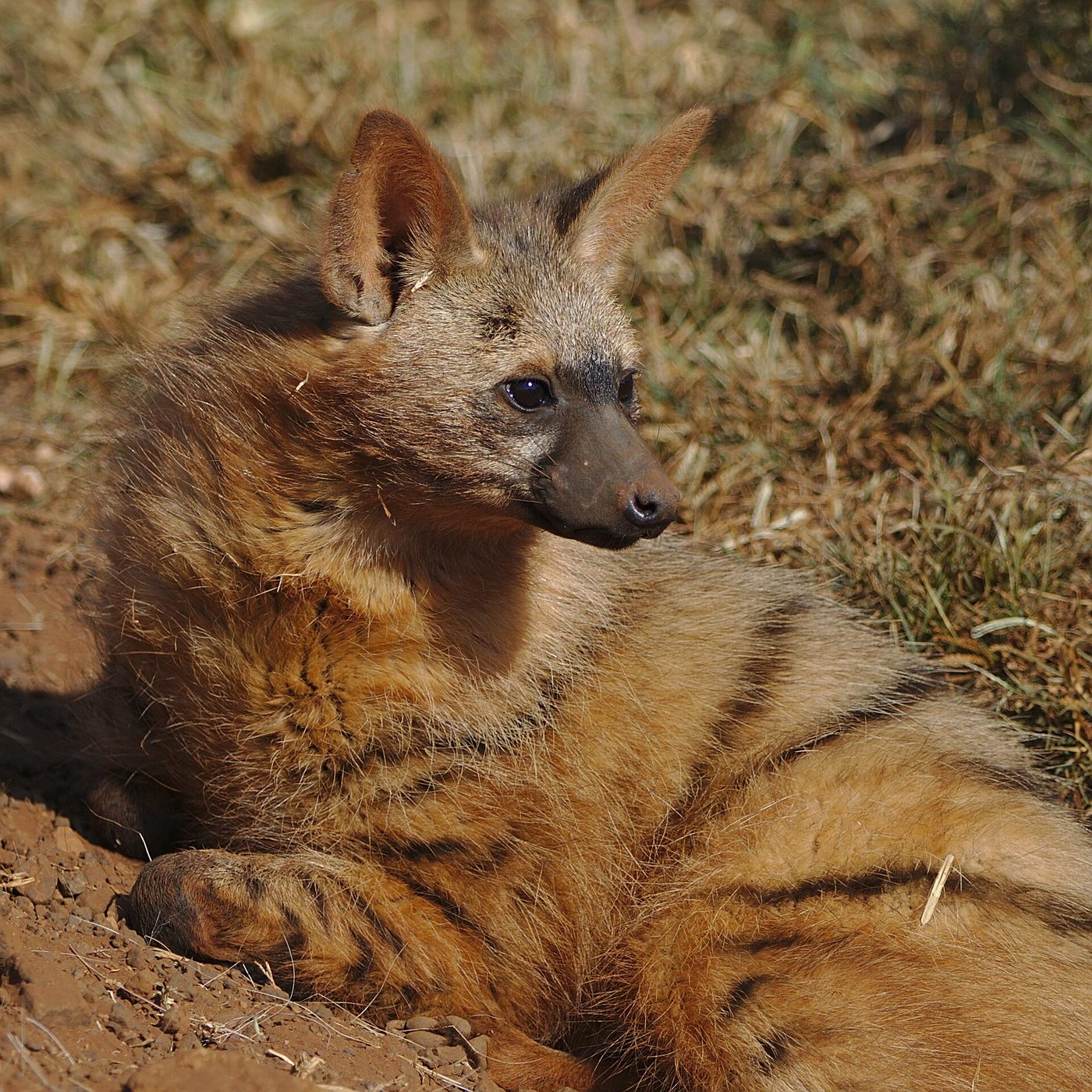
Aardwolf
Proteles cristata
Like a small striped hyena but gentle and insectivorous, the aardwolf is a shy African animal that feeds almost exclusively on termites, catching them with its tongue.
Characteristics
Temperament
Nocturnal, solitary, shy and gentle
Diet
Insectivore: almost exclusively termites
A hyena that eats insects
The aardwolf is an African mammal related to the hyenas, but with a completely different nature and habits. It has a slender body, covered with yellowish-tawny fur crossed by a few dark vertical stripes, and a striking mane along its back that it can raise to appear larger when frightened. Compared with true hyenas it is smaller and more slender, with a more tapered head and weak jaws: it is not a predator of large prey, but a specialist in a tiny food.
Habitat and distribution
It lives in the savannas and open grasslands of eastern and southern Africa, in two distinct, geographically separated populations. It prefers dry, bushy areas rich in termites, its almost exclusive food source. It spends the day hidden in underground burrows, often dug by other animals, and becomes active at night.
Behaviour and diet
The aardwolf's most extraordinary feature is its diet: it feeds almost exclusively on termites, in particular certain species that it gathers from the ground with its broad, sticky tongue, ingesting an enormous number every night. Unlike other ant-eaters, it does not destroy the termite mounds with its claws, but merely collects the insects at the surface, allowing the colonies to regenerate. It is a solitary and shy animal, which usually forages alone.
Curiosities
The name 'aardwolf', by which it is known in many languages, means 'earth wolf' in Afrikaans, a reference to its burrowing habits. Although its appearance recalls that of a hyena, the aardwolf is a gentle and harmless animal, which in the face of danger prefers to hide or to intimidate by puffing up its mane rather than to fight.
Conservation
The aardwolf is classified as a species of least concern, with populations on the whole stable. However, it can suffer locally from the use of pesticides, which reduce the termites it feeds on, and from persecution due to mistaken identification with harmful animals. Its specialised diet makes it a valuable ally in the natural control of termites.
Pros
- An unusual insectivore among hyena relatives
- Valuable natural controller of termites
- Gentle and harmless
- Populations on the whole stable
Cons
- Extremely specialised diet
- Sensitive to pesticides that reduce termites
- Sometimes persecuted through mistaken identification