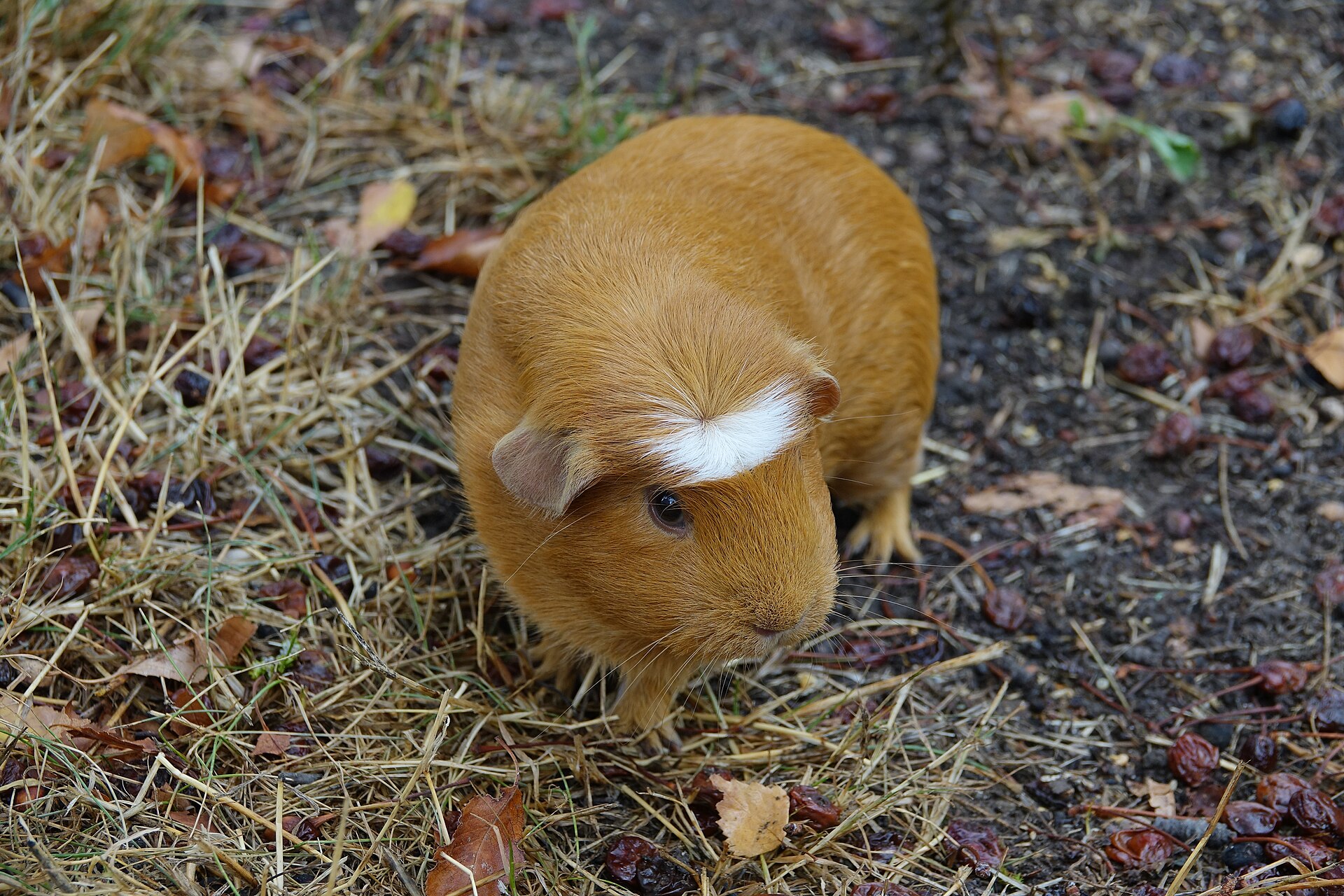
Guinea Pig
Cavia porcellus
Characteristics
Temperament
Diurnal, social, gregarious. Suffers greatly from solitude: in Switzerland it is FORBIDDEN to keep only one. Very vocal: 11+ distinct sounds to communicate with peers and owner.
Diet
Strict herbivore: hay (80% of diet), daily fresh vegetables, specific pellets, MANDATORY vitamin C (peppers, kiwi, parsley). Never onion, garlic, potato, avocado, chocolate.
The Guinea Pig (Cavia porcellus), also known as the domestic cavy, is a small rodent native to the South American Andes. Despite its English name, it has no link with Guinea or any region of pigs: the name is a linguistic distortion dating back to the early European imports in the 16th century. Domesticated by Andean peoples over three thousand years ago, it is today one of the most beloved pets in the world thanks to its peaceful nature, manageable size and rich vocal repertoire.
Classification and category
The Guinea Pig belongs to the order Rodentia, family Caviidae, subfamily Caviinae, genus Cavia. The domestic species is the result of selection, conducted by pre-Incan Andean peoples, of the wild species Cavia tschudii, still present in the wild on the slopes of the Peruvian and Bolivian Andes. It is a small-to-medium rodent: body length is 20-25 cm, average adult weight is 700-1200 g in females and 900-1400 g in males, with marked sexual dimorphism. It has no visible tail and a life expectancy of 5-8 years, with documented cases of over 10 years.
Habitat and distribution
There is no wild population of Cavia porcellus: the species exists only as a domestic form, distributed wherever specialised breeders are present. Its ancestral populations lived on the Andean slopes between 600 and 4,500 metres altitude, in grasslands, rocky areas and meadow environments of the Andes of Peru, Bolivia, Chile and northern Argentina.
Domesticated in South America as early as 5,000-3,000 BC by Andean peoples, it was raised both for meat (a use still common today in Peru and Ecuador, where cuy is a traditional dish) and for ceremonial and divinatory purposes. The first imports to Europe date back to the 16th century, by Spanish conquistadors; within a few generations it became a prized animal in aristocratic salons (Queen Elizabeth I of England owned one). The ideal domestic habitat is a large hutch or cage (minimum 0.7 m² per individual, doubled for the mandatory pair), enriched with hiding places, daily fresh hay and absorbent bedding.
Diet
The Guinea Pig is strictly herbivorous. Its diet must be based on plenty of high-quality hay (grass hay, never exclusively alfalfa for adults) always available ad libitum, which makes up 70-80% of the diet and keeps digestive functions and dental wear healthy. It must be supplemented with daily fresh vegetables (peppers, broccoli, chicory, celery, cucumber, radicchio), a small amount of cavy-specific pellets and occasionally fruit as a treat.
A unique and fundamental characteristic of the Guinea Pig is its inability to synthesise vitamin C, a condition it shares with humans and very few other mammals. For this reason it must receive daily foods rich in ascorbic acid (peppers, kiwi, parsley, cabbage) or specific supplements, otherwise it develops scurvy. To be absolutely avoided: onion, garlic, potato, avocado, chocolate, dairy products and all generic rodent pellets not formulated for cavies. Water must always be fresh, preferably in a sipper bottle.
Physical features
The Guinea Pig has a stocky, sturdy body with a large head, small rounded ears, large bright lateral eyes. Domestic selection has produced numerous breeds and varieties differing in coat, colour and size. The main recognised breeds include the Smooth (American), Peruvian (very long coat covering even the muzzle), Abyssinian (with rosettes), Sheltie (long coat without rosettes) and Skinny pig (hairless, obtained by mutation).
The teeth are characteristic of all rodents: continuously growing incisors (4 mm/week) which are naturally worn by chewing coarse fibre. Premolars and molars also grow continuously, and a low-fibre diet can cause severe malocclusions. The dentition is whitish, in contrast with the orange of other rodents like hamsters and beavers. Normal body temperature is 38-39 °C, and heart rate is notably rapid: 230-380 beats per minute at rest.
Behaviour and curiosities
The Guinea Pig is a diurnal, extremely social and gregarious animal: in the wild its ancestors live in small groups of 5-10 individuals led by a dominant male. In captivity solitude is a true source of stress: in many European countries (Switzerland first and foremost) the law prohibits keeping only one specimen, requiring at least two. The ideal is a pair or small same-sex group, or one made up of a female and a neutered male.
A fascinating feature is its extremely rich vocalisation: the Guinea Pig produces at least 11 distinct sounds, each with a specific meaning. The "wheek" (sharp and prolonged) means excitement or food request (often at the sound of the fridge or vegetable bag); "purring" (low vibration) expresses contentment; "chuttering" indicates annoyance; "teeth chattering" is a threat. The young are born already fully developed (precocial), with fur, open eyes and able to walk and eat solid food within hours of birth — a rarity among rodents, which are usually altricial. Gestation lasts 59-72 days, exceptionally long for the animal's size, and females cannot give birth easily after their first year of life due to ossification of the pubic symphysis: they must be bred only before this age.
Pros
- Indole docile e sociale, ottimo per bambini
- Vocalità ricca e comunicativa
- Longevo per un roditore (fino a 10+ anni)
- Cuccioli già autosufficienti alla nascita
Cons
- NON va MAI tenuto da solo
- Vitamina C obbligatoria nella dieta quotidiana
- Gabbia grande (minimo 0,7 m²)
- Fragile: cadute anche basse possono essere letali