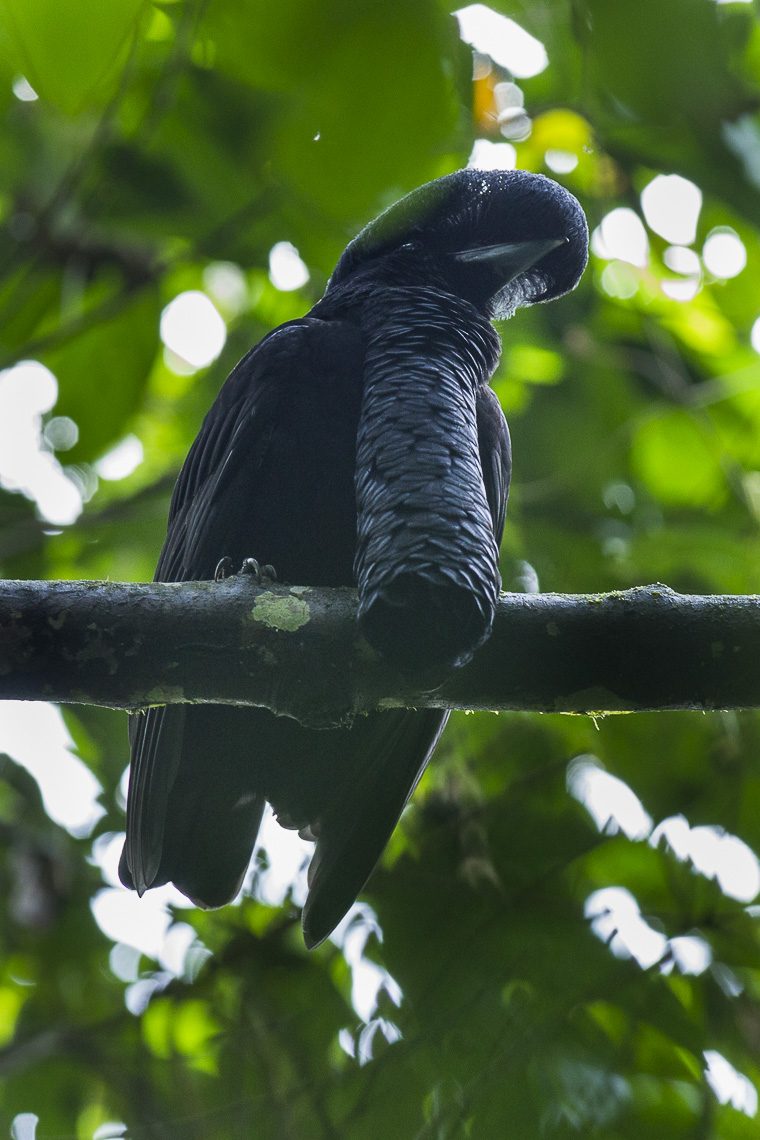
Long-wattled umbrellabird
Cephalopterus penduliger
A large cotinga of Andean cloud forests, the long-wattled umbrellabird sports an umbrella-like crest and a long feathered wattle the male inflates during courtship.
Characteristics
Temperament
Arboreal, gathers at leks to court
Diet
Frugivore: large fruit, insects, small vertebrates
A bird of extravagant looks
The long-wattled umbrellabird is a large cotinga with glossy black plumage and two spectacular ornaments. On its head it carries a prominent crest of feathers that, when spread, falls forward like a small umbrella or a wig. From its chest hangs a long wattle covered in scale-like feathers, which in the male can reach a striking length and which the bird can inflate and extend during courtship. The female is smaller and more modestly adorned.
Habitat and distribution
It lives on the Pacific slopes of the Andes, in south-western Colombia and western Ecuador, in humid premontane rainforest and cloud forest. It favours the canopy and mid-levels of the forest, moving seasonally along the slopes according to the availability of fruit.
Behaviour and courtship
It feeds mainly on large fruit, which it swallows whole and thus helps to disperse the seeds, along with insects and small vertebrates. Males gather at courtship arenas (leks): they inflate the wattle, spread the crest and give a deep booming call, like the low of a distant bull, which lies behind some of its local names ("pájaro toro", "vaca de monte").
Curiosities
Its role as a disperser of large seeds makes the species important for forest regeneration: few other animals can swallow and carry such bulky fruit. Its presence is an indicator of well-preserved forest.
Conservation
The IUCN classifies the species as Vulnerable. The main threats are the destruction of cloud forest for agriculture and logging, along with hunting. Protecting forest corridors on the Pacific slopes is essential to its survival.
Pros
- Unique ornaments: umbrella crest and feathered wattle
- Lek courtship with a booming call
- Key disperser of large forest seeds
Cons
- Vulnerable, declining species
- Depends on well-preserved cloud forest
- Not a pet: highly specialised wild needs