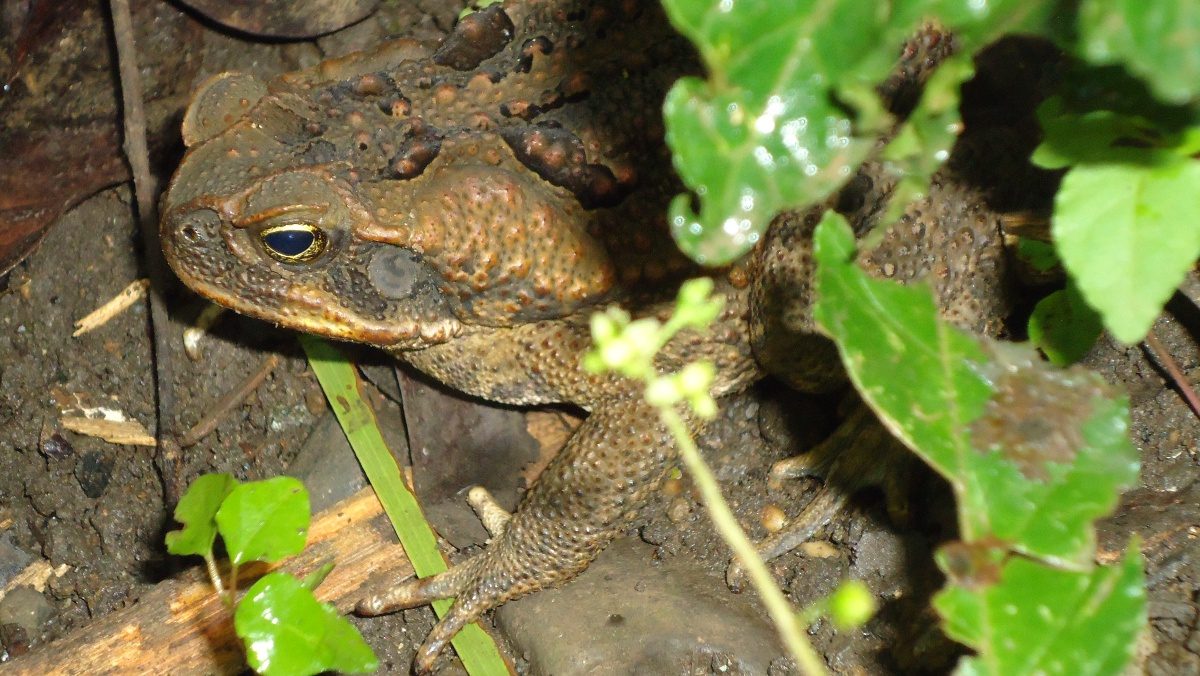
Photo: Obsidian Soul · CC0
Cane toad
Rhinella marina
The largest toad in the world, native to tropical America, the cane toad is famous for its venom glands and for becoming an invasive species in Australia.
Characteristics
Temperament
Ground-dwelling, nocturnal, opportunistic omnivore
Diet
Omnivore: insects, small animals, carrion, scraps
The largest toad in the world
The cane toad is the largest terrestrial toad in existence: adults usually measure 10–15 cm, but big individuals exceed 20 cm and can weigh over a kilogram. It has a massive body, warty brown skin and, on the sides of the head, two large swollen parotoid glands. These glands are its weapon: they secrete a potent venom (bufotoxin) that can kill animals that try to prey on it.
Origin and distribution
It is native to Central and South America, where it is a common and widespread species. However, it has been introduced by humans to many regions of the world — islands of Oceania and the Caribbean and especially northern Australia — in the vain hope of combating pest insects in sugar cane plantations.
A problematic invader
In Australia the introduction proved an ecological disaster: the cane toad did not control the pests but bred out of control, invading entire territories. It is an opportunistic omnivore that eats almost anything, alive or dead, and its venom kills native predators — snakes, crocodiles, quolls — that try to eat it, being unadapted to this toxin.
Curiosities
The female lays several thousand eggs in a single jelly-like string, an enormous reproductive rate. Even the tadpoles and eggs are toxic. In its native range, by contrast, the balance with local predators makes it a perfectly ordinary species.
Conservation
In its native range the IUCN lists it as Least Concern: it is abundant and not threatened. The problem, if anything, is the opposite: where it has been introduced it poses a serious threat to local wildlife.
Pros
- The largest toad in the world
- Effective chemical defence with parotoid glands
- Common and not threatened in its native range
Cons
- A serious invasive species where introduced
- Venom toxic to pets and predators
- Must not be handled or touched with bare hands