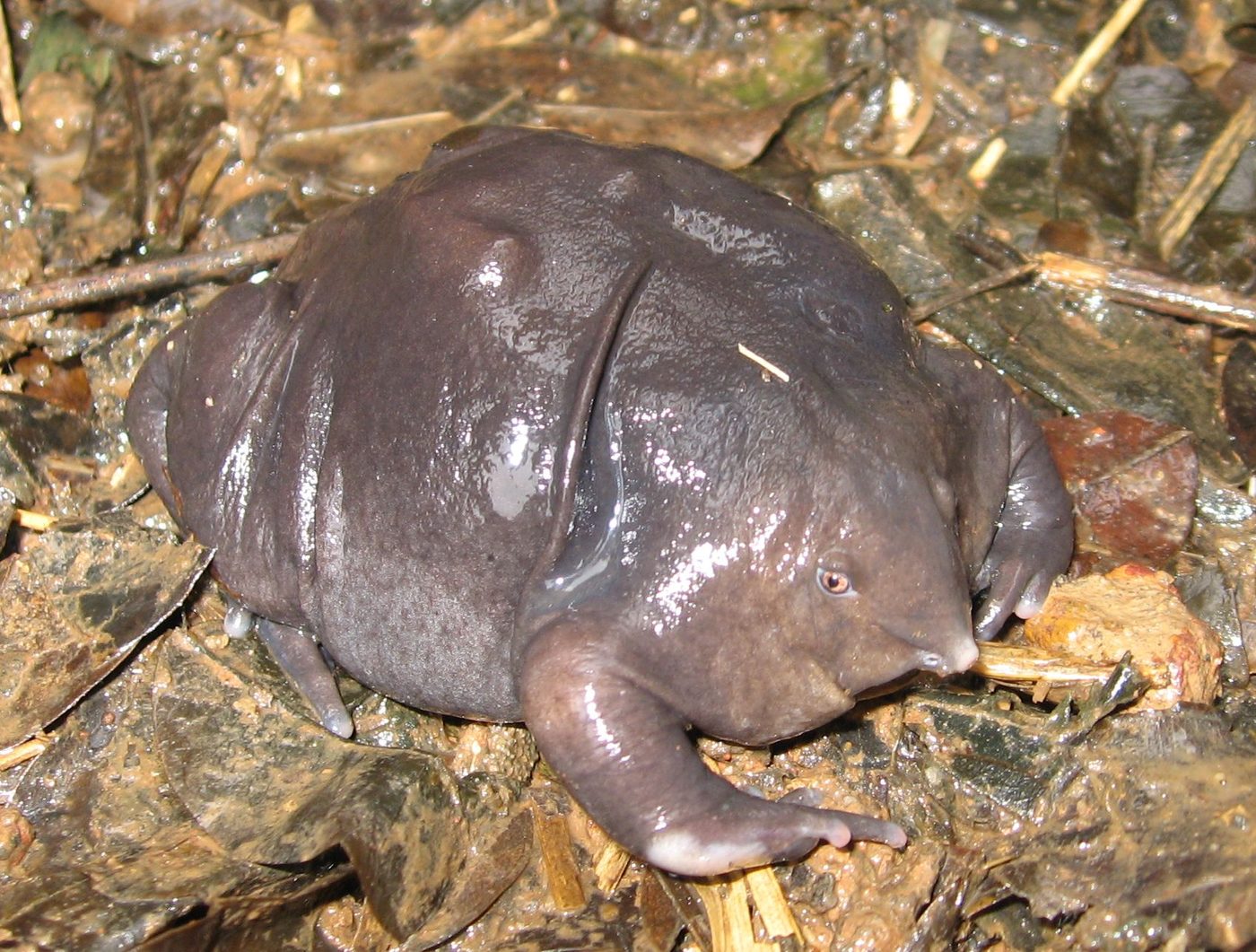
Purple frog
Nasikabatrachus sahyadrensis
With its rounded, purplish body and pointed snout, the purple frog is a rare Indian amphibian that spends almost all its life underground.
Characteristics
Temperament
Subterranean, shy, emerges only to breed
Diet
Insectivore: mainly termites, caught underground
A frog of unusual appearance
The purple frog is one of the strangest and most fascinating amphibians in the world. It has a stocky, bloated, almost spherical body, of a characteristic purplish or brownish-purple colour, supported by short, sturdy legs. Its head is small compared with the body and ends in a curious pointed snout, with a kind of small whitish proboscis. This appearance, so different from that of common frogs, is the result of an extreme adaptation to a very particular way of life.
Habitat and underground life
The purple frog is endemic to the Western Ghats, a mountain range in India rich in unique biodiversity. Its most extraordinary feature is that it spends almost all its life underground: it passes much of the year hidden in the soil, several metres deep, coming to the surface only for a very few days. Its rounded body and sturdy legs are perfect for digging and living beneath the surface.
Breeding and feeding
This frog emerges from underground only for a brief period each year, coinciding with the arrival of the monsoon and the rains, to breed quickly before disappearing underground again. It also lives hidden because its diet is subterranean: it feeds mainly on termites, which it catches with its tongue in their tunnels, without needing to come out to hunt.
A living fossil
The purple frog is considered a true living fossil: it belongs to a very ancient evolutionary lineage, which separated from other frogs tens of millions of years ago. Its scientific discovery, which occurred only relatively recently, aroused great interest precisely because of the unique value it represents in the evolutionary history of amphibians.
Conservation
The purple frog is classified as a near-threatened species. Its restricted range and hidden life make it vulnerable to the destruction and alteration of its habitat, due to agriculture and changes to the land. Protecting the forests and soils of the Western Ghats is essential for the survival of this extraordinary and very ancient amphibian.
Pros
- Unique, unmistakable appearance
- A true living fossil of ancient origin
- Extraordinary adaptation to underground life
- Valuable to the biodiversity of the Western Ghats
Cons
- Near-threatened species
- Very restricted, endemic range
- Threatened by the transformation of its habitat