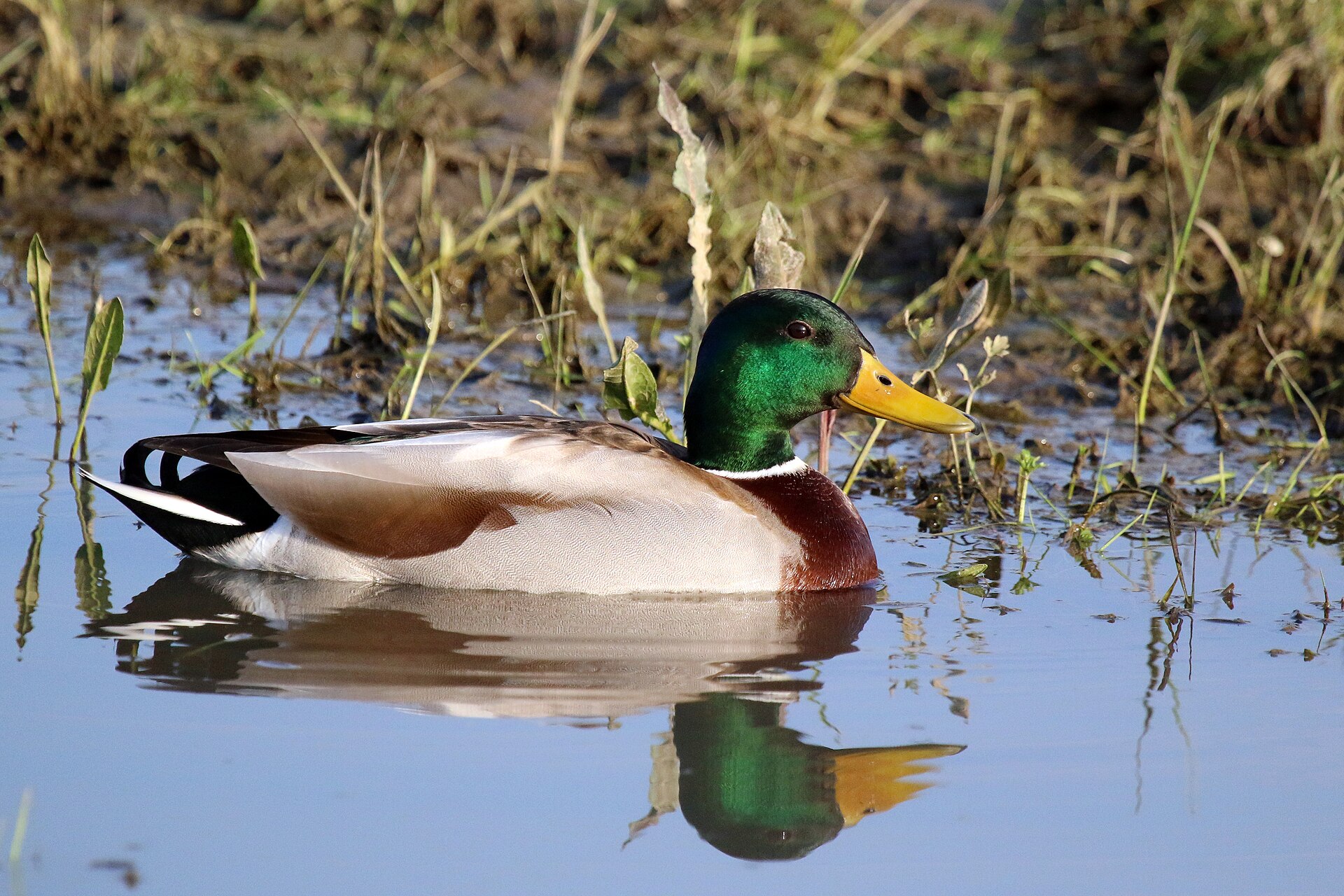
Mallard
Anas platyrhynchos
Characteristics
Temperament
A wild dabbling duck, social, diurnal and extremely adaptable. A good swimmer and flier, it tolerates the presence of humans very well: in city parks it is often confiding and approaches people. It forms pairs in the breeding season and gathers in groups outside the nesting period. It is native wildlife (even if it is the origin of domestic ducks): the best thing is to observe it free and NOT feed it bread or scraps, which are harmful to its health and to water quality.
Diet
Omnivorous and opportunistic: it feeds on aquatic plants, seeds and shoots, but also on invertebrates (aquatic insects, larvae, molluscs, small crustaceans, worms), and in agricultural and urban areas on grain. The typical technique is "dabbling": it immerses head and neck, tipping up with the tail in the air, grazing the shallow bottom without diving completely; the broad, flat bill, with lamellae, filters water and mud while retaining food. Important: in parks bread should NOT be given, being harmful to its health and to the water.
The Mallard (Anas platyrhynchos) is the duck par excellence: the most common, widespread and familiar in the world, and the ancestor of the vast majority of domestic ducks. Famous for:
- The male's green head: a bright iridescent green, with a white collar and chestnut breast
- The camouflaged female: brown and mottled, perfect for hiding on the nest
- The blue wing speculum: a blue band bordered with white, present in both sexes
- Upending to feed: it tips head-down with the tail in the air (dabbling)
- The enormous adaptability: it lives wherever there is water, city parks included
- The ancestral role: almost all breeds of domestic duck descend from it
IUCN status: Least Concern (LC). It enters the portal among the anatids, alongside the Mute Swan: two faces of the same great family of waterfowl, here represented both by the solemn elegance of the swan and by the lively familiarity of the best-known duck.
Classification and category
Order Anseriformes (ducks, geese and swans), family Anatidae, and it is a dabbling duck of the genus Anas. The species is Anas platyrhynchos. In the portal it is placed among the anatids. It is useful to tell it apart from other ducks and from the domestic forms: domestic ducks (except the Muscovy) almost all descend from the Mallard itself, and may resemble it or appear in white or variegated liveries; other dabbling ducks such as the teal, the wigeon, the pintail and the shoveler differ in size, colours and bill shape; diving ducks (such as the pochard or the tufted duck) submerge completely underwater, unlike the mallard, which dabbles at the surface. Etymology: "Anas" is the Latin word for "duck"; "platyrhynchos" comes from Greek and means "broad/flat-billed". Parameters: Length about 50-65 cm. Wingspan about 80-100 cm. Weight roughly 0.7-1.6 kg. Longevity: in the wild on average a few years (often 5-10), but in favourable conditions it can exceed 20 years. Reproduction: the female lays the eggs in a well-hidden ground nest; the young are precocial and follow the mother into the water a few hours after hatching.
Habitat and distribution
The Mallard is one of the most widespread waterfowl in the world: its range covers practically all of the Northern Hemisphere (Europe, Asia and North America), with introductions to other parts of the world (Australia, New Zealand). Northern populations are migratory, temperate ones (including Italy) largely resident. Preferred habitats — almost every kind of environment with fresh or brackish water: lakes, ponds, marshes and wetlands; slow rivers, canals and oxbows; and the ponds of urban parks and gardens, where it is often very confiding. The extraordinary adaptability is one of the keys to the Mallard's success: it tolerates the presence of humans well, exploits artificial environments and very varied food sources, and has thus become a familiar presence even in the heart of cities. It forms pairs in the breeding season and gathers in groups, sometimes large, outside the nesting period. IUCN status: Least Concern (LC). It is an abundant and healthy duck globally. One point of conservation concern, however, regards its tendency to hybridize with other, more localized duck species, which in some areas can threaten the genetic identity of native populations.
Diet
The Mallard is omnivorous and opportunistic, with a very varied diet. It feeds on: aquatic plants, seeds and shoots (the abundant plant component); invertebrates (aquatic insects, larvae, molluscs, small crustaceans and worms); and grain and scraps (in agricultural and urban areas it also exploits cereals and food left by humans). Feeding habits: "dabbling" (the typical technique of surface ducks — the mallard immerses head and neck, tipping up with the tail in the air, to graze the shallow bottom without diving completely); bill-filtering (the broad, flat bill has lamellae that filter water and mud while retaining food); and opportunism (it adapts its diet to what the environment offers, from natural wetlands to parks). An important note: in parks it is a widespread habit to give bread to ducks, but it is a harmful practice for their health and for water quality. It is much better not to feed them, or possibly to offer more suitable foods, letting them find their natural food.
Physical features
A medium-sized duck with marked sexual dimorphism. The male (in breeding dress) — the best-known face: an iridescent green head, bright and shifting in the light; a narrow white collar and a chestnut-brown breast; a pale grey body, a yellowish bill, and the characteristic curled central tail feathers. The female: a brown, mottled livery, camouflaged, ideal for staying hidden on the nest; a brown-orange bill. Traits common to both sexes: a blue wing speculum bordered with white, clearly visible in flight and at rest; orange webbed feet; a summer eclipse — after breeding, even the male temporarily takes on a duller livery, similar to the female's.
Behaviour and curiosities
The Mallard is a social, adaptable, diurnal bird, with a biology well studied precisely because of its spread and familiarity. It is a tireless swimmer and a good flier, able to take off almost vertically from the water.
The ancestor of domestic ducks: almost all the domestic duck breeds we know descend from the Mallard (the exception is the Muscovy duck, of another species); thousands of years of domestication have produced, from this single wild ancestor, a great variety of farmyard ducks, white or multicoloured, of different shapes and sizes. The "quack": the classic "quack" we associate with ducks is actually typical of the female Mallard; the male, instead, makes quieter, raspier sounds; when we imagine a duck's call, we are therefore thinking above all of this species' female voice. Upending to feed: the way the mallard feeds in water is unmistakable: instead of diving completely, it tips its body forward, immersing head and neck and leaving the tail straight up; it is the dabbling technique, shared with the other surface ducks, that lets it reach food on the bottom of shallow waters. The precocial ducklings: Mallard ducklings are precocial: they hatch already covered in down, with their eyes open, and a few hours after hatching are able to walk, swim and follow the mother; the image of the mother mallard followed in a line by her brood has become famous, and ducks were the stars of the historic studies on imprinting. The eclipse: after the breeding season, the male goes through a phase called "eclipse", in which it loses the showy breeding livery and temporarily takes on a duller plumage similar to the female's; in this period, during the moult of the flight feathers, it also becomes temporarily unable to fly and more vulnerable. Hybridization: the Mallard crosses very easily with other duck species; while this testifies to its vitality, it is also a conservation problem: in some areas crosses with rarer, more localized species (such as certain island ducks) threaten their genetic identity.
Pros
- Anatra bellissima e inconfondibile (maschio dalla testa verde), facile da osservare
- Estremamente adattabile: presente in laghi, fiumi, stagni e parchi cittadini
- Molto confidente: ottima 'porta d'ingresso' al birdwatching e all'educazione naturalistica
- IUCN Least Concern: comune e diffuso in tutto l'emisfero nord
Cons
- NON va alimentato con pane o avanzi: pratica dannosa per salute e acqua
- È fauna selvatica: non un animale da compagnia
- Si ibrida facilmente, minacciando in alcune aree specie di anatre più rare
- La grande adattabilità può portarlo a competere con specie locali dove è introdotto