Photo: Chrumps · CC BY-SA 3.0
Banded archerfish
Toxotes jaculatrix
Able to knock down insects with precise jets of water, the banded archerfish is an unerring marksman of the tropical brackish waters.
Characteristics
Temperament
Active, precise marksman, gregarious
Diet
Carnivore: insects and small invertebrates
The fish that shoots with water
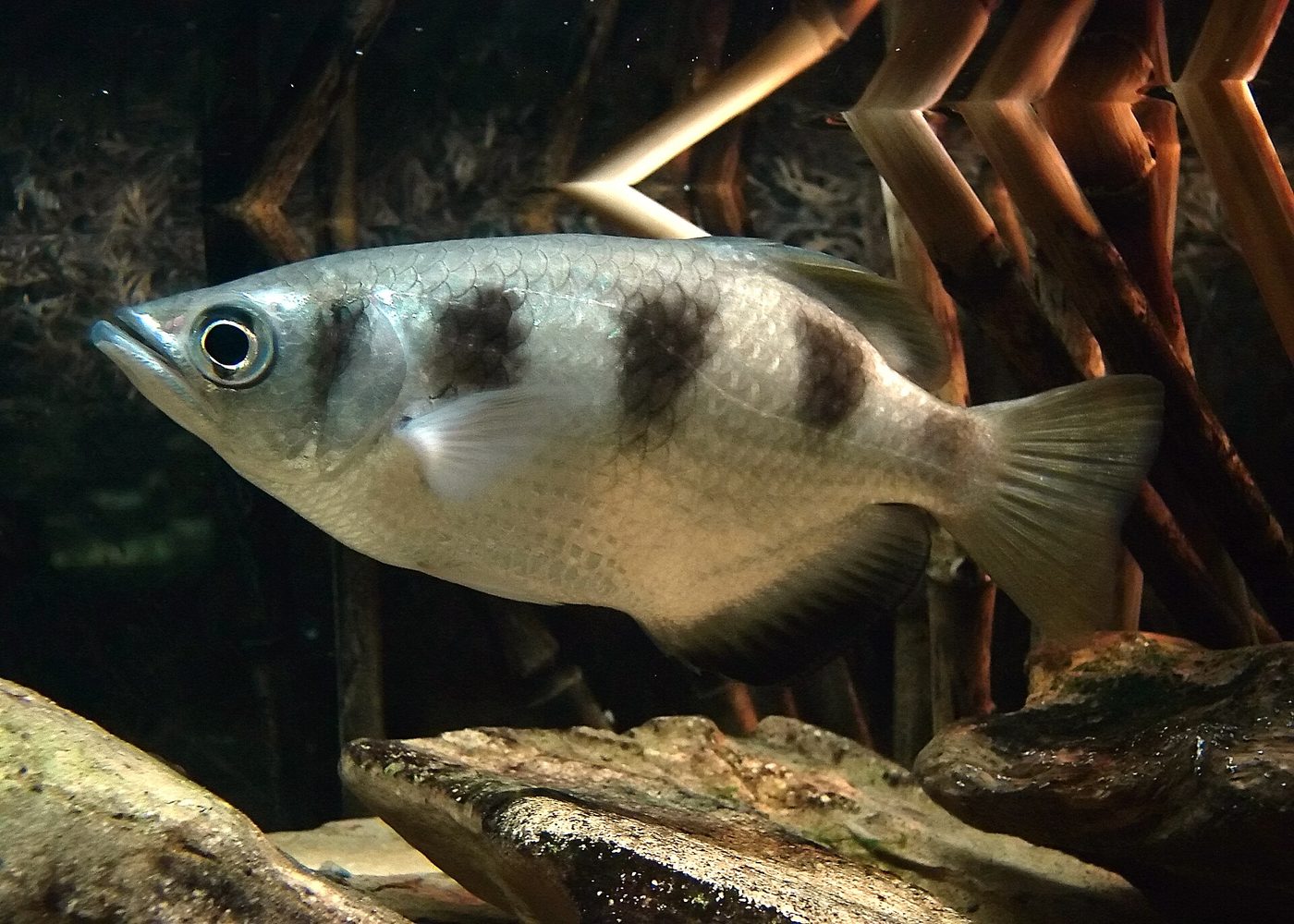
The banded archerfish is a fish with a compact, silvery body, marked along its sides by characteristic dark bands of semi-triangular shape. Its dorsal fin is set back, shifted towards the tail, and its mouth points upwards, a feature linked to its particular hunting style. It is a medium-sized fish, which can reach around twenty centimetres or more, and can live for several years.
Habitat and distribution
It lives in the waters of the Indo-Pacific and Oceania, mainly in brackish environments: at river mouths, in mangroves and estuaries. It is able to adapt to different degrees of salinity, moving over the course of its life between fresh, brackish and salt water. It prefers areas where the vegetation of the banks overhangs the water.
A unique hunting technique
The archerfish owes its name to its extraordinary ability to 'shoot' a jet of water at insects perched on the vegetation overhanging the water. By pressing its mouth against its palate, it expels a powerful and precise squirt that hits the prey and knocks it into the water, where the fish reaches it in an instant. Larger specimens can hit targets two or three metres away. Even more surprising is that the fish compensates for the bending of light between air and water, correcting its aim to hit the target it sees distorted by the surface.
Feeding and conservation
It feeds mainly on insects and small invertebrates, caught both with jets of water and with brief leaps out of the water, as well as small prey it finds beneath the surface. It is classified as a species of least concern. It is a fish much prized in aquariums for its spectacular behaviour, but it requires suitable tanks, with brackish water and space above the surface to perform its hunting.
Pros
- Extraordinary hunting technique with water jets
- Compensates for the bending of light to aim
- Spectacular behaviour in the aquarium
- Unthreatened populations
Cons
- Requires brackish water and suitable tanks
- Needs space above the surface
- Depends on mangrove and estuary habitats