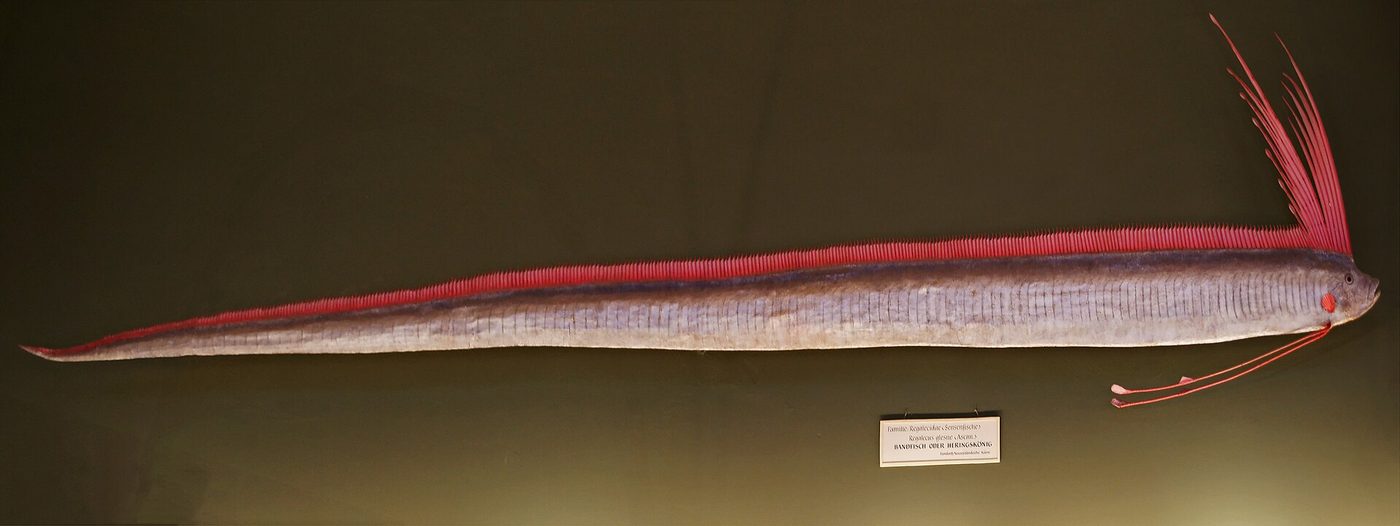
Giant oarfish
Regalecus glesne
The giant oarfish, or king of herrings, is the longest bony fish in the world: a silvery ribbon of the deep sea reaching several metres in length.
Characteristics
Temperament
Elusive, deep-dwelling, almost never seen alive
Diet
Planktivorous: krill, plankton and small crustaceans
The silver ribbon of the deep
The giant oarfish, also widely known as the king of herrings, is the longest living bony fish in the world. It has an extremely elongated, laterally compressed body like a long silvery ribbon, topped by a striking red dorsal fin that runs its whole length and forms a plumed crest on the head. It averages around five metres, with exceptional specimens far longer. It has no scales but a smooth, silvery skin.
Habitat and range
It has a worldwide distribution across all oceans except the polar regions. It lives in the open sea, in the mesopelagic zone, generally between 200 and 1000 metres deep. For this reason it is rarely seen alive: most knowledge comes from stranded or dying specimens.
Behaviour
Little is known of its habits. It swims in a vertical or undulating posture, rippling its long dorsal fin, and feeds by filtering small planktonic organisms, krill and tiny crustaceans. In 2013 remotely operated underwater robots finally filmed living specimens at depth, allowing the first descriptions of its natural behaviour.
Facts and legends
Because of its serpentine appearance, sightings of stranded oarfish have fuelled many tales of "sea serpents". In Japan it is tied to a folk belief that the appearance of these fish at the surface foretells earthquakes — an association not confirmed by science.
Conservation
The species is listed as Least Concern by the IUCN. Living in the ocean depths, it is little exposed to direct fishing pressure, but the scarcity of data makes it hard to assess its populations precisely.
Pros
- The world's longest bony fish
- Spectacular, legendary appearance
- Unthreatened, lives away from fisheries
Cons
- Biology still poorly known
- Rarely observable, lives at depth