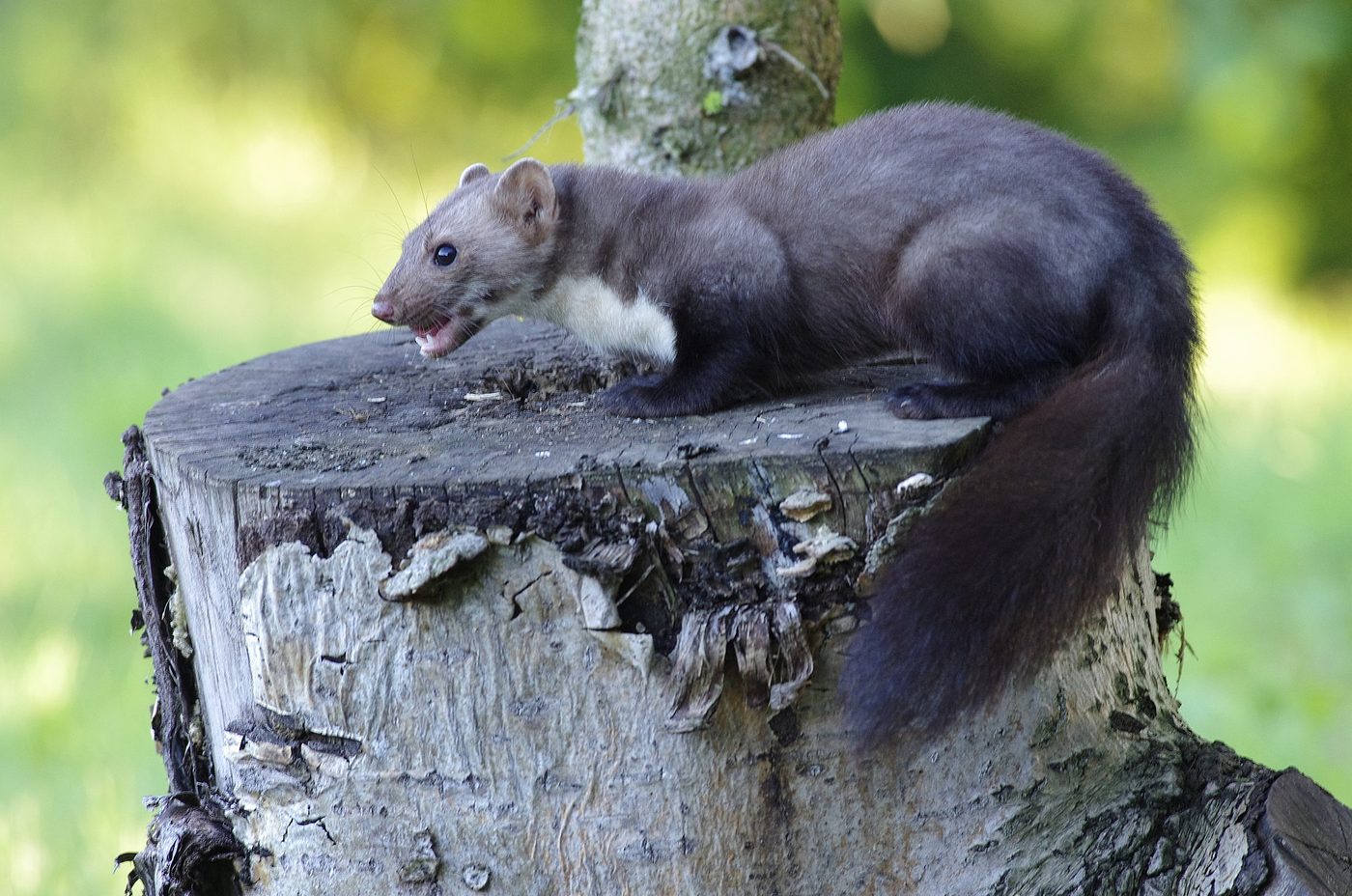
Photo: M.zlinko · CC BY-SA 3.0
Beech marten
Martes foina
The beech marten is an agile nocturnal mustelid with a brown coat and a distinctive white throat bib, often living close to houses and farmland.
Characteristics
Temperament
Nocturnal, solitary, adaptable
Diet
Omnivore: rodents, birds, eggs, insects and fruit
Description
The beech marten, also called stone marten, is a medium-sized mustelid with a long, supple body, short legs and a bushy tail. Its coat is greyish-brown, with a characteristic white patch on the chest and throat, the so-called "bib", which usually forks towards the front legs. It has a pointed muzzle, rounded ears and lively eyes. It is often confused with the pine marten, from which it differs by its white (rather than yellowish) bib and its habits more closely tied to humans.
Habitat and distribution
It is found across much of Europe and Central Asia. Unlike the pine marten, a forest specialist, the beech marten is far more adaptable: it frequents farmland, rocky areas, woodland edges and above all the vicinity of human settlements, where it settles in barns, attics and woodpiles.
Behaviour
It is a nocturnal, solitary and territorial animal, and an excellent climber. It has an omnivorous, opportunistic diet: it feeds on small mammals, birds, eggs, insects and seasonal fruit, which becomes important in summer and autumn. It is known for gnawing the rubber cables and hoses of car engines, sometimes causing damage.
Did you know?
The beech marten is one of the wild mammals that has best learned to live alongside humans, being present even in urban and suburban settings. Its passage through lofts is betrayed by night-time noises and food remains.
Conservation
It is classed as least concern, thanks to its wide distribution and remarkable adaptability. The main causes of death are road traffic and, in some areas, direct persecution due to the damage it can cause.
Pros
- Highly adaptable, thrives even near humans
- Useful predator of rodents
- Agile and skilful climber
Cons
- Can damage car cables and hoses
- Sometimes enters poultry runs and lofts
- Frequent victim of road traffic