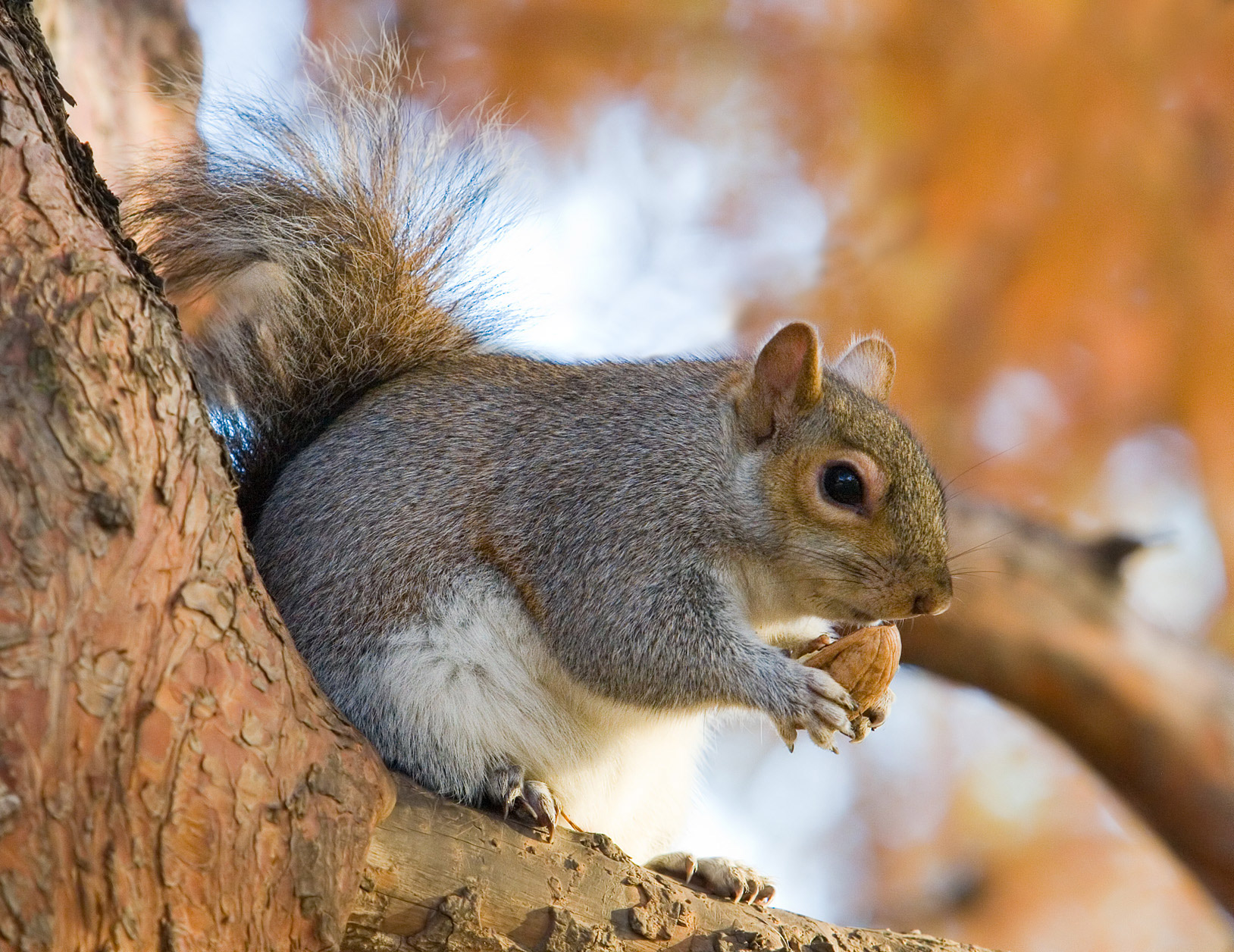
Eastern Gray Squirrel
Sciurus carolinensis
Characteristics
Temperament
Diurnal, active, curious and highly adaptable, often bold with people in parks. Mostly solitary but tolerant where food is plentiful. A tireless hoarder: it hides seeds in thousands of scattered caches and relocates them by memory and smell. Active all year (it does not hibernate). Its adaptability and efficiency make it a successful invader at the red squirrel's expense. Not a pet: a wild squirrel, and outside its range an invasive species to be managed.
Diet
An omnivore with a strong preference for seeds. Staple: acorns, nuts, beechnuts and seeds, especially in autumn; plus buds, flowers and bark (late winter/spring), fruit, fungi and occasionally insects, eggs and nestlings. It practises scatter-hoarding: it hides single seeds in thousands of scattered holes and relocates them by spatial memory and smell; not hibernating, it lives off these caches in winter. Some forgotten seeds sprout, so it is an oak disperser — the same efficiency that lets it beat the red squirrel.
The Eastern Gray Squirrel (Sciurus carolinensis) is a tree squirrel of eastern North America that has become one of the best-known examples of a successful invasive species. Famous for:
- The familiar face of parks: common and bold, it is the squirrel seen leaping among the trees of cities and gardens across much of the world
- Europe's invader: introduced by humans, it is now an invasive species in Italy, Britain and Ireland, where it threatens the native red squirrel
- Size and adaptability: larger and more generalist than the red squirrel, it beats it in competition for food
- The acorn-hoarder: it hides thousands of seeds in the ground, forgetting many — and so plants trees
- Year-round activity: it does not hibernate and stays active even in winter, living off its hidden caches
- The "healthy carrier" of a virus: it spreads a virus harmless to itself but lethal to the red squirrel
IUCN status: Least Concern (LC) in its native range, where it is abundant. Outside it, though, the story is different: it is the "rival" that, in Italy and the British Isles, is pushing back the native Red Squirrel, already in this portal. Native and invasive, the two species are the textbook case of conflict between indigenous wildlife and introduced species.
Classification and category
Order Rodentia, family Sciuridae (the squirrel family: squirrels, marmots, prairie dogs, chipmunks), genus Sciurus — that of the "typical" tree squirrels, the same as the Eurasian red squirrel (Sciurus vulgaris). It is essential to tell it apart from the very red squirrel it conflicts with: the gray squirrel is larger and sturdier, grey (sometimes with brownish tinges) with a pale belly, and has no ear tufts; the red squirrel is smaller and slimmer, red-fulvous, and in winter sports conspicuous ear tufts. There are also colour forms: melanistic (black) individuals are common in some areas, and more rarely white (leucistic) individuals appear. Etymology: "Sciurus" is from Greek skiouros, "the one that shades itself with its tail" (from skia, shade, and oura, tail); "carolinensis" denotes the Carolinas, in the USA, part of its native range. Parameters: Body 23-30 cm. Tail 19-25 cm (bushy, plume-like). Weight 400-700 g (heavier than the red squirrel). Longevity often a few years in the wild due to high juvenile mortality, but can reach 6-12 years (up to ~20 in captivity). Reproduction: very prolific, with 1-2 litters a year of 2-4 young, raised in leaf nests (dreys) or tree cavities.
Habitat and distribution
The Eastern Gray Squirrel has a native range and an ever-larger introduced one: native to eastern North America (from southeastern Canada to the eastern USA); introduced to Britain and Ireland (where it is now dominant), Italy (Piedmont, Lombardy, Liguria and spreading), and other areas. Preferred habitats — wherever there are trees: mature deciduous and mixed forests rich in acorn-, nut- and beechnut-bearing trees; urban parks, gardens and tree-lined avenues (it adapts very well to the city, where it is often bold); and woods, orchards and treed farmland. Its great adaptability is also the secret of its success as an invader: it tolerates human-modified environments well, exploits a wider range of foods and reaches higher densities than the red squirrel. It is diurnal and arboreal, but often comes to the ground to find and hide food. IUCN: Least Concern. But the picture must be read carefully: where native it is no concern; where introduced it is considered an invasive alien species (included on the list of invasive alien species of EU concern), the target of control programmes to protect local wildlife.
Diet
The Eastern Gray Squirrel is an omnivore with a strong preference for seeds, with a varied diet that changes with the seasons: acorns, nuts, beechnuts and seeds (the basis of the diet, especially in autumn); tree buds, flowers and bark (important in late winter and spring); fruit and fungi; and occasionally insects, eggs and nestlings. Feeding strategies: scatter-hoarding (unlike the chipmunk, which concentrates its stores in a larder, the gray squirrel hides single seeds in thousands of scattered caches, relocating them by memory and smell); winter activity (not hibernating, it depends on these caches to get through the cold months); and flexibility (its broad, opportunistic diet lets it thrive where other squirrels struggle). Crucially, some hidden, forgotten seeds sprout, so the gray squirrel is an important disperser of oaks and other trees; but precisely this efficiency in exploiting acorns is one reason it outcompetes the red squirrel.
Physical features
A sturdy tree squirrel with a spectacular tail. Coat: mainly grey, often with brownish or reddish tinges on the back and legs, and a white or pale belly; black (melanistic) forms exist, common in some populations, and rare white forms; dense fur, moulting twice a year. The body: a long, bushy, plume-like tail (used for balance in the trees, as a "parachute" in jumps, as a blanket and for communication); rounded ears with no tufts (unlike the red squirrel); powerful hind legs and sharp-clawed toes for climbing; and large, lateral eyes for a wide field of view. Performance: acrobatic climbing and jumping (it runs head-down on trunks and leaps nimbly from branch to branch); spatial memory and smell (to relocate hidden caches); agility on the ground (it sprints fast and changes direction sharply); and adaptability (its true winning weapon).
Behaviour and curiosities
A diurnal, active, adaptable animal, often solitary but tolerant of its own kind where food is plentiful. It builds nests of leaves and twigs (dreys) among the branches or uses tree cavities, and is active all year, peaking in the morning and late afternoon. Its boldness with people makes it one of the easiest wild animals to watch in parks.
The acorn memory: the gray squirrel hides thousands of seeds in single scattered holes in the ground (scatter-hoarding) and can relocate a good share months later, combining spatial memory and smell; it also "fakes it" — if it feels watched, it pretends to bury a seed to fool would-be thieves; the seeds it forgets sprout, helping plant new oaks: a curious exchange between rodent and forest. The successful invader: the gray squirrel is one of the most studied examples of an invasive species — introduced by humans outside its range (to Britain and Italy in the 19th-20th centuries), it spread fast thanks to its larger size, flexible diet and high reproductive capacity; where it arrives, it tends to replace the smaller, more specialized native red squirrel. The (unintentional) war on the red squirrel: the decline of the red squirrel in Britain, Ireland and parts of Italy is largely linked to the gray squirrel's arrival — the latter beats it in competition for food (it is more efficient at exploiting acorns) and, above all, is a healthy carrier of the squirrelpox virus, harmless to itself but almost always lethal to the red squirrel; it is not direct aggression, but competition and disease that make the "gray" a formidable rival. The Italian case: Italy is one of the best-known fronts of this story — after some introductions in the 20th century (in Piedmont, Liguria and elsewhere), the gray squirrel began to spread, raising alarm for the red squirrel's fate and for damage to trees; control attempts, sometimes very ethically debated, have made this species a symbol of the difficult balance between protecting native wildlife and managing alien species. Black and white forms: besides the classic grey, the gray squirrel has colour variants — in many areas (especially North America and Canada) fully black (melanistic) individuals are common, which some studies link to a thermal advantage in cold climates; rarer but very striking are white individuals, present in some populations that have become a small local attraction. The multipurpose tail: the famous bushy tail is not just beautiful — the gray squirrel uses it as a balancing pole when running and jumping among branches, as a "parachute" and rudder in bolder leaps, as a warm blanket when sleeping, as an umbrella and, by flicking it, as a signal of communication and alarm to other squirrels; its very scientific name recalls this "shading" tail.
Pros
- Disseminatore di querce e altri alberi; ruolo ecologico nel suo areale
- IUCN Least Concern (abbondante dove è nativo)
- Intelligente e adattabile, facile da osservare nei parchi
- Caso-scuola per capire le specie invasive e la tutela della fauna nativa
Cons
- Fuori areale è SPECIE INVASIVA: minaccia lo scoiattolo rosso nativo
- Porta sano del virus del vaiolo dello scoiattolo, letale per il rosso
- Può danneggiare alberi (scortecciamento) e raccolti
- Non è un animale da compagnia; la detenzione/rilascio è regolata o vietata in UE