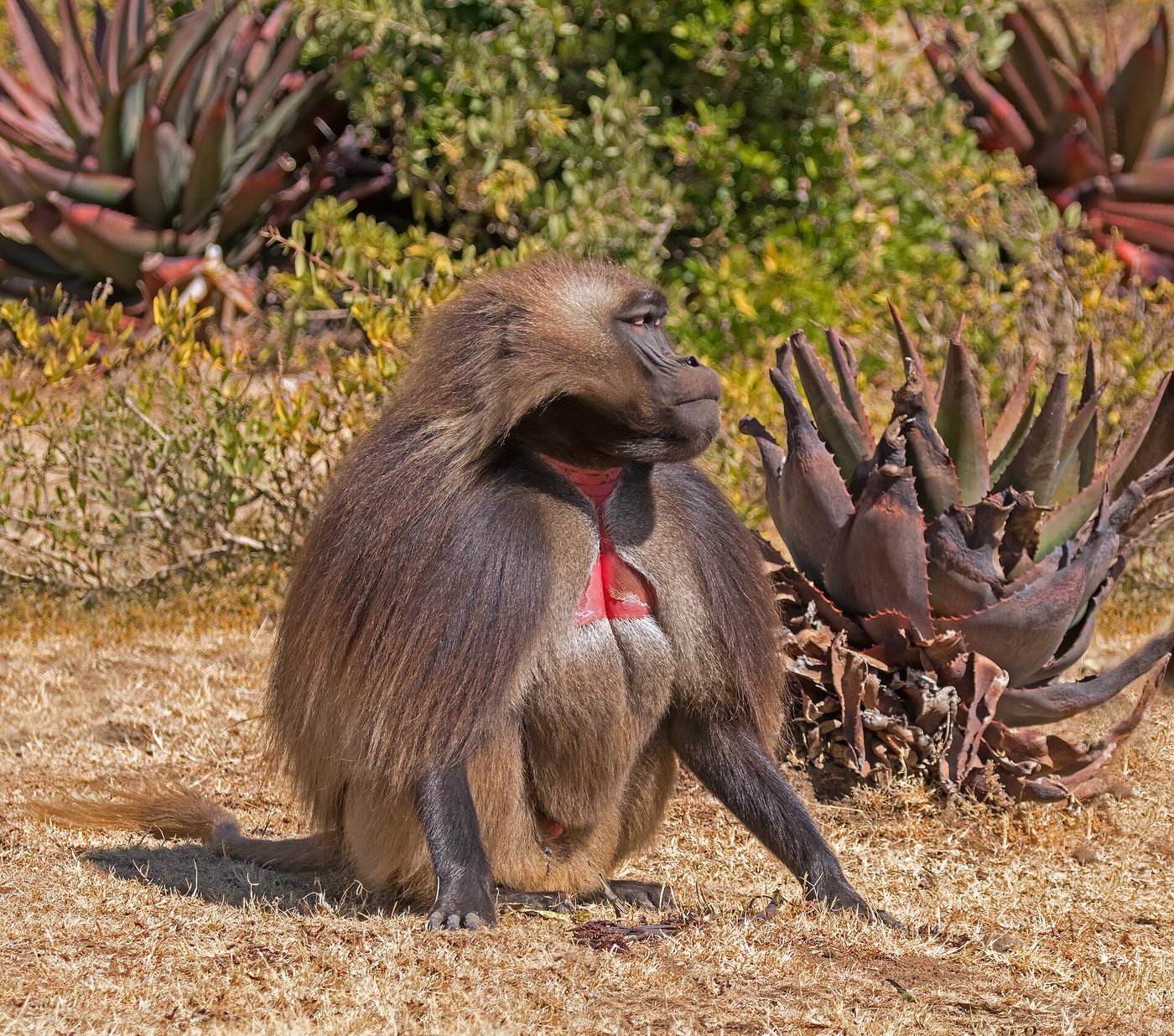
Photo: Charles J. Sharp · CC BY-SA 4.0
Gelada
Theropithecus gelada
With the showy red patch on its chest and the thick mane of the males, the gelada is a unique monkey of the Ethiopian highlands, the only primate that feeds almost entirely on grass.
Characteristics
Temperament
Social, diurnal, lives in large groups
Diet
Herbivore: almost exclusively grass, with roots and seeds
The monkey with a red heart
The gelada is a large Old World monkey, related to the baboons, of unmistakable appearance. Its most distinctive feature is a patch of bare skin of a bright red, hourglass-shaped, standing out in the middle of the chest: for this reason it is also called the 'bleeding-heart monkey'. The colour of this patch becomes more intense during the breeding periods. The males are much larger than the females and sport a long, thick mane of hair on the shoulders and back, as well as robust canines.
Habitat and distribution
It is endemic to the highlands of Ethiopia, where it lives at high altitudes, between 1,800 and 4,400 metres, in an environment of high-altitude grasslands, often near steep rock walls. On these walls it spends the night sheltered from predators, while by day it moves into the grasslands to feed.
A grass-eating primate
The gelada has a diet unique among primates: it feeds almost exclusively on grass, which can make up to 90% of its diet. It spends much of the day sitting in the meadows, plucking blades of grass, roots and seeds with skilful finger movements. This specialisation makes it different from any other monkey. It lives in a very complex, articulated society: small family units gather into groups that can number hundreds of individuals, forming some of the largest social aggregations among primates.
Conservation
The gelada is classified as a species of least concern, with still substantial populations on the Ethiopian highlands. However, the conversion of grasslands into farmland and competition with livestock represent growing pressures on its habitat.
Pros
- The only primate feeding almost only on grass
- Showy red patch on the chest
- One of the most complex primate societies
- Still substantial populations
Cons
- Endemic to the Ethiopian highlands only
- Habitat contested with agriculture
- Competes with livestock for grazing