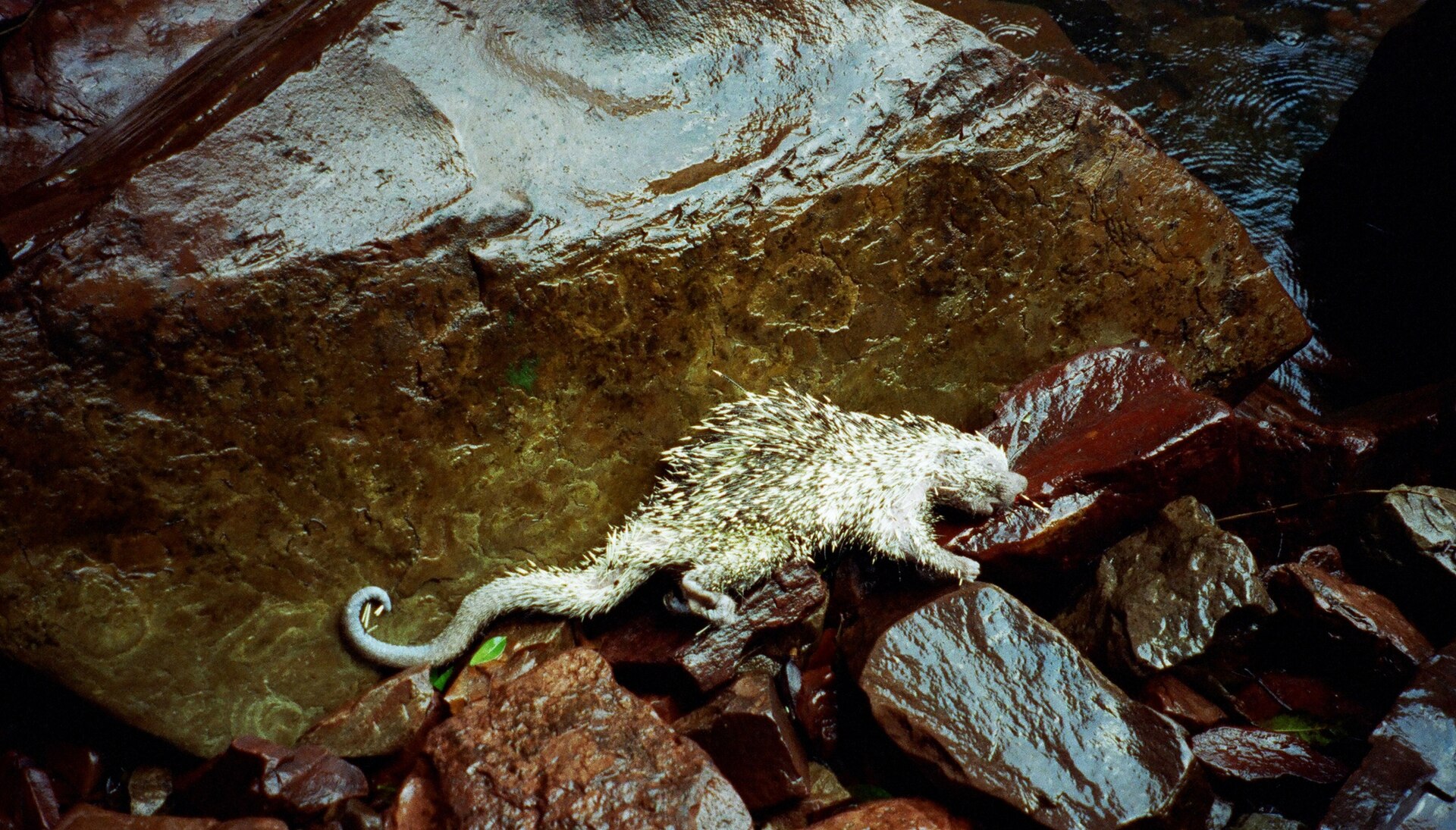
Brazilian Porcupine
Coendou prehensilis
Characteristics
Temperament
Solitary, nocturnal and quiet. A slow, methodical tree porcupine: it moves very carefully among the branches, relying on its prehensile tail (a "fifth limb") and its quills rather than speed. It does not dig burrows, sheltering in tree hollows and vegetation. A peaceful but well-defended herbivore, surprisingly vocal for a rodent. Not a pet: a wild porcupine dependent on the forest.
Diet
An arboreal herbivore. It feeds mainly on leaves, shoots and buds, on fruit (when available), on bark it gnaws, and on roots, tubers and flowers. It feeds directly among the branches, anchoring its weight with the prehensile tail wrapped around a branch to reach food safely even at great heights. Active at night. With ever-growing incisors it gnaws often, and is drawn to salt sources to supplement the sodium lacking in a leafy diet.
The Brazilian porcupine (Coendou prehensilis), also called the coendou or prehensile-tailed porcupine, is a New World porcupine that has conquered the trees of South American forests. Famous for:
- The prehensile tail: long and strong, it works as a "fifth limb" that wraps around branches for a secure grip
- The porcupine that lives in trees: unlike the ground-dwelling Old World porcupines, the coendou is an arboreal climber
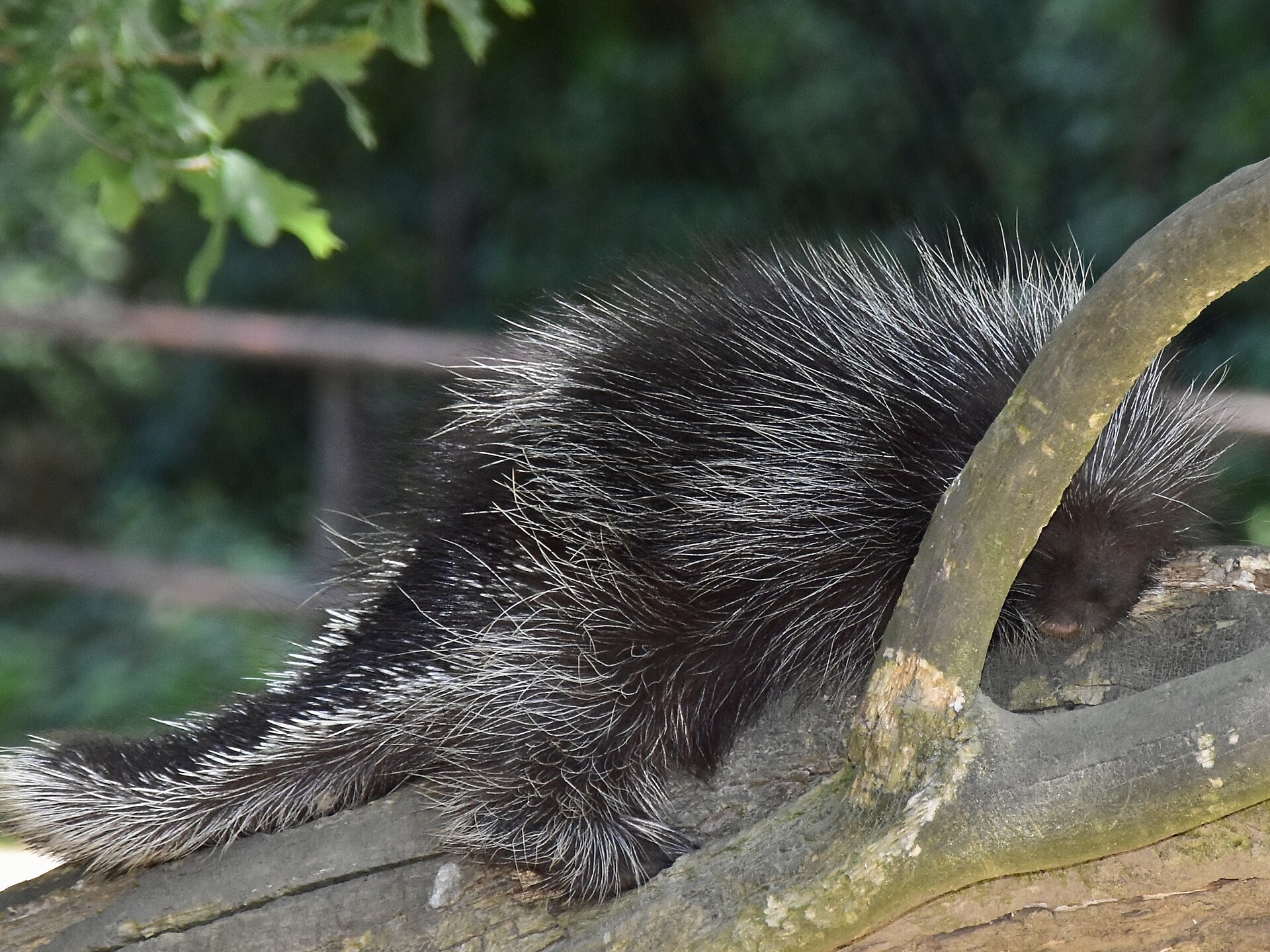
- Two-tone quills: short and dense, often whitish-yellow with dark tips, protecting it from predators
- The comical face: a stubby head with a big bulbous nose, small eyes and a curiously "cute" look
- A slow, nocturnal life: it moves calmly through the foliage in the dark and hides by day
- The canopy vegetarian: it feeds on leaves, shoots, fruit and bark
IUCN status: Least Concern (LC), with wide, widespread populations. It shares the South American rainforests with other canopy dwellers — including the small arboreal cat the Margay — to which, as a quill-armoured herbivore, it is a well-protected counterpart.
Classification and category
Order Rodentia, suborder Hystricomorpha, family Erethizontidae — the New World (American) porcupines. It must not be confused with the Old World porcupines: New World porcupines (Erethizontidae), like the coendou and the North American porcupine, are mostly arboreal, with shorter quills and, in many species, a prehensile tail; Old World porcupines (Hystricidae), like the crested porcupine, are ground-dwelling, larger, with long quills, and live in burrows. The two families are not close relatives — quills are a classic case of convergent evolution, developed independently as a defence. The genus Coendou includes several prehensile-tailed South American tree porcupines. Etymology: "Coendou" comes from a word in Brazil's Tupi language; "prehensilis" is Latin for "prehensile", for the gripping tail. Parameters: Body 30-60 cm. Tail 33-48 cm (prehensile, with the tip free of quills and callused for grip). Weight typically 4-5 kg. Longevity up to about 12-17 years (mostly documented in captivity). The female usually bears a single young after a long gestation (~200 days); the baby is well developed, born furred with soft quills that harden within a short time.
Habitat and distribution
The Brazilian porcupine ranges across much of tropical South America: from Venezuela and Colombia, through the Guianas and the Amazon basin, to Brazil, Bolivia and northern Argentina; it also occurs on Trinidad. Preferred habitats — almost always with tree cover: tropical rainforest (its prime habitat); deciduous and gallery forest; and wooded areas and plantations, where it can adapt if enough trees remain. The coendou is arboreal, nocturnal and solitary. It spends the day hidden — in tree hollows, dense vegetation or tangled among branches — and becomes active at dusk to feed in the canopy. Its movements are slow and careful, calculated never to lose its grip, with the tail always ready to anchor it. IUCN: Least Concern; a common, fairly adaptable species, with local threats from forest loss, hunting for meat in some areas, and road mortality.
Diet
An arboreal herbivore with a varied plant diet: leaves, shoots and buds (much of the diet); fruit (an important resource when available); bark (it gnaws the bark of branches and trunks); and roots, tubers and flowers. Feeding strategies: foraging aloft (feeding directly among the branches, reaching leaves and fruit that ground herbivores cannot touch); the safety tail (anchoring its weight with the prehensile tail wrapped around a branch while it stretches for food, working in complete safety even at great heights); and nocturnal activity (feeding by night to reduce exposure to daytime predators and heat). Like many rodents it has ever-growing incisors it must wear down by gnawing, and it craves minerals — sometimes gnawing bones and objects to supplement the sodium lacking in a leafy diet.
Physical features
A stocky, unmistakable animal, halfway between a porcupine and a slow little monkey. Quills and fur: a body covered in short, dense quills mixed with hair; often two-toned (whitish-yellow quills with dark bands or tips, giving a mottled look); the quills are a passive defence, lodging in anything that tries to bite it and detaching easily. The prehensile tail — its hallmark: long and muscular, with the upper distal part free of quills and callused for grip; it curls upward around branches (unlike the tails of many other animals) and acts as a fifth limb and safety anchor. The body: a stubby head with a big bulbous nose, small eyes and barely visible ears; sturdy limbs with long toes and curved claws and broad foot pads for gripping; and a compact, rounded build. Performance: an expert but slow, methodical climber; an exceptional grip thanks to feet and tail; a well-developed sense of smell; and surprisingly loud vocalizations (moans, whines and cries).
Behaviour and curiosities
A solitary, nocturnal, quiet animal. It does not dig burrows like ground porcupines: it shelters in tree hollows or vegetation and always moves with great care, relying on its tail and quills rather than speed. It communicates with a vocal repertoire surprisingly varied for a rodent.
The "fifth-limb" tail: the coendou's prehensile tail is a precision tool. Unlike many prehensile tails that curl downward, its curls upward around the branch; the tip is quill-free and covered in rough callused skin, perfect for grip — the animal can support much of its weight hanging by the tail alone while reaching for food. Quills (and false myths): like all porcupines, the coendou cannot "throw" its quills — that is a myth; the quills are only loosely attached and detach easily, lodging in the mouth or paws of a predator that tries to bite, and are covered in tiny scales that make them hard to remove — a passive but very effective defence, as few predators persist after the first painful taste. The Old World "cousin": the coendou and the crested porcupine (Old World) look alike because of their quills but belong to two different, not closely related families; quills evolved independently in the two groups — a classic case of convergent evolution — and their lifestyles are opposite: the crested porcupine lives on the ground and digs burrows, the coendou lives in the trees and climbs. A hunger for salt: a leaf-based diet is low in sodium, an essential mineral, so the coendou, like other herbivores, is drawn to salt sources and may gnaw bones, shed antlers or sweat- and urine-soaked objects to supplement minerals — behaviour it shares with many "gnawing" rodents. A single, well-armed baby: the female usually gives birth to a single young after a gestation very long for a rodent (about six to seven months); the newborn is precocial, born with eyes open, already furred and with soft quills that harden within days or weeks, quickly able to climb and defend itself.
Pros
- Istrice arboricolo affascinante con coda prensile (rara tra i mammiferi)
- IUCN Least Concern: popolazioni ampie e diffuse
- Erbivoro ben difeso, importante nelle reti trofiche della foresta
- Contraltare educativo perfetto all'istrice terricolo del Vecchio Mondo
Cons
- Non è un animale domestico (istrice selvatico con aculei)
- Dipende dalle foreste: vulnerabile localmente alla deforestazione
- Bassissimo tasso riproduttivo (di norma un solo piccolo)
- Vittima frequente di investimenti stradali in alcune aree