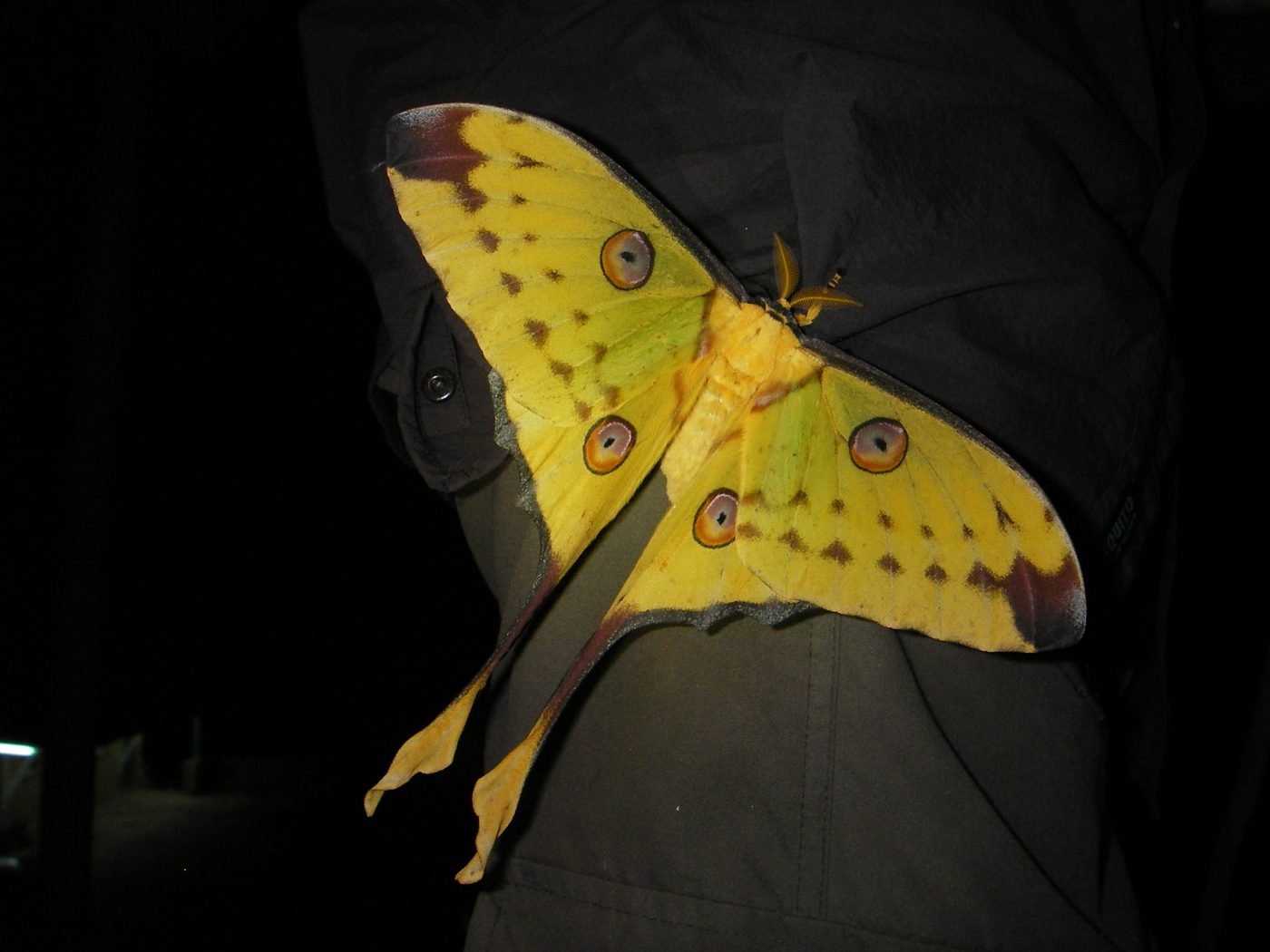
Photo: Axel Strauß · CC BY-SA 3.0
Comet moth
Argema mittrei
The comet moth is one of the largest silk moths in the world, with yellow wings drawn out into very long ribbon-like tails resembling a comet's trail.
Characteristics
Temperament
Nocturnal and harmless; adults very short-lived.
Diet
Caterpillars: leaves of Eugenia, Weinmannia, Uapaca; adults: do not feed.
A living comet
The comet moth (Argema mittrei), or Madagascan moon moth, is a spectacular moth of the family Saturniidae, among the largest silk moths in the world. Its wings are a deep yellow, dotted with prominent eyespots that startle predators. Each hindwing is drawn out into a very long ribbon-like tail: in the male the wingspan can reach 20 cm and the tails 15 cm, giving the impression of a comet's trail — hence the name. The genus name Argema is Greek for "speckled eye", for the abundance of eyespots.
Habitat and range
It is endemic to the rainforests of Madagascar. The caterpillars feed on the leaves of various local plants, such as Eugenia, Weinmannia and Uapaca.
Life cycle
The female lays about 120–160 eggs; the caterpillar takes a couple of months to pupate. The cocoon is covered in numerous holes through which water drains, so the pupa does not suffocate during the forest's daily rains. The adult, like many saturniids, has no functional mouthparts: it does not feed at all and lives only 4 to 5 days, just long enough to breed.
Did you know?
The long tails are not just for beauty: they are thought to confuse the echolocation of bats, deflecting attacks away from the body. It is an icon of Madagascar's wildlife and one of the most photographed moths in the world.
Conservation
It is threatened in the wild by the massive deforestation of Madagascar, which destroys its habitat. However, it is successfully bred in captivity, both for conservation and for entomological displays.
Pros
- Among the largest silk moths in the world
- Spectacular long ribbon-like tails
- Successfully bred in captivity
Cons
- Threatened by deforestation in Madagascar
- Adults very short-lived (4–5 days)
- Depends on specific food plants