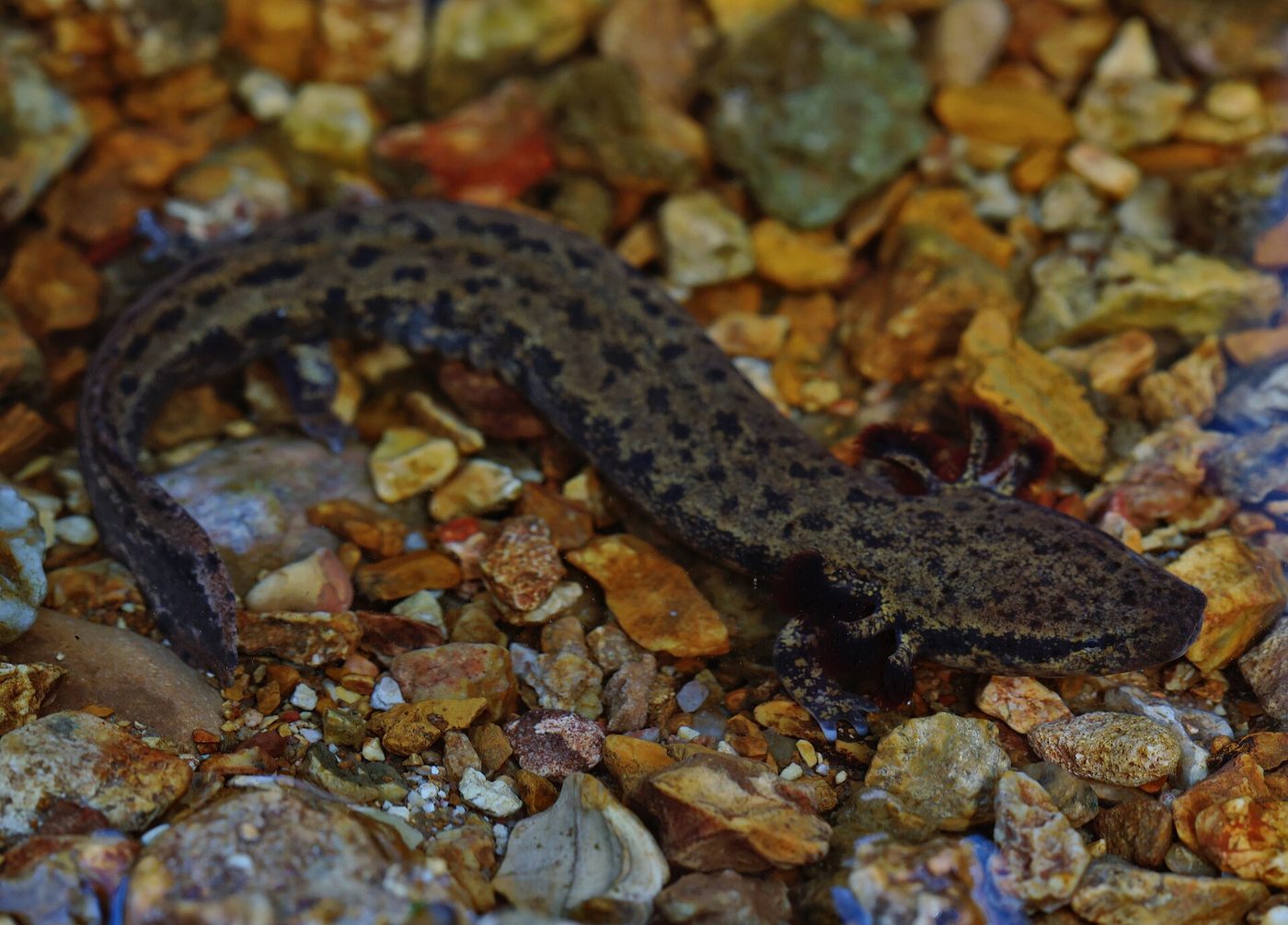
Photo: Peter Paplanus · CC BY 2.0
Common mudpuppy
Necturus maculosus
The common mudpuppy is a fully aquatic North American salamander that keeps its striking feathery external gills throughout its life.
Characteristics
Temperament
Nocturnal, solitary and fully aquatic.
Diet
Opportunistic carnivore: insects, molluscs, earthworms, small fish.
The salamander with feathery gills
The common mudpuppy (Necturus maculosus) is a fully aquatic salamander of the family Proteidae. Its most distinctive feature is paedomorphosis (neoteny): unlike many amphibians that lose their gills as adults and switch to breathing with lungs, the mudpuppy keeps its conspicuous red, feathery external gills at the sides of its head throughout life. Its long, cylindrical body is rusty brown with dark spots, its tail is flattened, and each leg has four toes.
Habitat and range
It lives in the fresh waters of eastern North America — lakes, rivers and ponds. Skin and lung respiration alone are not enough, so it depends on its gills: in cold, well-oxygenated water they stay small, while in warm, stagnant water they grow much larger and bushier to make up for the lower oxygen supply.
Behaviour and diet
It is nocturnal, active by day only when the water is murky. It is an opportunistic predator that eats almost anything it can fit in its mouth: insects, molluscs, earthworms, small fish and eggs. Females reach sexual maturity at around six years and lay an average of about sixty eggs.
Did you know?
In the wild it lives about eleven years on average. Its name "mudpuppy" comes from the false belief that these amphibians make dog-like sounds; in reality they are almost silent.
Conservation
The IUCN lists it as Least Concern. It is still widespread, but being fully aquatic it is sensitive to pollution and degradation of fresh water: its presence is considered a good indicator of water quality.
Pros
- Keeps its external gills throughout life
- A bioindicator of water quality
- Least Concern, still widespread
Cons
- Sensitive to freshwater pollution
- Fully aquatic, never leaves the water
- Relatively slow maturity and breeding