Photo: Boštjan Burger · Public domain
Olm
Proteus anguinus
Pale, blind and entirely aquatic, the olm is a mysterious amphibian of the karst caves, once believed to be the offspring of a dragon.
Characteristics
Temperament
Cave-dwelling, slow, elusive
Diet
Carnivore: small aquatic invertebrates
An amphibian of the dark
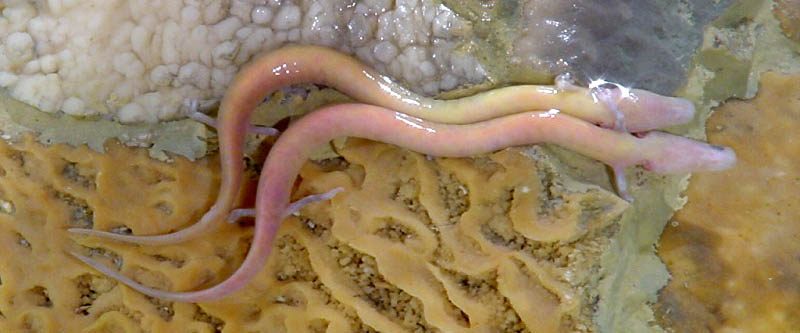
The olm is an amphibian of unusual and fascinating appearance, perfectly adapted to life in the darkness of caves. It has a long, serpentine body of a whitish or pinkish colour, with skin so pale that the internal organs show through, so much so that in some languages it is called the 'human fish'. Its legs are small and thin, its eyes are reduced and hidden beneath the skin, practically blind, while at the sides of its head it carries tufts of bright red external gills, with which it breathes underwater. It is the only European vertebrate that lives exclusively in caves.
Habitat and distribution
It lives in the underground waters that flow through the karst bedrock of the Dinaric Alps, particularly in southern Slovenia, the Trieste area in Italy, western Croatia and Bosnia and Herzegovina. It is an entirely aquatic animal: it eats, sleeps and breeds underwater, in the cold and dark subterranean currents, never emerging into the light.
Extraordinary adaptations
Living in total darkness has shaped the olm in surprising ways. Having lost the usefulness of sight, it relies on other highly developed senses: it perceives vibrations, smells and even electric and magnetic fields to orient itself and find prey. Its metabolism is extremely slow: it can survive for years without eating, and lives a very long time, able to exceed seventy years of age. It keeps its larval characteristics throughout its life, including the external gills, a phenomenon called neoteny.
Conservation
The olm is classified as a vulnerable species. It is extremely sensitive to water pollution: since it depends entirely on the purity of the underground waters, contamination by humans represents its main threat. The protection of karst environments and their waters is essential for its survival.
Pros
- Extraordinary adaptations to life in the dark
- Extremely long-lived
- Can survive years without food
- The only exclusively cave-dwelling European vertebrate
Cons
- Vulnerable species
- Extremely sensitive to water pollution
- Restricted, fragmented range