Common Pheasant
Phasianus colchicus
Characteristics
Temperament
A terrestrial, diurnal and rather shy wild galliform, tied to agricultural environments, woodland edges and fallow land. It moves by walking and running in dense vegetation, where it forages and hides; it flies reluctantly and only in danger, with an "explosive", noisy take-off, then glides a short distance. It is polygynous, with the male defending a harem of females. It is NOT a pet: it is birdlife (largely introduced as game) to be observed and managed in its environment; the cryptic female rears the precocial chicks alone.
Diet
Omnivorous with a varied, seasonal diet: seeds, grain and berries (the basis, especially in autumn and winter), shoots, leaves and roots, plus insects, worms and other small invertebrates (important in spring-summer and for the chicks). It scratches on the ground, scratching and rummaging in the soil and litter as a chicken does, and in the countryside readily takes advantage of cereals and grain. The flexible diet and the ability to exploit agricultural environments are among the reasons for its great success outside its native range.
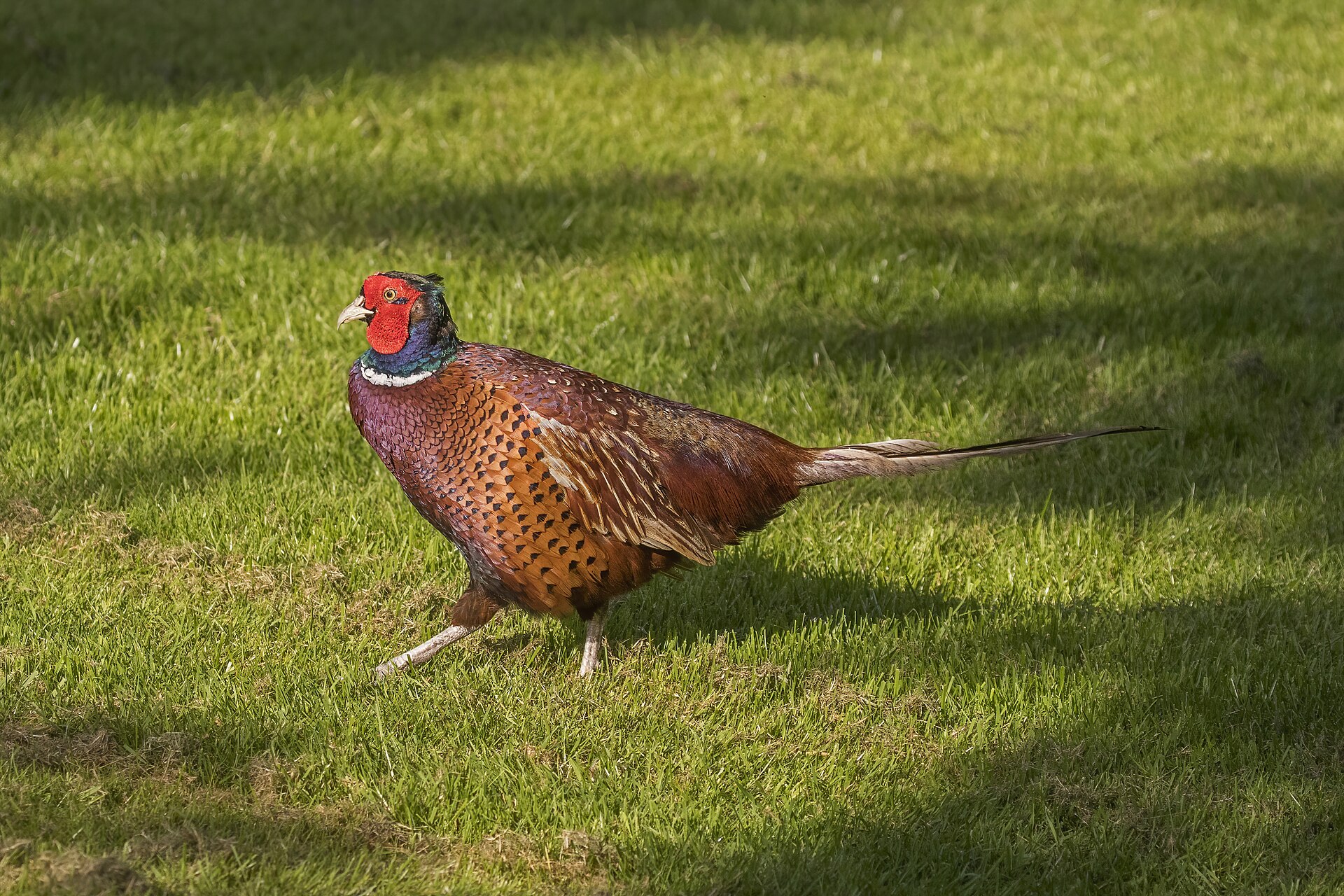
The Common (ring-necked) Pheasant (Phasianus colchicus) is one of the showiest and most familiar ground birds of the countryside: a galliform with a gaudy male and a very long tail, widespread everywhere thanks to humans. Famous for:
- The spectacular male: an iridescent green-blue head, red wattles, a copper-and-gold body
- The very long tail: pointed and finely barred, doubling its length
- The white neck-ring: present in many populations ("ring-necked")
- The cryptic female: brown and mottled, perfect for hiding on the ground
- Ground life: it runs more than it flies, taking wing only in danger
- The worldwide spread: introduced everywhere as game
IUCN status: Least Concern (LC). It enters the portal among the galliforms, alongside the Peacock and the Wild Turkey: with them it shares the order of large ground birds, often with showy males, tied to the ground and capable only of short, explosive flights.
Classification and category
Order Galliformes (the galliforms, like chickens, turkeys, peafowl and partridges), family Phasianidae. The species is Phasianus colchicus. In the portal it is placed among the galliforms. It is useful to tell it apart from other galliforms and pheasants: the Peacock (also in the portal) — much larger, famous for its tail "fan"; quite different from the pheasant; ornamental pheasants such as the golden pheasant (Chrysolophus pictus) or Lady Amherst's pheasant — of even gaudier, more "exotic" colours, often kept in captivity; partridges and grey partridges — smaller, stockier galliforms, without the pheasant's long tail; the Japanese green pheasant (Phasianus versicolor) — a related species/form, with a greener body. Etymology: the genus name Phasianus comes from the river Phasis, in ancient Colchis (today's Georgia, on the Black Sea), hence also the epithet colchicus: by tradition, it was from those lands that the pheasant reached the Greek and Roman world; the word "pheasant" itself derives from this root. Parameters: Male length about 70-90 cm, including the very long tail. Weight roughly 1-1.5 kg (the male more than the female). Dimorphism: very marked, with a coloured male and a cryptic female. Longevity: in the wild often short, even less than a few years, due to hunting and predation; in captivity it can live much longer. Reproduction: the female lays the eggs in a simple, well-hidden ground scrape; the chicks are precocial.
Habitat and distribution
The Common Pheasant has an Asian origin but today an almost worldwide distribution: native range Asia, from the Caucasus and the Black Sea to China and East Asia; introduced range Europe (including Italy), North America and many other regions, where it has been introduced for centuries mainly as a game bird. Preferred habitats — mixed countryside environments, with cover and open spaces: cultivated fields, woodland edges and hedgerows; fallow land, meadows, reedbeds and wetlands; and scrub and thickets where it can find shelter. It is a mainly terrestrial bird: it moves by walking and running in dense vegetation, where it forages and hides. It flies reluctantly, but when surprised at close range it takes off with a thunderous "explosion" of wingbeats, then glides a short distance. At night, however, it often roosts in trees to sleep safe from ground predators. Its dependence on agricultural environments with hedgerows and fallow land closely ties it to the traditional rural landscape. IUCN status: Least Concern (LC). It is extremely widespread and abundant, also thanks to continual releases for hunting: in many areas, indeed, the populations are sustained or restocked with captive-reared, released birds.
Diet
The Common Pheasant is omnivorous, with a varied diet that changes with the seasons. It feeds on: seeds, grain and berries (the basis of the diet, especially in autumn and winter); shoots, leaves and roots; and insects, worms and other small invertebrates (important in spring-summer and for the chicks). Feeding habits: it scratches on the ground (it looks for food by scratching and rummaging in the soil and litter, as a chicken does); it exploits the fields (in the countryside it readily takes advantage of cereals and grain); and it supplements with animal protein (in the warm season it catches insects and invertebrates, essential for the chicks' growth). Crucially, the flexible diet and the ability to exploit agricultural environments are among the reasons for the pheasant's great success outside its native range, where it finds in cultivated fields an environment rich in food.
Physical features
A large galliform with very marked sexual dimorphism. The male (cock) — the most spectacular face: an iridescent green-blue head with showy red wattles and ear-tufts; a white neck-ring (in many populations); a copper-and-gold body, finely marked with dark, of great effect; and a very long tail, pointed and barred with dark. The female (hen): a brown, mottled, cryptic livery, with a shorter tail; a plain look, ideal for staying hidden on the nest. General traits: a sturdy body with strong ground-bird legs (the male has spurs); a powerful but short, "explosive" flight, reserved for emergencies; and the ability to run fast in dense vegetation.
Behaviour and curiosities
The Common Pheasant is a terrestrial, diurnal and rather shy bird, tied to agricultural environments and woodland edges. Its presence in the countryside, with the gaudy-coloured cock and its characteristic call, is a classic of the rural landscape across much of the world.
The name that comes from a river: the pheasant owes its name to the river Phasis, in ancient Colchis (today's Georgia, on the Black Sea); by classical tradition, it was from that region that the bird became known and spread in the Greek and Roman world; this is why both the scientific name (Phasianus colchicus) and the word "pheasant" preserve the memory of those distant lands. The explosive flight: the pheasant is a runner, not a great flier; it prefers to escape danger by running and hiding among the vegetation; but when surprised at close range, it suddenly takes off with a thunderous "explosion" of wingbeats, rising steeply and then gliding a short distance; it is a powerful but short-range take-off, designed to get out of trouble quickly. The call and the drumming: the male gives a characteristic hoarse, ringing call (a two-note "korr-kok"), often followed by a rapid wing-whirring that acts almost as a "drum"; this call serves to mark the territory and attract the females, and is one of the most typical sounds of the countryside where the species is widespread. The game bird par excellence: the Common Pheasant is probably the most widespread and reared game bird in the world; in very many regions, the wild populations are sustained or restocked with birds reared and released specifically for hunting; this has made it, in spite of itself, a species present almost "everywhere", far beyond its Asian native range. Sleeping in the trees: although a markedly terrestrial bird by day, at night the pheasant changes its habits: it often roosts on tree branches to sleep, putting itself safe from predators that hunt on the ground, such as foxes and mustelids; it is a compromise between life "on the ground" and the need for a protected rest. The precocial brood: like many galliforms, pheasant chicks are precocial: they hatch already covered in down and able to walk and follow the mother soon after hatching, pecking food on their own under her watch; the cryptic female rears the brood alone, relying above all on hiding rather than fighting.
Pros
- Maschio spettacolare e inconfondibile: uno degli uccelli da terra più belli delle campagne
- Facile da incontrare in molti ambienti agricoli, anche fuori dall'areale d'origine
- Dieta flessibile e grande adattabilità
- IUCN Least Concern: estremamente diffuso e abbondante
Cons
- NON è un animale da compagnia: è avifauna selvatica/da selvaggina
- In gran parte 'sostenuto' da immissioni a scopo venatorio (popolazioni semi-artificiali)
- Specie introdotta fuori areale: può avere impatti locali sugli ecosistemi
- Vita media spesso breve in natura per caccia e predazione