Photo: SantiagoGG · CC BY-SA 4.0
Blue-footed booby
Sula nebouxii
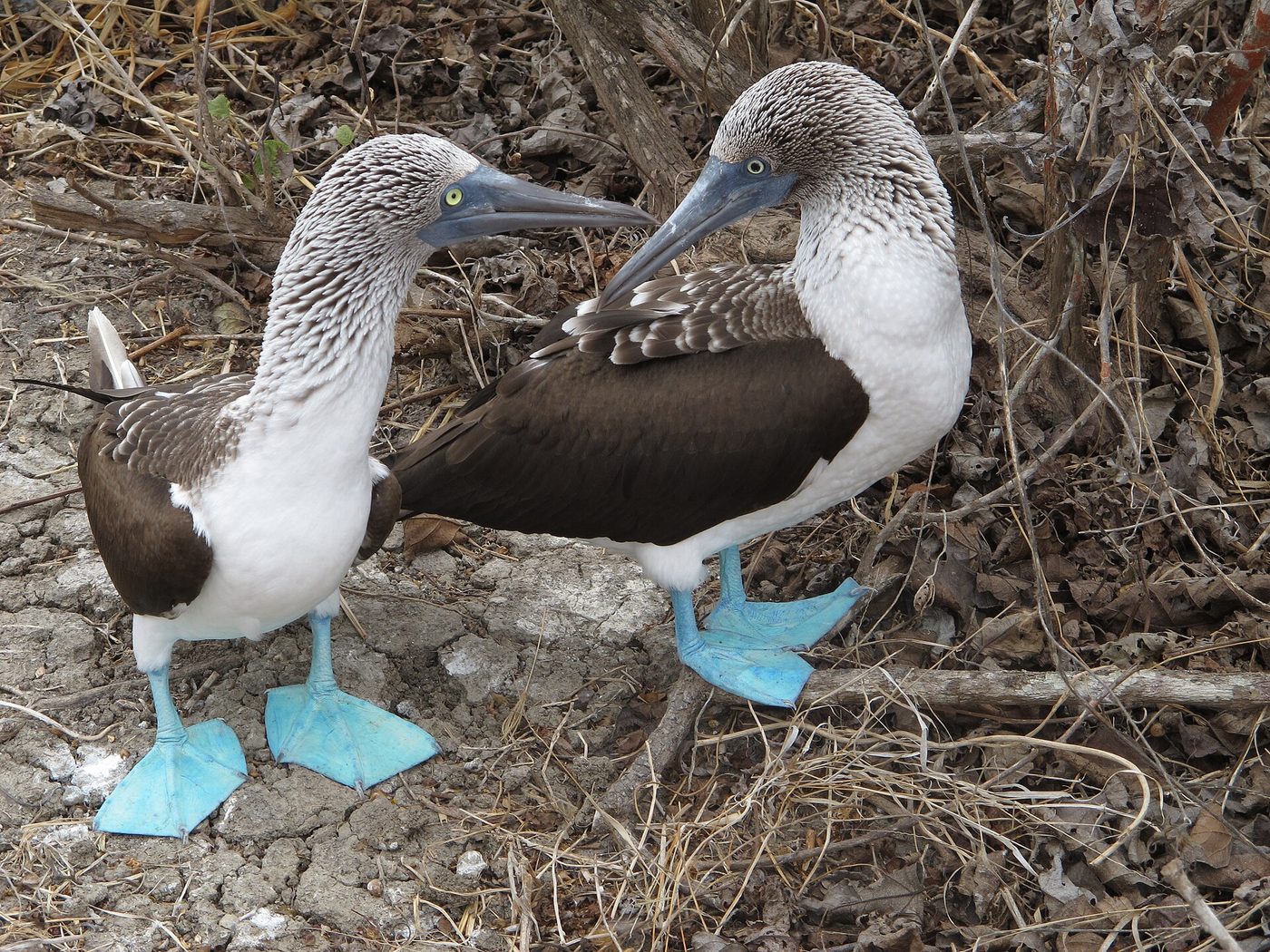
Famous for its striking bright blue feet and its comical courtship dance, the blue-footed booby is an elegant diver of the seas of the eastern Pacific.
Characteristics
Temperament
Marine, gregarious, dancer in courtship
Diet
Fish-eater: fish caught with plunge-dives
The bird with blue feet
The blue-footed booby is a medium-sized seabird, with mainly white and brown plumage, a streaked head and a long, pointed beak. Its unmistakable feature, however, is its feet: large, webbed and of a bright, almost turquoise blue. This extraordinary colour derives from the pigments present in the fish it feeds on, and is an indicator of the individual's health and vigour: more intense feet signal an animal in better condition. Females are slightly larger than males.
Habitat and distribution
It lives along the coasts of the eastern Pacific, from the Galápagos Islands to the Gulf of California, right down to Peru. It is a seabird that nests in colonies on rocky coasts and islands, while spending much of its time on the open sea hunting fish.
The courtship dance
The most famous behaviour of the blue-footed booby is the male's courtship, a genuine display. The male proudly shows off its blue feet, lifting them up and down with slow, solemn movements while strutting before the female, accompanying it all with calls and the offering of twigs. The female assesses the colour of the suitor's feet before choosing her mate.
Hunting and conservation
It is a skilful diver: having spotted a shoal of fish from above, it plunges into the water at great speed, folding its wings at the last instant to pierce the surface like an arrow. It is classified as a species of least concern. On the Galápagos it was among the animals studied by Charles Darwin, and is today one of the most beloved attractions for visitors to the archipelago. (Note: the weight value on Wikidata, 61 kg, is clearly wrong; the real weight is around 1–2 kg.)
Pros
- Striking bright blue feet
- Comical, famous courtship dance
- Skilful plunge-diver
- Unthreatened populations
Cons
- Depends on the abundance of fish
- Sensitive to changes in ocean currents
- Nests in colonies vulnerable to disturbance