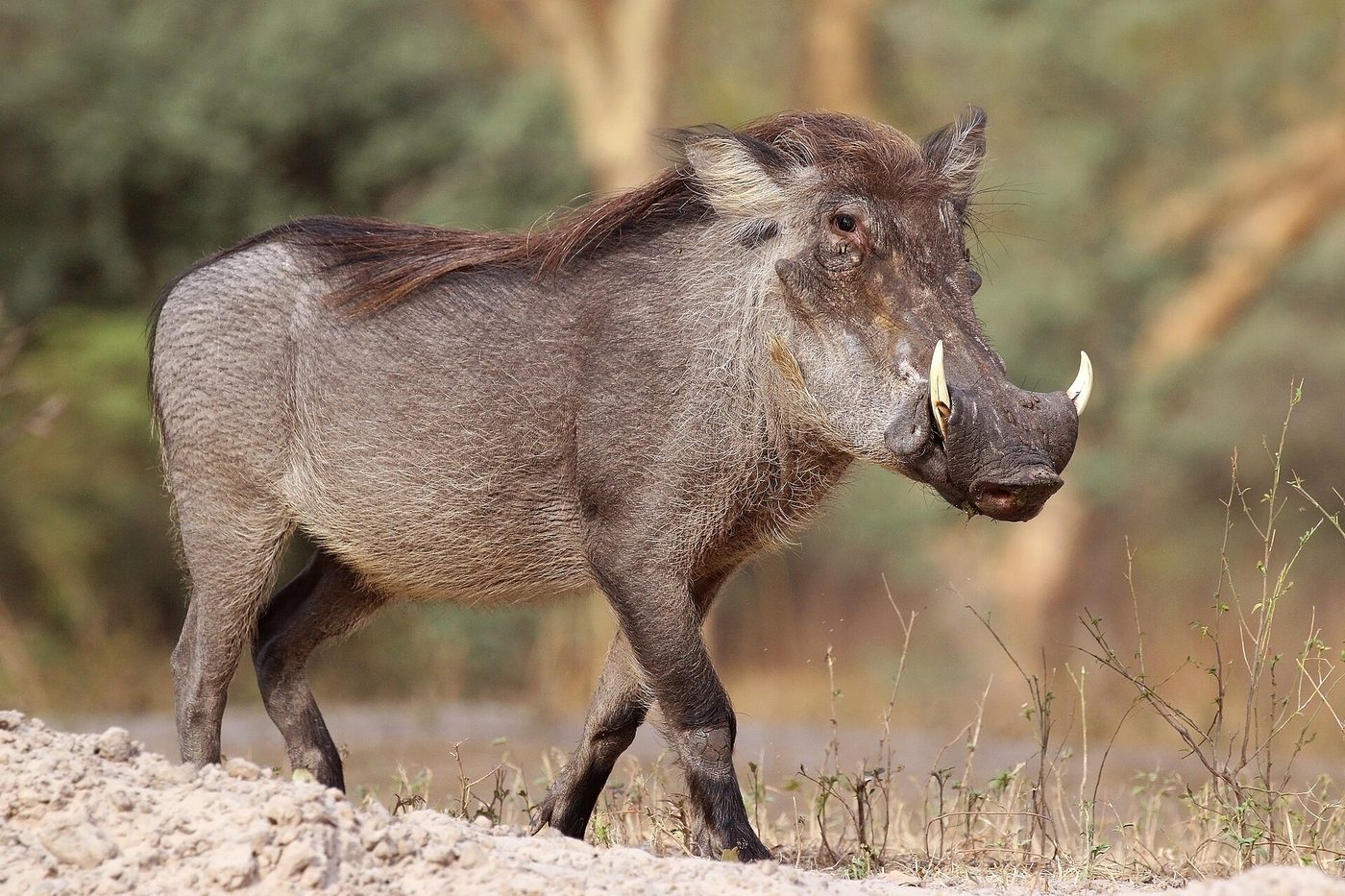
Photo: Charles J. Sharp · CC BY-SA 4.0
Common warthog
Phacochoerus africanus
With its curved tusks, prominent facial 'warts' and tail held straight up when it runs, the warthog is the comical and hardy wild pig of the African savanna.
Characteristics
Temperament
Diurnal, social, lively but cautious
Diet
Herbivore and opportunist: grass, roots, bulbs, fruit
The wild pig of the savanna
The warthog is an African suid, a wild relative of pigs and boars, with an unmistakable and, in its way, endearing appearance. It has a sturdy body, a large, elongated head and greyish, almost hairless skin, except for a mane of bristly hairs along its back. Its most characteristic feature are the two pairs of fleshy 'warts' on its face, from which its name derives, and the curved tusks protruding from its mouth: the upper ones can be quite long and prominent, especially in males.
Habitat and distribution
It lives across much of sub-Saharan Africa, preferring open savannas, grasslands and sparse scrubland. It is an animal tied to open spaces, where it grazes and moves about in search of food. To shelter from the heat, the night cold and predators, it uses underground burrows, often dug by other animals such as aardvarks, adapting them to its own needs.
Behaviour
The warthog is mainly herbivorous: it feeds on grass, roots, bulbs and fruit, but is opportunistic when needed. One of its typical behaviours is to kneel on its front legs to graze on the lowest grass and dig the ground with its snout. When frightened, it flees at a run holding its tail stiff and straight up, like an antenna: a comical and characteristic image of the savanna. Its tusks, besides digging, serve as a defence against predators.
Curiosities
The warthog's 'warts' are not true pathological growths, but thickenings of the skin that protect its face during fights and digging. Despite its inelegant appearance, it is a well-adapted and very successful animal, able to coexist with many of the great African predators.
Conservation
The warthog is classified as a species of least concern, with large populations widespread throughout Africa. It is a common and adaptable animal. Locally it can suffer from hunting and competition with livestock, but on the whole it is not considered threatened. It is a familiar and lively presence of Africa's parks and savannas.
Pros
- Comical, unmistakable appearance
- Well-adapted and hardy for savanna life
- Large, unthreatened populations
- Coexists with many large predators
Cons
- Locally hunted or in competition with livestock
- The males' tusks can be dangerous
- Depends on burrows dug by other animals