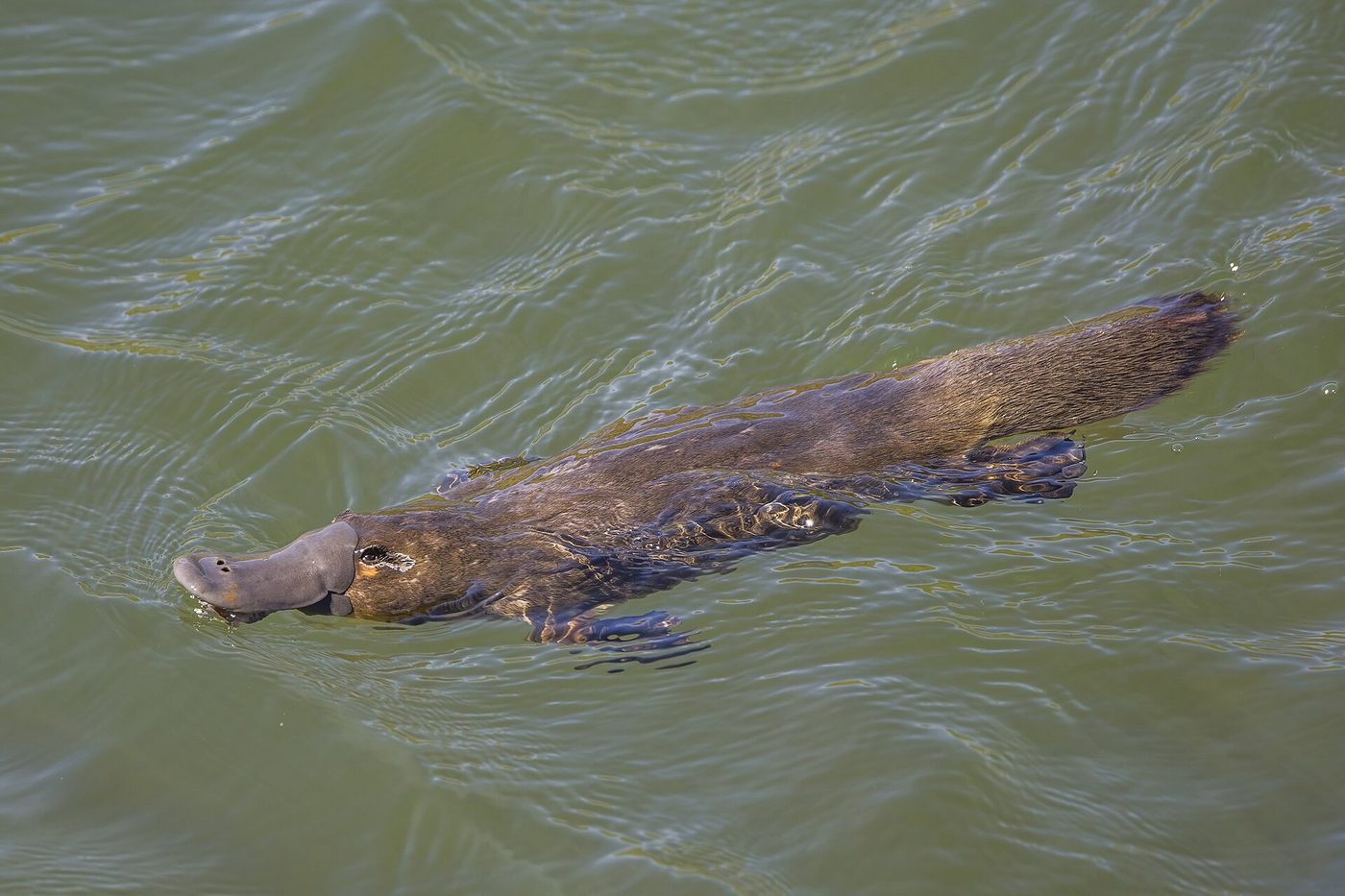
Photo: Charles J. Sharp · CC BY-SA 4.0
Platypus
Ornithorhynchus anatinus
With its duck bill, webbed feet and eggs, the platypus is one of the most bizarre animals on the planet: a mammal that seems assembled from different parts.
Characteristics
Temperament
Shy, solitary and mostly crepuscular or nocturnal. It hunts underwater using electroreception; males have a venomous spur used in fights.
Diet
Carnivore: worms, insect larvae, small crustaceans and molluscs, sought on the riverbed.
The impossible animal
The platypus is so strange that, when the first specimens reached Europe, scientists suspected a hoax, an animal stitched together from different parts. It has a stocky body covered in dense waterproof fur, a flat bill like a duck's but soft and sensitive, webbed feet and a broad beaver-like tail. It lives in the rivers and watercourses of eastern Australia and is one of the very few mammals in the world to lay eggs.
A mammal that lays eggs
The platypus belongs to a very ancient group of mammals, the monotremes, which reproduce by laying eggs instead of giving birth to live young. The female incubates the eggs and, once they hatch, suckles the young. But even the suckling is unusual: the platypus has no nipples, and the milk oozes from the skin, where the young lick it. These features link it to very ancient stages in the evolution of mammals.
An electric hunter
The platypus hunts underwater, where it closes its eyes, ears and nostrils. How does it find its prey in the dark with its main senses shut off? Through an extraordinary ability: its bill is fitted with receptors that detect the weak electric fields produced by the muscles of its prey. With this electroreception it locates worms, larvae and small crustaceans in the mud of the riverbed, moving its bill from side to side like a living metal detector.
A venomous mammal
Another rarity: the platypus is among the very few venomous mammals. Males have a spur on their hind legs connected to a gland that produces venom, used mainly in fights between males during the breeding season. It is not lethal to humans, but it can cause intense and prolonged pain.
Conservation
The platypus is classified as near threatened. It depends closely on clean, intact watercourses, threatened by drought, fires, pollution and the alteration of rivers. Its conservation is tied to the protection of Australia's aquatic environments, of which it is a unique and irreplaceable symbol.