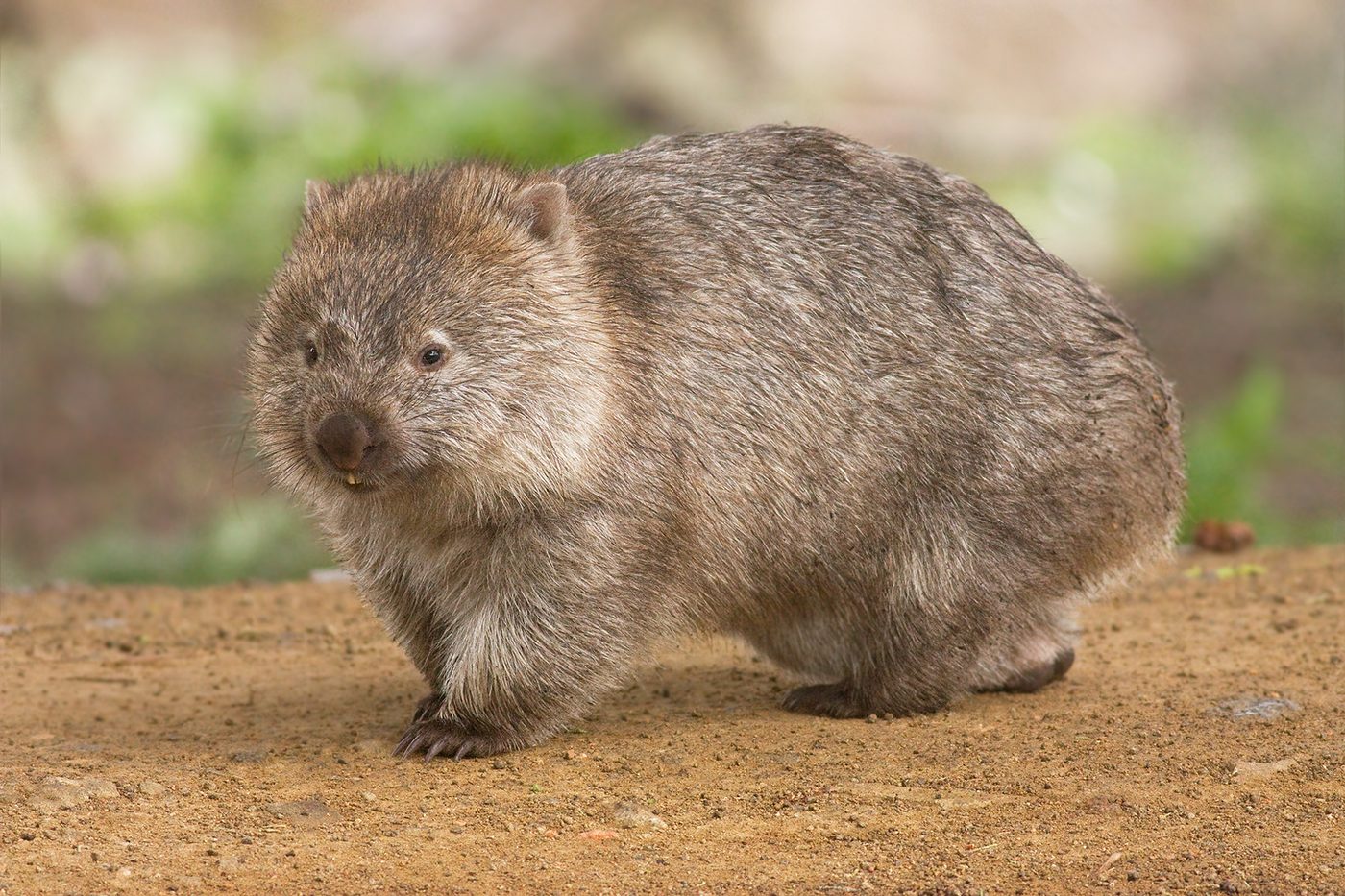
Common wombat
Vombatus ursinus
Stocky, powerful and a tireless digger, the common wombat is an Australian marsupial that lives in underground burrows and produces cube-shaped droppings.
Characteristics
Temperament
Solitary, placid but capable of quick bursts; nocturnal
Diet
Herbivore: grasses, roots and bark
A stocky, powerful marsupial
The common wombat is an Australian marsupial with a stocky, muscular body, short sturdy legs and an appearance that vaguely recalls a small ground-dwelling bear. It can weigh as much as a medium-sized dog and is equipped with strong claws, true digging tools. Its coarse, greyish-brown coat protects it from the cold and from the abrasion of its burrows. Despite its bulk and placid air, over short distances it can run with surprising speed.
Habitat and distribution
It lives in south-eastern Australia, Tasmania and on some islands, in environments ranging from forests to scrubland and hilly grasslands. It is an animal tied to the underground: it digs extensive systems of tunnels, true underground refuges in which to shelter from heat, cold and predators. The burrows can be several metres long and are used and extended over time.
Behaviour
The wombat is mainly nocturnal and solitary. It spends much of the day sheltered in its burrow and comes out at dusk and by night to feed. It is a herbivore that feeds mainly on grasses, roots and bark, with a very slow, efficient metabolism that allows it to get the most from a poor diet. It has a curious anatomical peculiarity: the female's pouch faces backwards, so it does not fill with earth while the animal digs.
Curiosities
The wombat is famous for a truly unique trait in the animal kingdom: it produces cube-shaped droppings. This unusual shape, due to the way the intestine moulds the faeces, seems to stop them from rolling away, helping the animal to mark its territory by depositing them on rocks and rises. It is one of the most studied and surprising oddities of Australian wildlife.
Conservation
The common wombat is classified as a species of least concern and its populations are on the whole stable. Locally, however, it can suffer from habitat loss, road accidents and disease. Protecting its environments and driving with care in the areas where it occurs remain important to ensure its peaceful coexistence with humans.
Pros
- Extraordinary digger, builds complex burrows
- Efficient metabolism, adapted to arid environments
- Populations on the whole stable
Cons
- Locally vulnerable to road accidents and disease
- Mainly nocturnal, hard to observe
- Sensitive to habitat loss