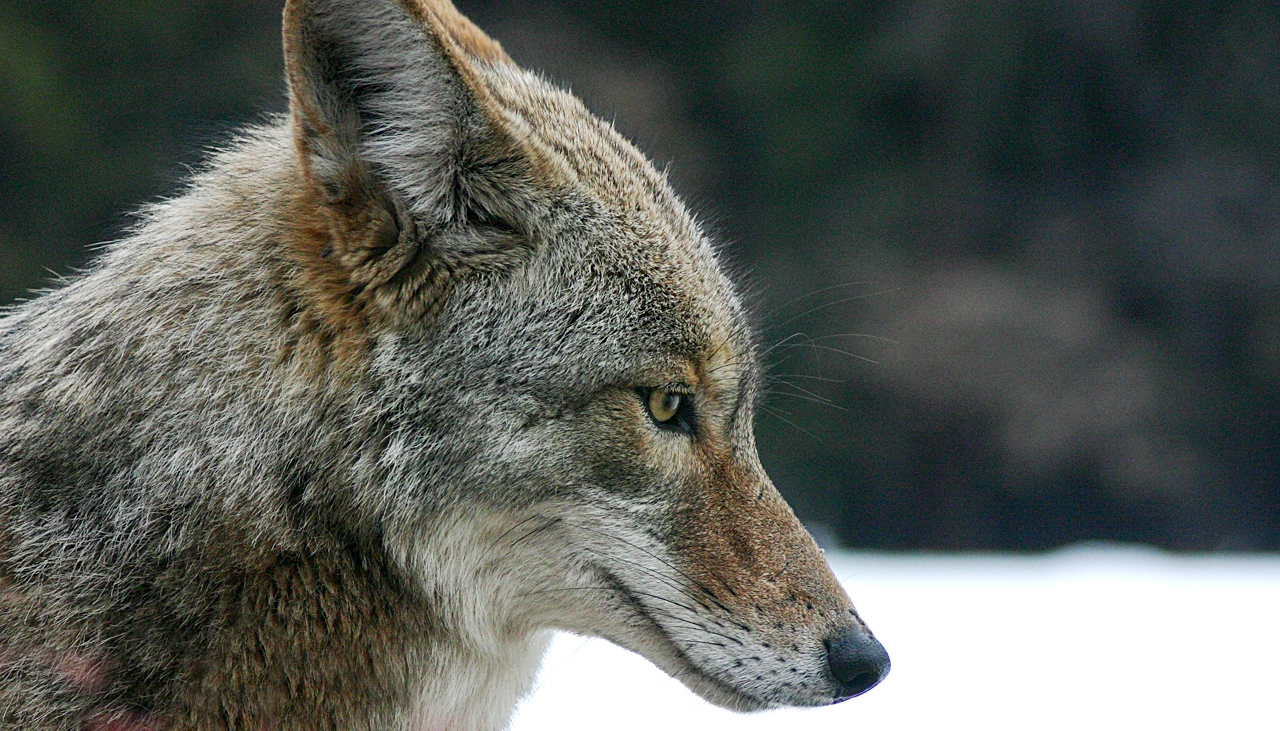
Coyote
Canis latrans
Characteristics
Temperament
Intelligent, opportunistic, cunning and socially flexible: lives alone, in pairs or in small family packs depending on resources. The most adaptable canid in North America, thriving from deserts to big cities. The "song dog", famous for nocturnal choruses of howls and yips. Pairs usually monogamous and long-lasting. Shy with people. The more it is persecuted, the more it expands. The "Trickster" of Native American legend.
Diet
Opportunistic omnivore with a highly flexible diet. Staple: small mammals (mice, voles, rabbits, hares, ground squirrels). In packs takes deer (especially fawns). Important carrion scavenger. Also birds, reptiles, amphibians, fish, insects, fruit and berries (autumn), urban garbage. Hunts alone with the "mouse pounce", large prey in packs, and sometimes pairs with the American badger (the badger digs, the coyote catches escapees on the surface).
The Coyote (Canis latrans), also called the "prairie wolf" or "American jackal", is the most adaptable and successful wild canid in North America. Famous for:
- The "song dog": its scientific name latrans means "barking". It has the richest vocal repertoire of any North American mammal — howls, yips, barks and the famous group choruses that echo through western nights
- The continent's most adaptable canid: lives in deserts, prairies, forests, mountains AND major cities (New York, Los Angeles and Chicago all have stable urban coyote populations)
- Expands its range despite persecution: the more it is hunted and poisoned, the more it spreads — today it occupies all of North America from Alaska to Panama, a far larger range than before European colonization
- Opportunistic omnivore: eats anything, from rodents to fruit, carrion to urban garbage
- Social and flexible: lives alone, in pairs or in small family packs depending on resources
- The "Trickster": a central figure (the cunning trickster) in the mythology of many Native American peoples
- Hunts in partnership with the American badger: one of the best-known inter-species collaborations in the animal kingdom
IUCN status: Least Concern (LC), with an increasing and expanding population. It is one of very few large carnivores whose range has grown in response to human activity.
Classification and category
Order Carnivora, family Canidae, genus Canis — the same as the grey wolf (Canis lupus), the domestic dog, the golden jackal and the Ethiopian wolf. A close relative of the wolf, of which it is a smaller, more generalist version. About 19 subspecies vary in size and colour across the vast range. Genetically very close to the wolf, it readily hybridizes with it and with dogs: the "coywolf" (eastern coyote) of NE North America is a coyote × wolf × dog hybrid, larger than western coyotes, that colonized the eastern woods after wolves were exterminated; "coydog" is a coyote × dog cross. Etymology: "Canis" Latin for "dog"; "latrans" means "barking", for its famous calls; the common name comes from Nahuatl "coyotl". Parameters: Body 75-100 cm. Tail 30-40 cm (bushy, carried low). Shoulder height 45-55 cm. Weight 8-20 kg (eastern "coywolves" the largest, desert coyotes the smallest). Longevity 10-14 years in the wild (often 6-8), up to 18-20 in captivity. Generally monogamous pairs, gestation ~60-63 days, litters of 4-7 (up to 12 when resources are rich or the population is under pressure).
Habitat and distribution
The Coyote has one of the largest and fastest-expanding ranges of any carnivore: all of North America, from Alaska and Canada through the entire USA and Mexico to Panama in Central America (still pushing south toward South America). Before European colonization it was mostly confined to the central prairies and deserts; wolf extermination and deforestation opened whole continents to it. Habitats — virtually all: prairies and grasslands (ancestral), deserts and arid zones, forests and mountains (above 3,000 m), farmland, and urban/suburban areas (parks, suburbs and even city centres — stable "urban coyote" populations live in New York, including Central Park, Chicago, Los Angeles, Denver). Its extraordinary ecological plasticity is the key to its success: it adapts diet, group size, activity times and behaviour to its surroundings — more nocturnal and shy where persecuted, learning traffic lights, underpasses and bins in cities. IUCN: Least Concern, abundant and expanding. A rare example of a large predator that thrives alongside humans, so much so that lethal control programs have largely failed to reduce its numbers.
Diet
An opportunistic omnivore with an extremely flexible diet that changes with season and region: small mammals (the staple — mice, voles, ground squirrels, rabbits and hares), medium-large mammals (in packs can take deer, especially fawns, and pronghorn), carrion (an important scavenger of large carcasses), birds, reptiles, amphibians, fish and insects, fruit and plants (berries, apples, melons, mesquite — significant especially in autumn), and garbage, pet food and occasionally small pets in urban areas. Hunting strategies: solitary hunting of small prey using keen hearing and the classic "mouse pounce" (rears up and dives onto the prey); pair or pack hunting of large prey like deer, coordinating relay chases; and collaboration with the American badger — coyote (fast above ground) and badger (digger) hunt prairie rodents together, the badger digging them out and the coyote catching those fleeing on the surface, both catching more prey than alone. This opportunistic omnivory is what makes the Coyote indestructible: it can live anywhere there is something to eat, from wild prey to human refuse.
Physical features
Looks like a slender, alert dog — halfway between a fox and a wolf. Coat: grey-fulvous, brown-yellowish, shading from greyish (cold/montane areas) to sandy-fulvous (deserts); paler, almost white belly and throat; legs, ears and muzzle often reddish; thick fur, longer and denser in winter. Body: slender and light (far more gracile than the wolf, built for running and endurance), long pointed muzzle (narrower than a wolf's), large erect pointed ears (proportionally larger than a wolf's), bushy tail carried LOW (a key distinguishing trait — the coyote runs with its tail down, the wolf holds it horizontal, the dog often high), alert yellow eyes. Performance: speed up to 65 km/h (among the fastest canids), tireless trotting endurance over many kilometres, very acute hearing/smell/sight, agile jumping over fences and ditches, and good swimming when needed.
Behaviour and curiosities
Intelligent, opportunistic and socially flexible. Social structure varies with resources: family packs where food is abundant and concentrated (large prey, cities), pairs or solitary where it is scarce and dispersed. Pairs are usually monogamous and long-lasting, with both parents raising the pups.
The "song dog": the richest vocal repertoire of any North American mammal (at least 11 distinct calls). The famous nocturnal choruses — a crescendo of howls, yips and barks from the whole group — gather the pack, mark territory and communicate; an acoustic effect makes a few coyotes sound like many (the "beau geste"). "The more you fight it, the more it multiplies": over a century of extermination campaigns has not reduced numbers — its range has tripled instead. When a population is culled, coyotes respond with larger litters and earlier maturity, and vacated territories are quickly recolonized (demographic compensation makes it nearly impossible to eradicate). Badger partnership: coyote and American badger sometimes hunt prairie rodents together, the badger digging and the coyote catching escapees — together catching more than apart. The "Trickster": a central figure in many Native North American mythologies — the cunning, mischievous trickster, sometimes world-creator and gift-bringer, sometimes the fool of his own schemes. The eastern "coywolf": the coyote of the NE USA and eastern Canada is a coyote × eastern wolf × dog hybrid, larger and sturdier, formed over the last century as coyotes spread east through wolf-free land — rapid evolution before our eyes. Wile E. Coyote: made world-famous by Looney Tunes' endless ACME-powered chase of the Road Runner. The urban coyote: perhaps the most surprising trait of the modern coyote — its conquest of cities (a long-running Chicago study has radio-collared hundreds living in the city, crossing streets in traffic lulls and raising pups in parks), mostly invisible and harmless to people.
Pros
- Canide più adattabile del Nord America, prospera ovunque
- IUCN Least Concern, popolazione in aumento
- Controlla naturalmente roditori e prede in eccesso
- Icona culturale: il 'Trickster' e Willy il Coyote
Cons
- Non è un animale domestico (canide selvatico)
- Conflitti con allevatori (predazione occasionale di bestiame)
- Nelle città può avvicinarsi a rifiuti e piccoli animali domestici
- Si ibrida con cani e lupi alterando i pool genetici locali