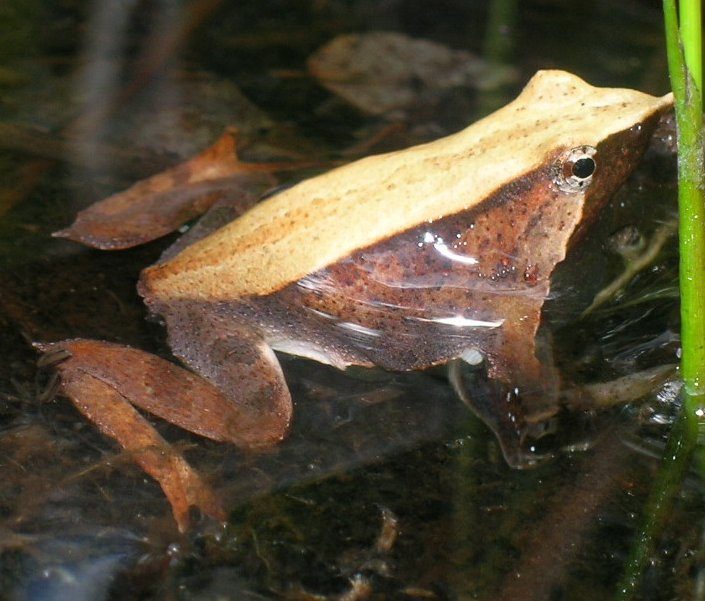
Photo: Mono Andes · CC BY-SA 2.0
Darwin's frog
Rhinoderma darwinii
Tiny and camouflaged like a dead leaf, Darwin's frog is famous for a unique behaviour: the male raises its young inside its own vocal sac.
Characteristics
Temperament
Discreet, cryptic, elusive
Diet
Insectivore: small invertebrates
A frog that looks like a leaf
Darwin's frog is a small amphibian of delicate appearance, only a few centimetres long. Its most curious feature is its snout, which ends in a flattened, elongated point, almost forming a little nose. This shape, combined with the green or brown colour of its body, makes it strikingly resemble a dead leaf fallen to the ground, rendering it almost invisible among the forest litter. It owes its name to the famous naturalist Charles Darwin, who discovered it during his voyage in Chile aboard the Beagle.
Habitat and distribution
It is endemic to the temperate forests of Chile and Argentina, where it lives among the dense undergrowth and the litter of mature native woods, often associated with southern beeches. It prefers humid, well-preserved forest environments, rich in shelter and vegetation.
An extraordinary way of breeding
The most fascinating behaviour of Darwin's frog is the way it raises its offspring. After the female has laid the eggs, it is the male that cares for them in a completely unique way: when the embryos are ready, it swallows them and keeps them inside its own vocal sac, where the tadpoles develop in safety. After a few weeks, from the father's mouth emerge not tadpoles, but little fully-formed frogs. It is one of the very rare cases in nature of 'mouth-brooding' by the male.
Conservation
Darwin's frog is classified as an endangered species. It is threatened by the loss and fragmentation of forests, by climate change and, particularly severely, by a fungal disease of amphibians, chytridiomycosis, which is decimating many species of frog around the world. The protection of the native temperate forests is essential for its survival.
Pros
- Extraordinary mouth-brooding by the male
- Perfect dead-leaf camouflage
- Discovered by Charles Darwin
- Symbol of South America's temperate forests
Cons
- Endangered species
- Threatened by chytridiomycosis
- Depends on mature native forests