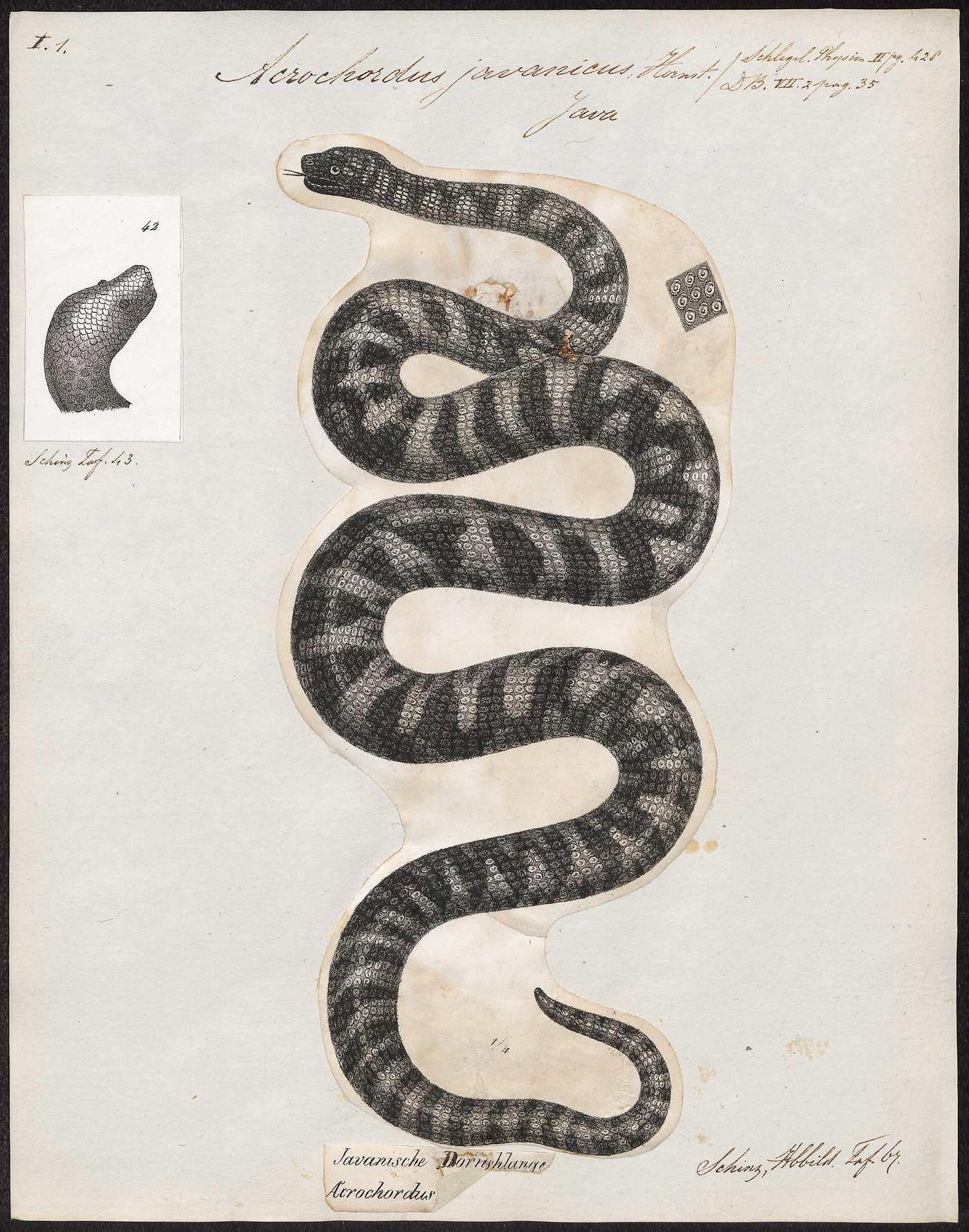
Photo: Wikimedia Commons · Public domain
Elephant trunk snake
Acrochordus javanicus
An aquatic snake of Southeast Asia with loose, baggy skin like an oversized sleeve, the elephant trunk snake grips fish thanks to its rough, file-like scales.
Characteristics
Temperament
Nocturnal, sedentary, almost entirely aquatic
Diet
Carnivore: fish grasped from ambush
A snake wearing skin too big for it
The elephant trunk snake, or Javan file snake, is an aquatic snake of unmistakable appearance: its body is bulky and its skin looks soft, wrinkled and baggy, as if the animal were wearing a suit several sizes too large. This skin is covered in small pointed, rough scales, like the surface of a file or rasp, hence its other common names of "file snake" and "wart snake". It is a non-venomous snake belonging to an archaic family of entirely aquatic snakes.
Habitat and distribution
It lives in the fresh and brackish waters of Southeast Asia and Indonesia, among rivers, estuaries, lagoons and swamps. It is so adapted to aquatic life that it is almost helpless on land, where it moves with great difficulty.
Behaviour and hunting
It is nocturnal and sedentary, an ambush predator that spends most of its time submerged, surfacing only occasionally to breathe. It feeds on fish, which it grasps and holds by coiling around them: its rough skin and pointed scales give it a firm grip on the slimy, slippery prey that would otherwise escape. It is viviparous and gives birth to fully formed young.
Curiosities
Its rough skin was once used to make leather. The elephant trunk snake is sometimes kept as an exotic terrarium animal, but it is delicate: it needs a large, well-maintained tank of water and does not tolerate handling.
Conservation
The IUCN lists the species as Least Concern. Collection for its skin and for the terrarium trade, along with wetland loss, can nonetheless affect populations locally.
Pros
- Rough, baggy skin unique among snakes
- Extraordinary adaptation to aquatic life
- Non-venomous
Cons
- Almost helpless on land
- Delicate in a terrarium, does not tolerate handling
- Depends on wetlands