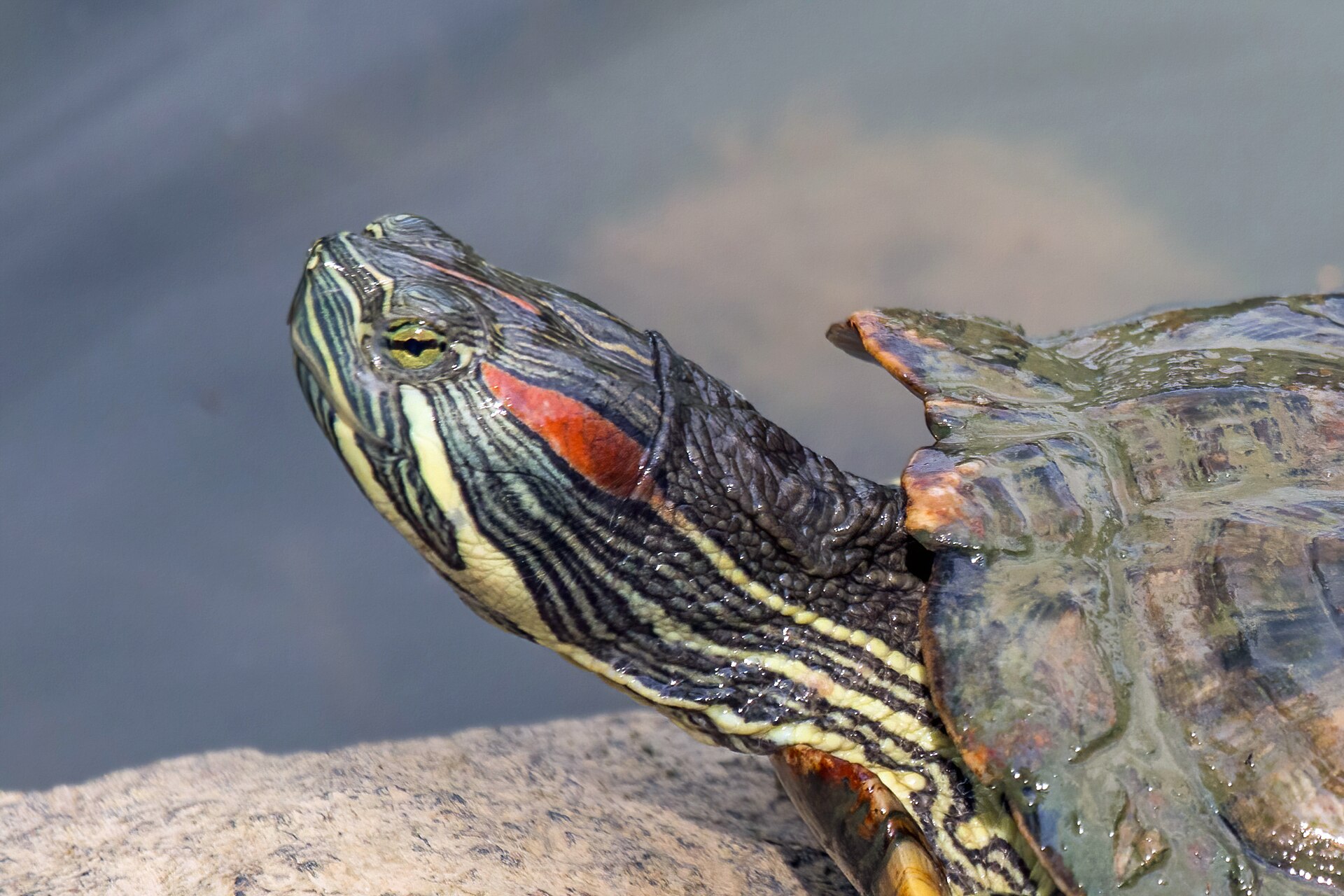
Red-eared Slider
Trachemys scripta elegans
Characteristics
Temperament
A diurnal aquatic turtle, lively, hardy and very adaptable. It spends much of its time in the water but often comes out to bask on logs and rocks, sliding away at the slightest alarm (hence "slider"). It is not the "easy" animal it is often thought to be: it grows a lot, lives for decades and needs large, filtered aquariums with a basking area and a UVB lamp, plus a correct diet. It must NEVER be released into the wild: outside its range it is a damaging invasive species, banned from trade in the EU, that competes with native turtles.
Diet
Omnivorous with a diet that changes with age: as a juvenile mainly carnivorous (insects, larvae, small fish, tadpoles, worms, crustaceans), as an adult increasingly vegetarian (aquatic plants, algae, leaves, shoots), with occasional scavenging. It eats while submerged. In captivity it needs a varied, balanced diet, with the right share of plants and calcium (and UVB light), to avoid serious shell and bone problems. Its voracity and dietary adaptability are among the reasons for its success as an invasive species.
The Red-eared Slider (Trachemys scripta elegans) is the best-known and most widely sold freshwater pet turtle in the world — and, in spite of itself, also one of the most problematic invasive species. Famous for:
- The "red ears": the bright red-orange patch behind each eye, which gives it its name
- Its huge popularity as a pet: sold by the million as an aquarium "baby turtle"
- The downside: released specimens have made it one of the world's worst invasives
- Longevity: it can live more than 20-30 years, far longer than many buyers expect
- The "slider" behaviour: it slides off its basking logs into the water at the slightest alarm
- Hardiness: adaptable and tough, it thrives in a great many aquatic environments
IUCN status: Least Concern (LC) in its native range, but it is listed among the 100 worst invasive species in the world. It enters the portal among the Turtles, alongside the European pond turtle, Matamata, Snapping turtle and others: a textbook case of how a much-loved animal can become an ecological problem when poorly managed.
Classification and category
Order Testudines (the turtles), family Emydidae (the New World pond turtles). It is one of the subspecies of the pond slider (Trachemys scripta): specifically Trachemys scripta elegans. In the portal it is placed among the Turtles (freshwater and pond turtles). It is useful to tell it apart from similar or related species: the European pond turtle (Emys orbicularis), also in the portal, is the native European water turtle that the slider tends to displace — darker, without the red patch; the other subspecies of Trachemys scripta (e.g. the yellow-bellied slider) have yellow patches instead of red behind the eye; other North American emydids such as Pseudemys (cooters), Graptemys (map turtles) and Chrysemys (painted turtles) have different patterns and shapes. Etymology: "Trachemys" refers to the carapace surface; "scripta" ("written") and "elegans" allude to the showy yellow markings on skin and shell; the common name "slider" comes from the habit of quickly "sliding" into the water from basking spots at the first sign of danger. Parameters: Carapace length commonly 15-30 cm; females are markedly larger than males. Weight adults can reach and exceed 1-2 kg. Dimorphism: males stay smaller but have very long front claws, used in courtship. Longevity: remarkable — in captivity it commonly lives 20-30 years and more, one of the reasons so many buyers, underestimating its long-term needs, end up abandoning it. Reproduction: the hatchlings' sex depends on the egg incubation temperature.
Habitat and distribution
The Red-eared Slider has a very specific origin but today an almost worldwide distribution because of humans: native range the south-central United States, particularly the Mississippi basin and the areas around the Gulf of Mexico; introduced range almost everywhere — Europe (including Italy), Asia, Australia, South Africa, South America — from released or escaped pets. Preferred habitats — still or slow fresh waters rich in vegetation: ponds, pools, marshes and swamps; slow rivers, canals and ditches; and park and garden ponds, where abandoned specimens often concentrate. It is a strongly aquatic but "sun-loving" turtle: it spends much time in the water but needs to come out to bask on logs, rocks or banks to thermoregulate and keep shell and bones healthy. Its adaptability, omnivorous diet, fast growth and competitive aggressiveness let it thrive in very many environments, often at the expense of native turtles. Status: Least Concern in the wild, but a high-impact invasive species outside its range. In the European Union the trade and import of this subspecies are banned under invasive alien species regulations: it is essential never to release it into ponds, rivers or pools.
Diet
The Red-eared Slider is omnivorous, with a diet that changes greatly with age. It feeds on: as a juvenile, mainly animal food (insects, larvae, small fish, tadpoles, worms, crustaceans); as an adult, increasingly vegetarian (aquatic plants, algae, leaves and shoots); and carrion and remains (it will occasionally scavenge). Feeding habits: it eats in the water (like many aquatic turtles, it swallows food while submerged, helped by its strong jaws); it is opportunistic and voracious (this, together with competition for food and basking spots, is one reason it puts native species under pressure); and in captivity it requires a varied, balanced diet (with the right share of plants and calcium), otherwise serious shell and bone health problems follow. Crucially, the combination of voracity, dietary adaptability and hardiness is exactly what makes it an excellent "survivor" — and, outside its range, a formidable competitor for local turtles.
Physical features
A medium-sized water turtle, brightly coloured especially when young. The head and the "red ears" — the distinguishing trait: a bright red-orange patch behind each eye, hence the name (not true external ears, which turtles lack); greenish skin marked with thin yellow stripes. The shell (carapace and plastron): a carapace from olive-green to brownish, with yellow patterns, tending to darken with age; a yellow plastron (the underside) with rounded dark blotches; and webbed feet with strong claws, suited to swimming. Variations with age and sex: the young are a bright green and very vivid in colour, the tones fading over the years; old males can become very dark (melanism), even masking the patterns; females are larger, while the smaller males sport long front claws.
Behaviour and curiosities
The Red-eared Slider is an aquatic, diurnal, sun-loving reptile, lively in character and enormously adaptable. These very qualities make it a fascinating animal to watch, but also a classic example of the problems tied to the careless trade in exotic animals.
The name "slider": the English name "slider" describes a typical behaviour: these turtles love to line up on logs and rocks to bask in the sun, but at the slightest sign of danger they let themselves slide quickly into the water, vanishing in an instant; basking (sun exposure) is not a whim: it serves to thermoregulate, to absorb the UV rays essential for shell health, and to shed algae and parasites. The "baby turtle" that does not stay small: much of its fame comes from selling the hatchlings, green and a few centimetres long, as cheap, "easy" pets; in reality the slider grows a lot, can live decades and needs large, filtered aquariums with a basking area; underestimating its needs is the main cause of the many abandonments — and thus of its success as an invasive. The global invasive: released or escaped almost everywhere, the Red-eared Slider is now listed among the 100 worst invasive species in the world; outside its range it competes with native turtles — in Europe especially with the European pond turtle (Emys orbicularis) — for food, nesting sites and sunny basking spots, often favoured by its larger size and aggressiveness; this is why the EU has banned its import and trade. The "never release into the wild": the most important message tied to this species is precisely this; abandoning a red-eared slider in a pond or river is not a "kind" act but an ecological harm and an offence: it means introducing a competitor of local species and contributing to an environmental problem; those who can no longer keep it should turn to specialised centres, associations or vets. The sex decided by climate: as in many turtles, the hatchlings' sex is not fixed by chromosomes but by the egg incubation temperature: lower temperatures tend to produce males, higher ones females; it is a fascinating mechanism, but also a weak point in the face of climate change, which can skew the sex ratio. The surprising longevity: those who buy a "baby turtle" do not always realise they may be adopting an animal able to live 20, 30 or more years; this longevity, combined with hardiness, means many specimens survive long after being abandoned, accumulating in city park ponds, where it is not rare to see dozens basking side by side.
Pros
- Tartaruga d'acqua vivace e affascinante da osservare, soprattutto durante il basking
- Molto robusta e adattabile, resistente in cattività se ben gestita
- Molto longeva: può accompagnare per decenni
- Ottima 'ambasciatrice' per parlare di specie invasive e di acquisti responsabili
Cons
- NON va MAI liberata in natura: è una delle specie invasive più dannose al mondo
- Nell'UE importazione e commercio di questa sottospecie sono vietati
- Cresce molto e vive decenni: richiede acquari ampi, filtrati, con basking e UVB
- Le cure inadeguate causano gravi problemi a guscio e ossa; troppi acquisti d'impulso finiscono in abbandoni