Photo: Beckmannjan · CC BY-SA 3.0
Flying gurnard
Dactylopterus volitans
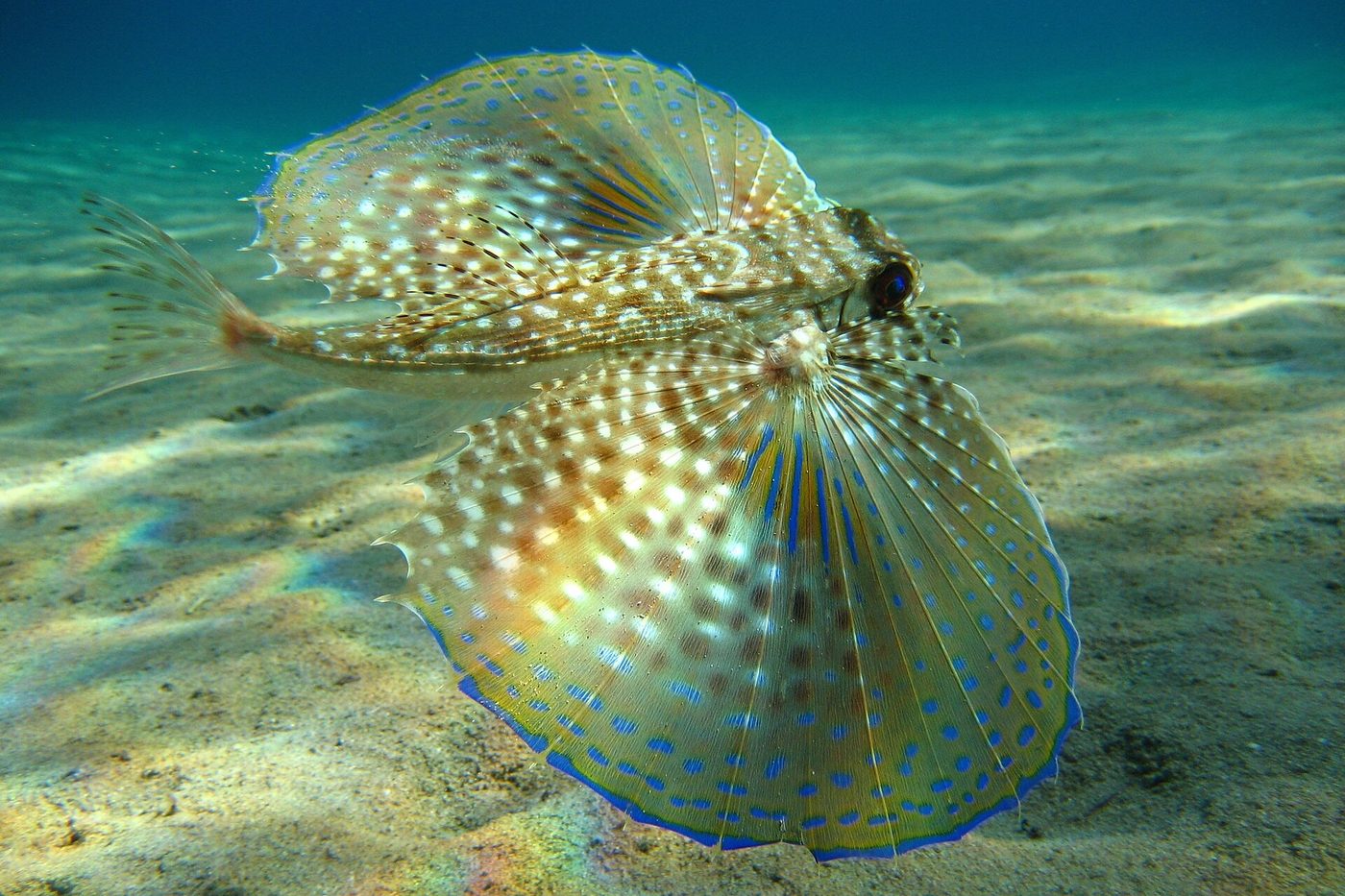
The flying gurnard is a curious bottom-dwelling fish with huge wing-like pectoral fins, which it spreads like a fan — a marine butterfly.
Characteristics
Temperament
Slow and sedentary; 'walks' on the bottom and spreads its large fins.
Diet
Carnivorous: small crustaceans, molluscs and worms from the bottom.
A fish with butterfly wings
The flying gurnard (Dactylopterus volitans), also called the helmet gurnard, is a bottom-dwelling bony fish, the only species of the genus Dactylopterus. Its most spectacular feature is its enormous pectoral fins, which it keeps folded along its sides at rest but, when alarmed or displaying, spreads out like great colourful wings, often edged with blue. Its body is stocky, with a sturdy, armoured head. Despite its name, it does not actually fly out of the water: the legend of a fish gliding on those "wings" is unfounded.
Habitat and range
It lives on sandy and muddy bottoms of tropical and warm-temperate waters on both sides of the Atlantic, and is common in the Mediterranean. It is generally found at shallow to moderate depths, always near the bottom.
Behaviour and diet
It is a slow, sedentary fish that "walks" over the seabed using the first rays of its pelvic fins like little legs, while it forages in the sand. It feeds on small benthic invertebrates — crustaceans, molluscs and worms. The large fins probably serve to startle predators, making it suddenly appear much bigger.
Did you know?
Its rich variety of folk names — sea swallow, batfish, sea hen — reflects the appeal of its unusual shape. It also produces sounds using its swim bladder, which it uses in communication.
Conservation
The IUCN lists it as Least Concern. It is not considered threatened, but like all bottom-dwelling fish it depends on the quality of coastal marine habitats.
Pros
- Spectacular huge fan-like pectoral fins
- 'Walks' on the seabed with its fins
- Least Concern, common in the Mediterranean
Cons
- Does not really fly, despite the name
- Slow and poorly manoeuvrable
- Depends on healthy coastal seabeds