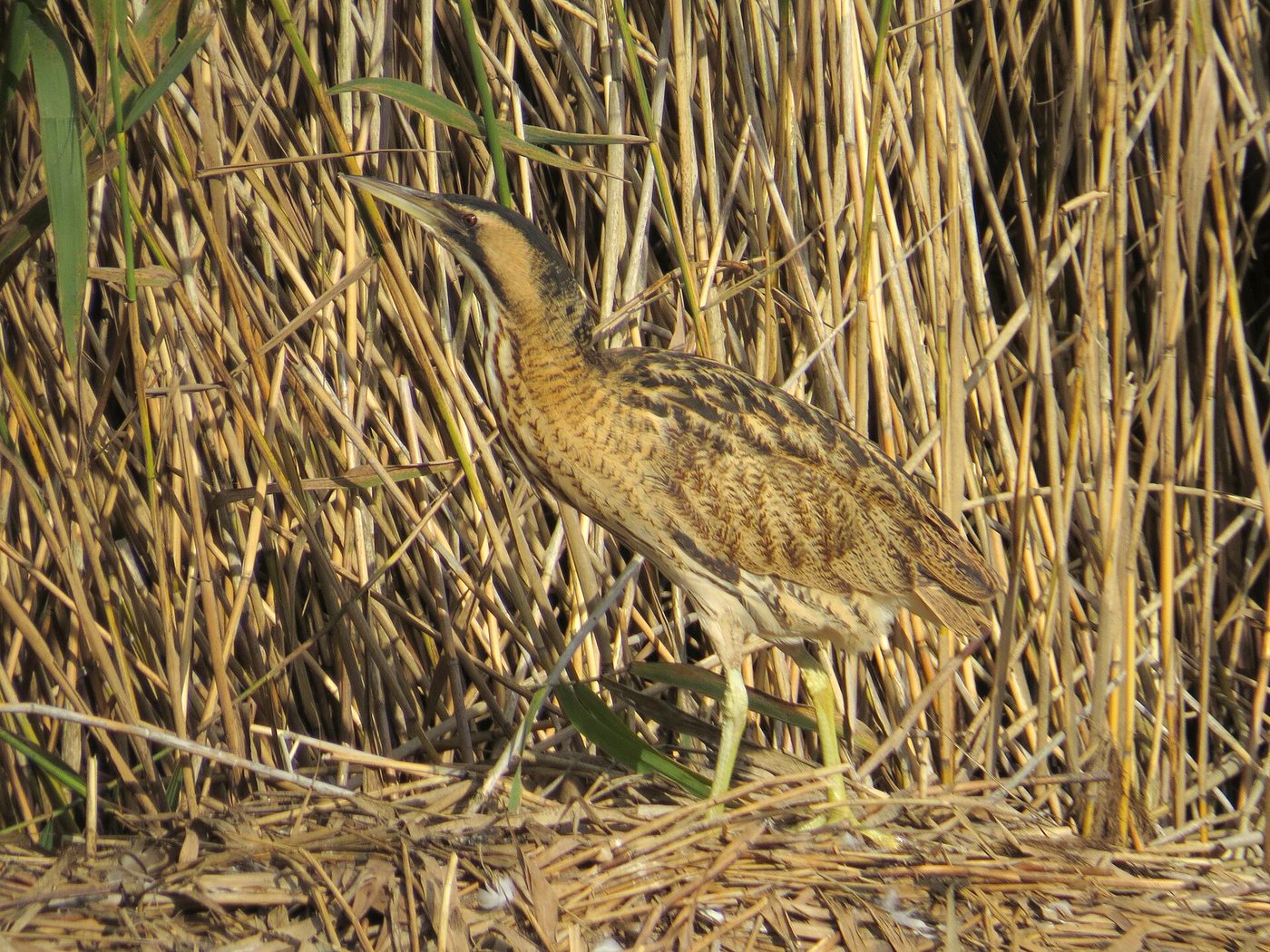
Photo: MPF · CC BY-SA 3.0
Eurasian bittern
Botaurus stellaris
The Eurasian bittern is a shy, camouflaged heron of the reedbeds, famous for the male's booming, bull-like call that carries for kilometres in spring.
Characteristics
Temperament
Shy, solitary, extremely well camouflaged
Diet
Carnivorous: fish, amphibians, small mammals and insects
The invisible heron of the reeds
The Eurasian bittern is a stocky, robust heron of the family Ardeidae, with brown-buff plumage finely streaked and mottled with black. This cryptic livery makes it almost invisible among the reeds: when it senses danger, it points its bill vertically upward and stays motionless, mimicking the reeds and even swaying in the wind. (Note: the mass value reported by Wikidata, 42 kg, is clearly erroneous: this bird actually weighs about 0.9 to 1.9 kg.)
Habitat and range
It lives in extensive reedbeds and freshwater wetlands across Eurasia and North Africa. It is an extremely secretive species that rarely shows itself in the open, preferring to move stealthily through dense marsh vegetation.
Behaviour and diet
It is an ambush hunter, advancing slowly among the reeds: it feeds on fish, amphibians, small mammals, fledgling birds, crustaceans and insects. In spring the male gives a deep, hollow call like a bull's bellow, audible even kilometres away — a sound that has earned it ox- and cow-related nicknames in many languages.
Notable facts
The bittern's famous booming is produced thanks to its expandable oesophagus, which acts as a resonating chamber. It is one of the most characteristic sounds of European wetlands at dusk and dawn. The scientific name stellaris refers to the star-like spots of its plumage.
Conservation
The species is listed as Least Concern globally, but in many European countries it is considered vulnerable or endangered, due to the drainage and degradation of reedbeds. Wetland restoration is crucial for its local survival.
Pros
- Exceptional camouflage among the reeds
- Unique bull-like booming call
- Indicator of wetland health
Cons
- Very sensitive to reedbed loss
- Extremely hard to observe