Bohemian waxwing
Bombycilla garrulus
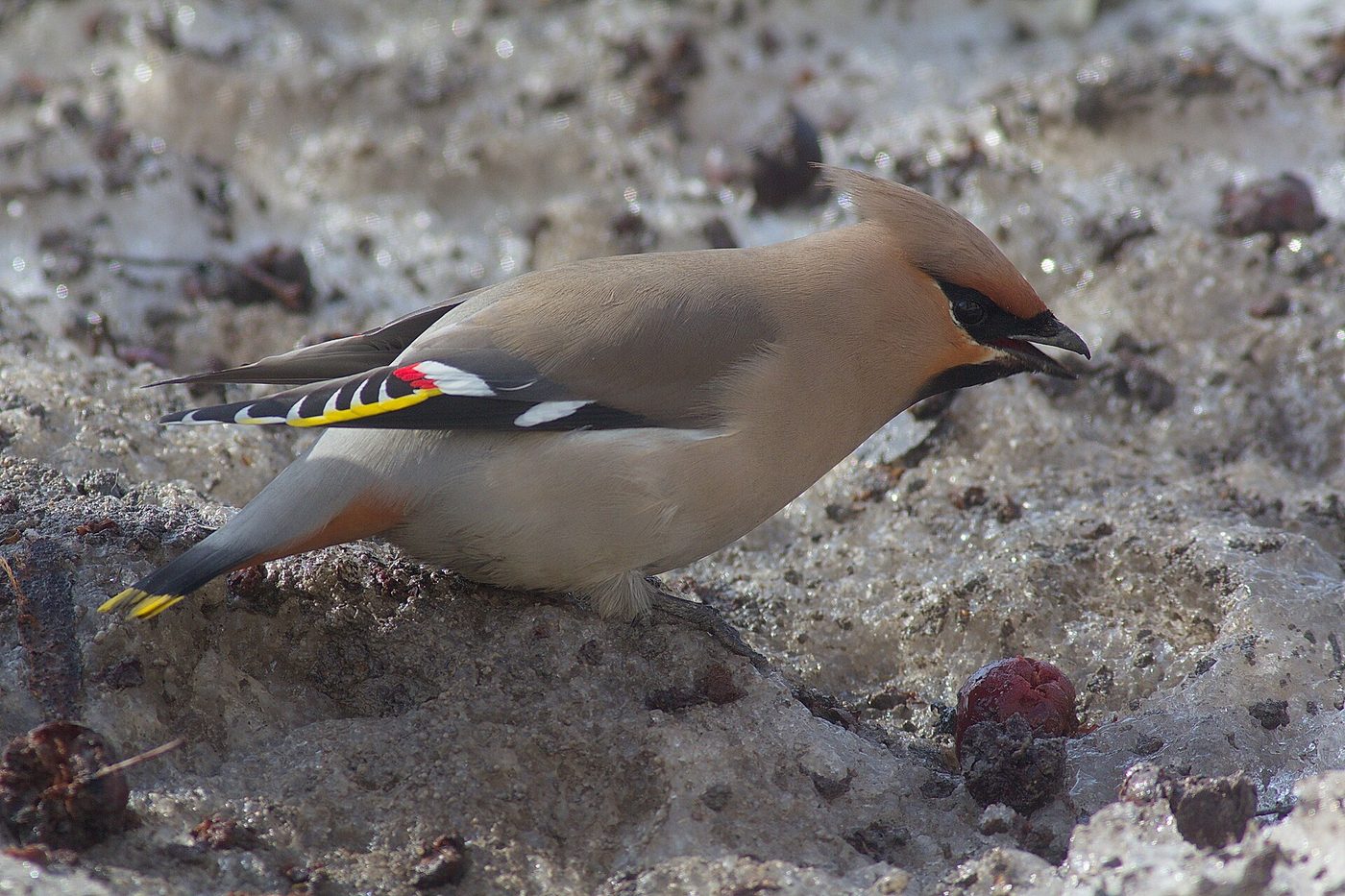
The Bohemian waxwing is an elegant northern bird with a pointed crest and wing feathers tipped with vivid red like drops of sealing wax.
Characteristics
Temperament
Gregarious, sociable, moves in flocks
Diet
Frugivorous: berries; insects in summer
The bird with sealing-wax tips
The Bohemian waxwing is an elegant, starling-sized passerine with soft buff-grey plumage. It has a striking pointed crest, a black mask around the eyes and a dark throat. Its wings are patterned with white and bright yellow and, above all, with curious red waxy tips on some of the feathers, resembling drops of sealing wax — hence the name waxwing. The tail ends in a yellow band.
Habitat and range
It breeds in the boreal coniferous forests of northern Europe, Asia and North America. It is the only waxwing found on all continents with subarctic zones. In winter it migrates south, and in Italy and central Europe it appears irregularly, with flock "irruptions" in certain years.
Behaviour and diet
It is a social, gregarious bird that moves in tight, noisy flocks. In summer it supplements its diet with insects caught on the wing, but for much of the year it is essentially frugivorous: it feeds eagerly on the berries of rowan, juniper, mistletoe, holly and hawthorn, able to swallow huge quantities. It thus helps to disperse seeds.
Notable facts
The waxwing's winter appearances in temperate Europe depend on berry availability in the northern regions: when food runs short, the flocks push farther south in search of fruit-laden trees. Because the berries can ferment, waxwings are sometimes seen appearing "drunk".
Conservation
The species is listed as Least Concern by the IUCN and is widespread. Its populations are considered stable, although its appearance in southern regions remains unpredictable from year to year.
Pros
- Elegant livery with waxy red wingtips
- Important seed disperser
- Spectacular winter flock irruptions
Cons
- Unpredictable winter appearance
- Depends on berry availability