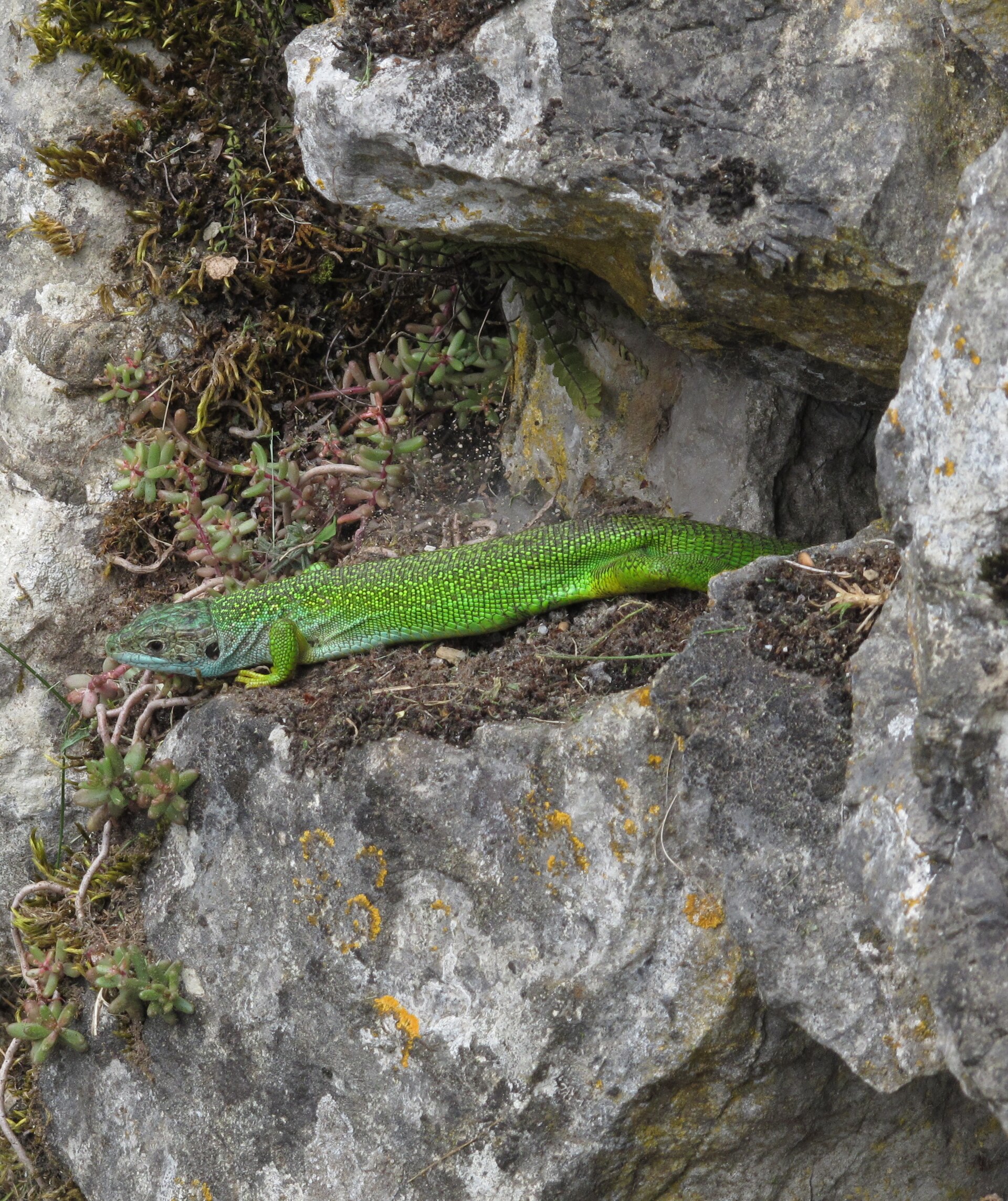
Western Green Lizard
Lacerta bilineata
Characteristics
Temperament
Diurnal, territorial and heat-loving. Very fast, dashing and shy: often noticed only as a "green flash" fleeing through the grass when a person passes. Males, in spring, defend their territory and compete for females, sometimes in real fights. It basks long in the sun before hunting and hibernates in winter. If handled it can bite firmly, but it is entirely harmless. Not a pet: a useful wild lizard to watch from a distance.
Diet
A mainly insectivorous predator. It eats mostly insects (beetles, grasshoppers, crickets, caterpillars, butterflies), spiders and other invertebrates, snails and earthworms; occasionally small lizards, the ground eggs of other reptiles or birds, and ripe fruit and berries. It hunts by sight, spotting moving prey and lunging with very quick dashes after warming in the sun to its optimal temperature. By devouring many harmful insects, it is a useful ally in countryside, vineyards and gardens.
The Western Green Lizard (Lacerta bilineata) is one of the largest, most striking and beloved lizards of Italy and western Europe. Famous for:
- Brilliant green: a vivid green coat, finely speckled with black, that makes it unmistakable among grass and bushes
- The males' blue throat: in spring, the breeding season, males develop a conspicuous blue throat (and sometimes head)
- A considerable size: it is one of Europe's largest lizards, with a very long tail
- Speed: quick and agile, it darts through vegetation and climbs into bushes at the slightest alarm
- A love of the sun: a heat-loving reptile, it loves to bask on walls, stones and brambles
- Harmlessness: entirely harmless to humans, and indeed a valuable ally because it devours many insects
IUCN status: Least Concern (LC), common and widespread. With it, this portal sets beside the small, northern Viviparous Lizard a large, gaudy Mediterranean one: two faces — one discreet, one showy — of the same fascinating world of the lacertids, the "true lizards" of the Old World.
Classification and category
Order Squamata, family Lacertidae (the lacertids, the "true" European lizards), genus Lacerta — that of the large lizards. A note on "green lizards": there are two very similar species, long considered one: the western green lizard (Lacerta bilineata) of this profile, found in Italy, France, northeastern Spain and nearby areas; and the eastern green lizard (Lacerta viridis), the twin species of central-eastern Europe and the Balkans. Not to be confused, moreover, with: the small Podarcis lizards (wall and field lizards), much smaller; the Viviparous Lizard, brown and montane; and the ocellated lizard (Timon lepidus), another large green lacertid but with blue spots on the flanks. Etymology: "Lacerta" is simply Latin for "lizard"; "bilineata" ("two-lined") refers to the two pale stripes present especially in juveniles and females. The Italian name "ramarro" is of uncertain origin, perhaps linked to the colour or to old dialect roots. Parameters: Total length up to 30-40 cm, including the tail (which is about two-thirds of the length). Body ~13 cm. Weight up to about 35 g. Longevity about 5-10 years in the wild (up to ~12). Reproduction: oviparous — the female usually lays, in summer, 6-20 eggs in a hole dug in sunny soil, from which the young hatch after a few weeks.
Habitat and distribution
The Western Green Lizard occurs in western and southern Europe: Italy (where it is common across much of the peninsula and Sicily), France, northeastern Spain, southern Switzerland and nearby areas. Preferred habitats — warm, sunny and rich in low vegetation: hedgerows, brambles, scrub and woodland edges (its prime habitat, with cover to hide and clearings to warm up); dry meadows, embankments, vineyards and sunny fallow land; and hilly and lowland zones, often near water or dense vegetation. The green lizard needs the combination of sun (to warm up, being a cold-blooded reptile) and dense plant cover (to shelter from predators), so it thrives in mosaics of meadow and bush and suffers where hedges and natural edges disappear. It is diurnal, very active in the warm hours, and in winter it hibernates in underground refuges. IUCN: Least Concern. A still-common species, but locally it can suffer from hedge destruction, intensive agriculture and pesticide use that reduces the insects it eats.
Diet
The Western Green Lizard is a mainly insectivorous predator, eager for anything it can catch at its size. It eats: insects (the staple — beetles, grasshoppers, crickets, caterpillars and butterflies); spiders and other invertebrates; snails and earthworms; and occasionally small lizards, the ground eggs of other reptiles or birds, and ripe fruit and berries. Hunting strategies: visual hunting (it spots moving prey and lunges with very quick dashes, using keen sight and agility); thermoregulation (it warms in the sun to its optimal temperature, then becomes an efficient hunter; in the hottest hours it is at peak activity); and exploring hedges and bushes (it rummages through tall grass and low branches, where insects abound). Crucially, by eating large quantities of insects and other invertebrates, the green lizard plays a useful "pest control" role in countryside, vineyards and gardens, and is itself important prey for snakes, birds and small mammals.
Physical features
A large, slender lizard with spectacular colours. Colours: a back of brilliant green, finely speckled with black (with sheens that shift in the light); a blue throat and head in adult males in spring (a conspicuous nuptial signal used to attract females and intimidate rivals); females often browner or with pale streaks; juveniles brownish/bronze, with two or four pale lines (hence bilineata). The body: a sturdy but slender body, with a very long tail (about two-thirds of total length); a relatively large head, especially in males, with strong jaws; sturdy legs with long, clawed toes for running and climbing; and fine scales on the back, larger on the belly. Performance: speed and dash (among Europe's fastest lizards, it darts off at the slightest danger); climbing (it nimbly scales bushes, brambles and walls); tail autotomy (it can shed its tail to escape a predator; the tail regrows, shorter); and keen sight (essential for hunting and spotting danger).
Behaviour and curiosities
The Western Green Lizard is a diurnal, territorial, heat-loving animal. Males, especially in spring, defend their territory and compete for females, sometimes in real fights. Though conspicuous, it is also shy and very fast: often you notice it only as a "green flash" fleeing through the grass as a person passes.
The blue throat: one of the loveliest spectacles of spring in our countryside is the male green lizard in breeding dress, with its throat (and sometimes the sides of the head) an intense blue; this colour, especially vivid in dominant males, signals strength to females and intimidates rivals — a rare touch of blue in an already splendidly green animal. The "green flash": despite its size and colours, the green lizard is surprisingly hard to watch up close — extremely fast and wary, at the slightest suspicious movement it bolts through the tall grass and bushes and vanishes; for many, the typical encounter is the fleeting glimpse of a "green bolt" crossing the path. The self-sacrificing tail: like many lizards, it can resort to caudal autotomy — if seized by the tail, it sheds it along preset break planes; the severed tail keeps writhing vigorously for a few moments, drawing the predator's attention and giving the lizard time to flee; the tail regrows, shorter and of different structure — an acceptable price to save its life. The "scary" but harmless bite: if picked up, a large male green lizard can bite with surprising determination, and the bite can even hurt; yet it is entirely venomless and utterly harmless — there is no real danger to humans; handling it only stresses the animal needlessly, and it is best let go undisturbed; its "ferocity" is only a defensive bluff. The farmer's friend: like most lizards, the green lizard is a great devourer of insects, spiders and other invertebrates, many harmful to gardens, vineyards and crops, so it has always been a natural ally of growers, a little "guardian" that helps keep pests in check for free; protecting hedges and field edges also means protecting it. The two green lizards: for a long time Europe's green lizards were considered one species (Lacerta viridis); more recent studies have separated the western green lizard (Lacerta bilineata, found in Italy) from the eastern one (Lacerta viridis, of central-eastern Europe); the two are almost identical in appearance, distinguished mainly by genetics and small details — another example of "twin species" revealed by modern science.
Pros
- Lucertola grande e bellissima, simbolo delle campagne italiane assolate
- IUCN Least Concern, comune e diffuso
- Utile alleato: divora insetti dannosi per orti, vigneti e colture
- Del tutto innocuo per l'uomo (non velenoso)
Cons
- Non è un animale da compagnia (lucertola selvatica)
- Sensibile alla distruzione di siepi, all'agricoltura intensiva e ai pesticidi
- Spesso ucciso o disturbato per paura immotivata
- Molto schivo e veloce: difficile da osservare da vicino