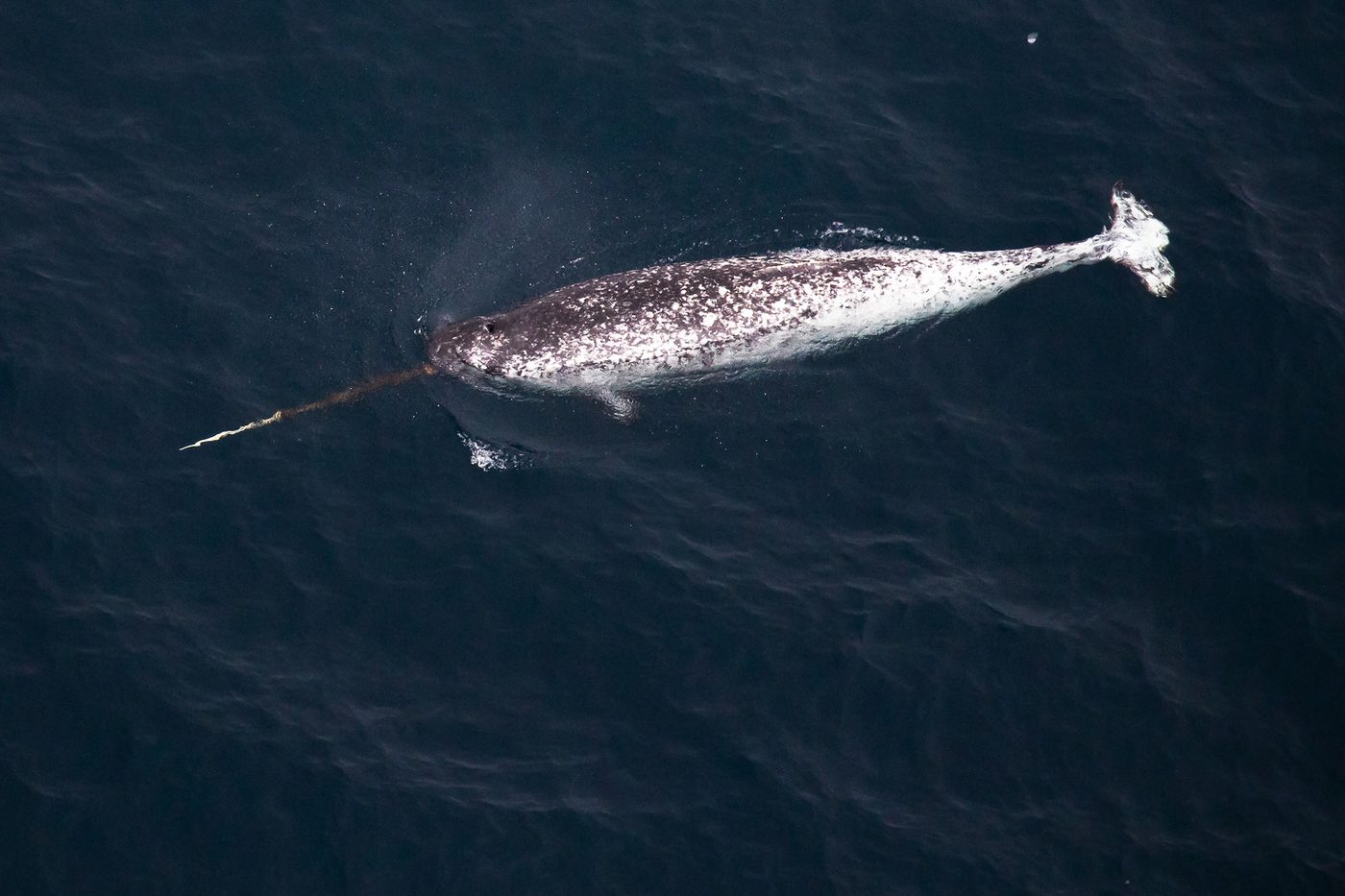
Narwhal
Monodon monoceros
Called the unicorn of the sea for its long spiral tusk, the narwhal is a mysterious cetacean of the icy Arctic seas, wrapped in ancient legends.
Characteristics
Temperament
Social and migratory, living in groups among the Arctic ice. A highly skilled diver; it uses echolocation to orient itself and hunt in the dark waters.
Diet
Carnivore: fish, squid and shrimp, sought with deep dives on the seabed.
The unicorn of the sea
The narwhal is one of the most extraordinary and mysterious cetaceans on the planet, famous for the long spiral tusk that projects from the males' heads, earning it the nickname 'unicorn of the sea'. It is a medium-sized marine mammal, with a stocky body and no dorsal fin, and a grey-and-white mottled colouring that lightens with age. It lives exclusively in the cold Arctic seas, among the ice of Greenland, Canada and Russia.
The secret of the tusk
The narwhal's famous tusk is not a horn but a tooth: it is an enormously elongated left canine that, instead of staying in the mouth, grows by piercing the lip and developing forward in a spiral, until it exceeds two or three metres in length. Usually only the males have it. Its function was long debated: today it is thought to be above all a sensory organ, rich in nerve endings, and a trait for courtship and disputes between males, which sometimes cross their tusks.
A hunter of the Arctic depths
The narwhal is a highly skilled diver, able to descend to considerable depths, among the greatest of all marine mammals, to search for food on the bottom. It feeds on fish, squid and shrimp. In winter it lives among the moving ice, where it finds gaps to breathe, in an extreme environment that very few species manage to exploit.
A social species
Narwhals live in groups that can reach large sizes during seasonal migrations. They communicate through a variety of sounds and, like other cetaceans, use echolocation to orient themselves and hunt in the dark, ice-covered waters.
Conservation
The narwhal is classified as least concern, but it is considered especially vulnerable to climate change: it depends closely on Arctic sea ice, which is shrinking rapidly. Ocean noise pollution, increasing ship traffic in the Arctic and hunting in some regions also pose threats to this fascinating polar species.