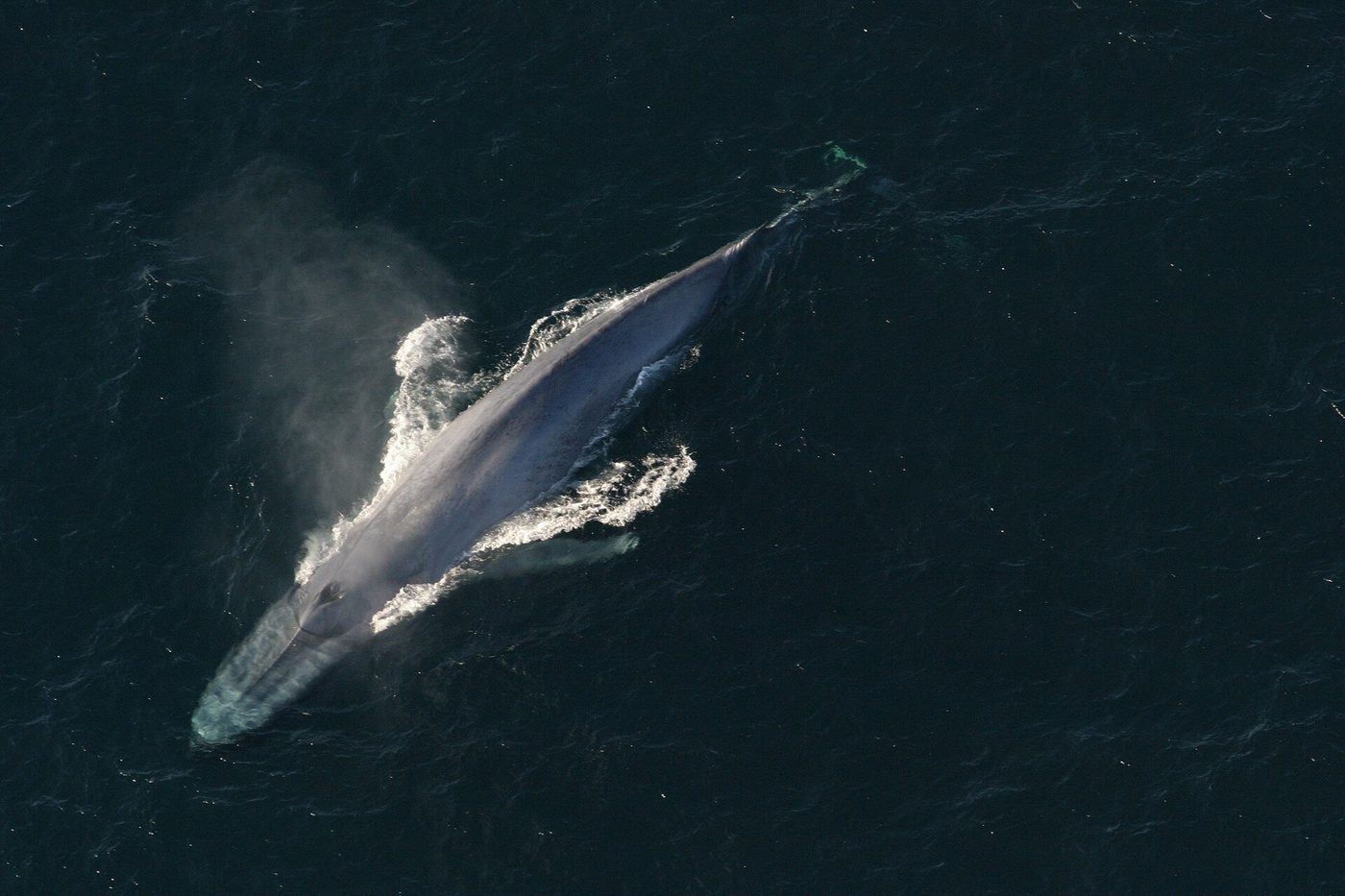
Photo: NOAA Photo Library · Public domain
Blue whale
Balaenoptera musculus
The largest animal ever to have lived on Earth, the blue whale exceeds thirty metres and a hundred tonnes, and yet feeds on tiny crustaceans.
Characteristics
Temperament
A peaceful giant, mostly solitary or in small groups. It makes long seasonal migrations and communicates over great distances with very-low-frequency calls.
Diet
Filter feeder: it feeds almost entirely on krill, retained by the baleen by filtering enormous quantities of water.
The largest of all
The blue whale is not only the largest living animal: it is the largest being that has ever existed on Earth, larger than any known dinosaur. It can exceed thirty metres in length and weigh over a hundred tonnes. Its tongue alone can weigh as much as an elephant, and its heart is the size of a small car. The long, tapered body is a mottled grey-blue that gave it its name, and on its back it bears a small dorsal fin, disproportionately tiny compared with its bulk.
A giant that eats the tiny
Despite its colossal size, the blue whale feeds almost entirely on krill, tiny shrimp-like crustaceans. It has no teeth but long horny plates called baleen that hang from the upper jaw. It gulps enormous quantities of krill-rich water, then pushes the water out through the baleen, which retains the prey like a giant sieve. In a single day during the feeding season it can consume several tonnes of krill.
The song of the deep
The blue whale produces some of the most powerful and deep sounds in the animal kingdom. Its calls, at very low frequencies largely inaudible to the human ear, can travel for hundreds of kilometres across the ocean, letting far-distant individuals communicate. These songs remain in part a mystery to scientists.
Ocean migrations
These giants make long seasonal migrations, moving between the cold polar waters, rich in krill, where they feed in summer, and the warmer waters where they breed. Despite their bulk, they are elegant swimmers and can reach surprising speeds.
Conservation
The blue whale is classified as an endangered species. The commercial whaling of the twentieth century brought it to the brink of extinction, drastically reducing its populations. Today it is protected internationally and shows signs of a slow recovery, but it remains threatened by collisions with ships, by ocean noise pollution and by climate change altering the availability of krill.