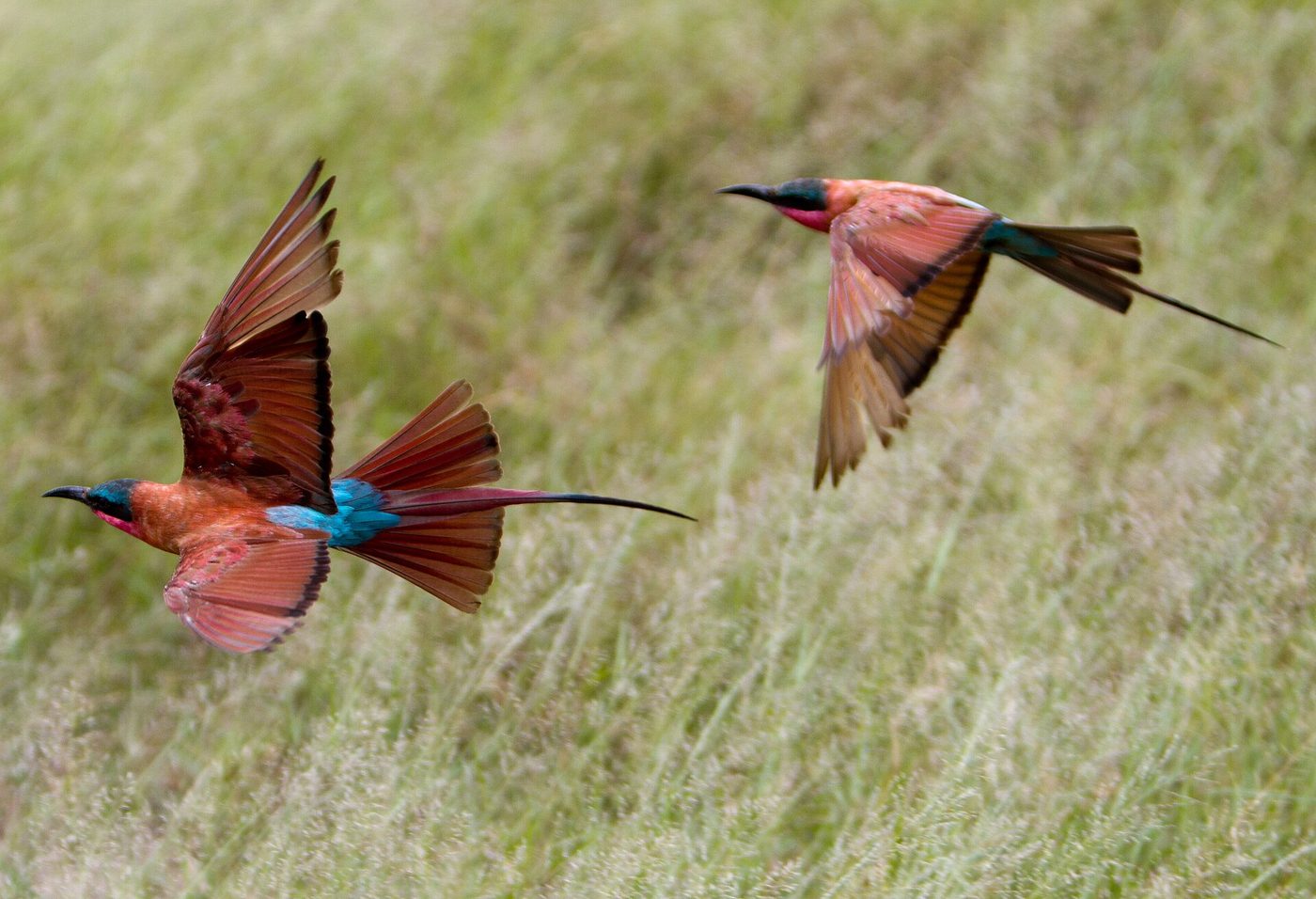
Photo: Uncovery · CC BY-SA 3.0
Southern carmine bee-eater
Merops nubicoides
A dazzling bird of southern Africa, the southern carmine bee-eater flaunts carmine-red plumage and catches insects in acrobatic flight.
Characteristics
Temperament
Social, colonial, aerial hunter
Diet
Insectivore: bees, wasps and flying insects
A flying jewel in carmine red
The southern carmine bee-eater is one of the most beautiful and striking birds in Africa. Its plumage is an intense carmine red over most of the body, with a bluish-green throat and head and a black mask over the eyes. The bill is long, slender and slightly curved, and the two central tail feathers extend into fine streamers. Like all bee-eaters, it is an elegant aerial hunter.
Habitat and distribution
It lives in sub-equatorial Africa, from South Africa and Namibia to Gabon, the south of the Democratic Republic of the Congo and Kenya. It is a migratory species, moving seasonally within the continent according to the availability of food and its breeding periods.
Behaviour and hunting
As its name suggests, it specialises in catching bees, wasps and other flying insects, seizing them in flight with spectacular acrobatics. Before swallowing a stinging prey, it beats it against a branch to remove the sting and venom. It often hunts from the backs of large mammals or near savanna fires, taking advantage of the insects flushed out.
Reproduction
It nests in large colonies along sandy riverbanks, where each pair digs a long tunnel in the ground in which to lay its eggs. Thousands of individuals may gather on the same bank, creating an extraordinary natural spectacle.
Conservation
The IUCN lists the species as Least Concern: it is common and widespread. The stability of the sandy riverbanks needed for nesting is nonetheless important for its conservation.
Pros
- Spectacular carmine-red plumage
- Fascinating acrobatic aerial hunting
- Common and widespread, not threatened
Cons
- Depends on sandy riverbanks for nesting
- Migratory: present only in certain seasons
- Not a bird to keep