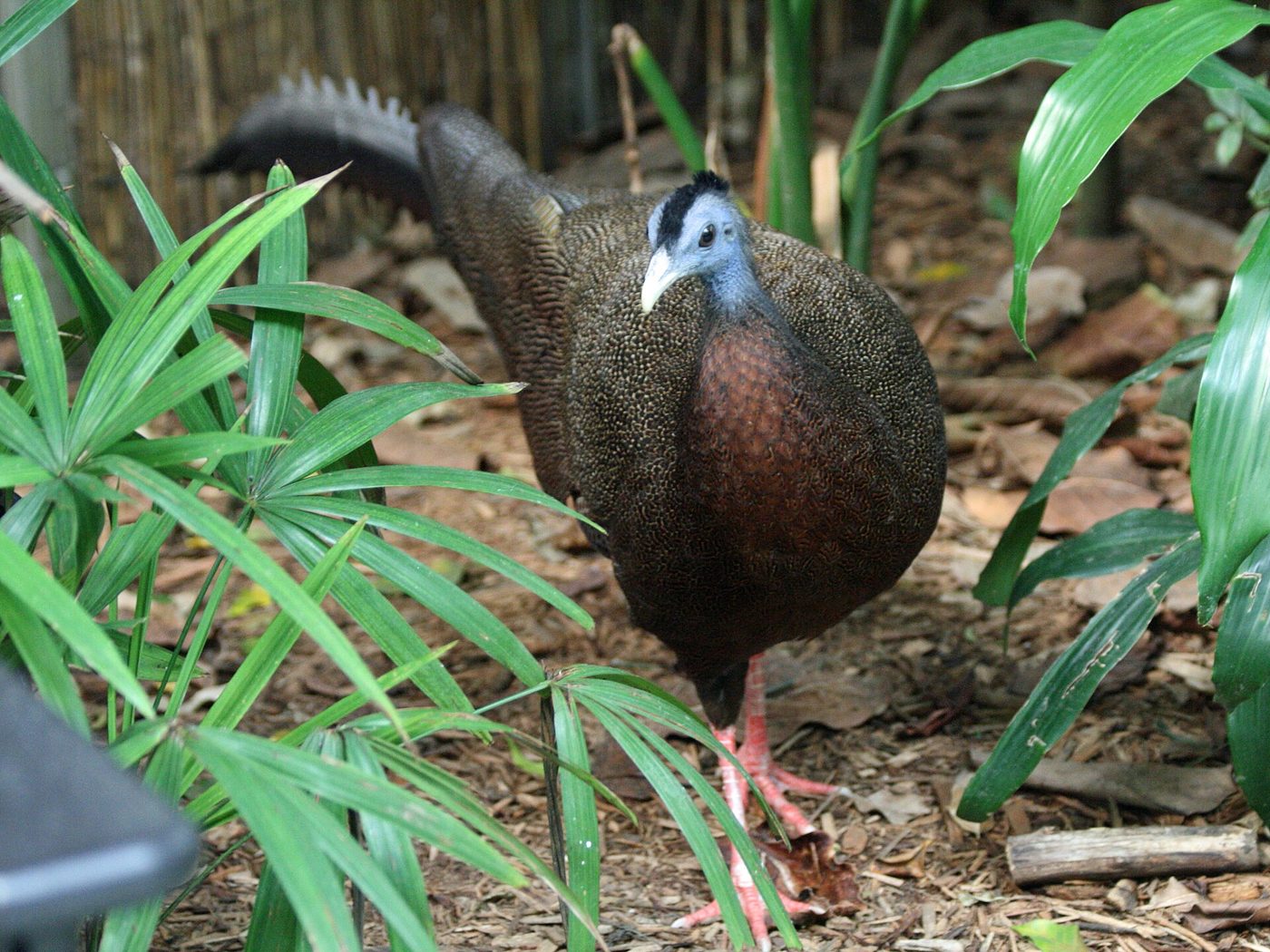
Great argus
Argusianus argus
The great argus is a large Southeast Asian pheasant, famous for its enormous wing feathers adorned with dozens of 'eyes' and a spectacular courtship dance.
Characteristics
Temperament
Shy and ground-dwelling; males with an elaborate courtship dance.
Diet
Omnivorous: fruit, seeds, shoots, insects and invertebrates.
The pheasant with a hundred eyes
The great argus (Argusianus argus) is a large pheasant of the family Phasianidae, the only species of its genus. The male is famous for its secondary wing feathers, extraordinarily elongated and covered in rows of large ocelli — round spots that mimic three-dimensional eyes. These "eyes" give the bird its name, after Argus, the hundred-eyed giant of Greek mythology. The female is smaller and plainer. The overall plumage is brown and finely speckled, a masterpiece of camouflage.
Habitat and range
It lives in the rainforests of Southeast Asia, particularly the Malay Peninsula, Sumatra and Borneo. It is a shy, ground-dwelling bird that moves through dense undergrowth and is easier to hear than to see.
Behaviour and courtship
It feeds on fruit, seeds, shoots, insects and other small invertebrates. The male is famous for its elaborate courtship dance: it carefully clears a large "arena" on the forest floor and summons the female with powerful calls. When she approaches, it spreads its wings into an imposing fan studded with ocelli, which glitter in the gloom.
Did you know?
The ocelli of its feathers were studied by Charles Darwin as an example of how sexual selection can produce extraordinary ornaments. At rest, however, the bird remains nearly invisible among the dead leaves.
Conservation
The IUCN lists it as Vulnerable. Rainforest destruction and hunting — both for meat and for the long ornamental feathers — threaten its populations across much of its range.
Pros
- Wing feathers with dozens of spectacular 'eyes'
- One of the most elaborate courtship dances
- Perfect camouflage in the undergrowth
Cons
- Vulnerable and declining
- Threatened by deforestation and hunting
- Shy and hard to observe in the wild