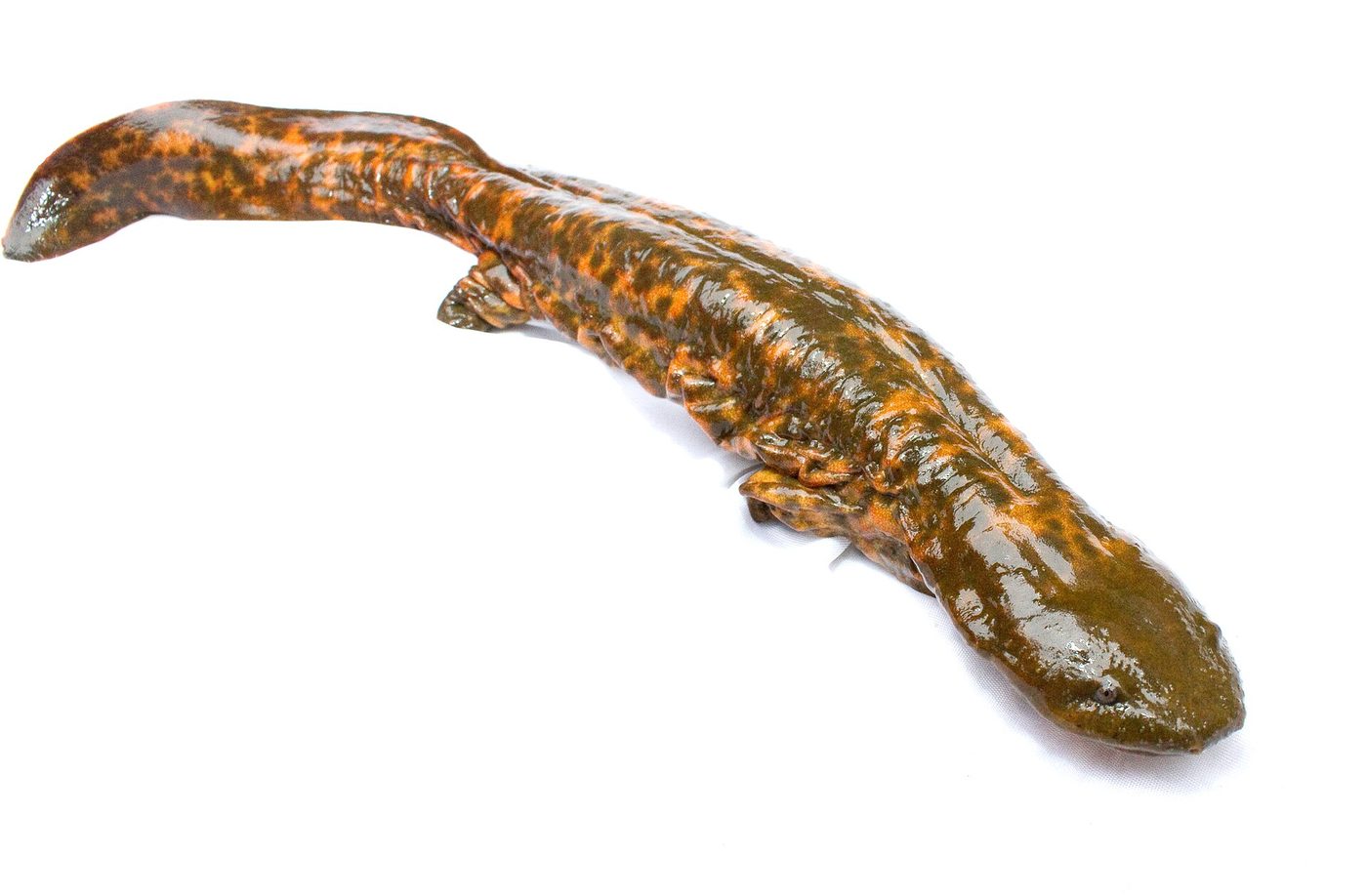
Photo: Brian Gratwicke · CC BY 2.0
Hellbender
Cryptobranchus alleganiensis
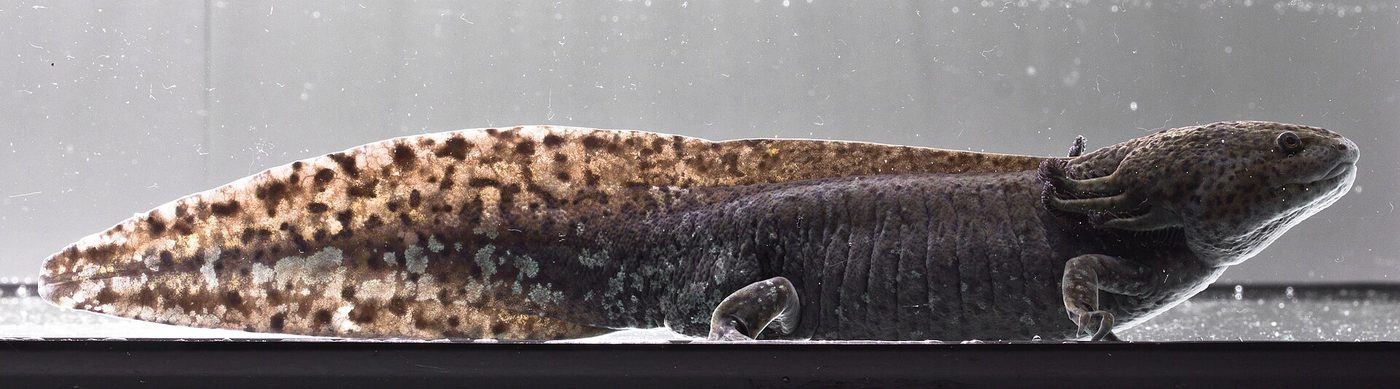
The hellbender is the largest salamander in North America: a fully aquatic giant amphibian that breathes almost entirely through the folds of its skin.
Characteristics
Temperament
Solitary, nocturnal and secretive; entirely tied to water.
Diet
Carnivorous: mainly crayfish and small fish.
A giant hidden in the rivers
The hellbender (Cryptobranchus alleganiensis) is the largest salamander in North America and the only living species of the genus Cryptobranchus. Its flattened, sturdy body can exceed 60 cm in length; the slimy, wrinkled greyish-brown skin forms broad folds along its sides. These folds are the key to its biology: by increasing the animal's surface area, they let it breathe almost entirely through its skin, exchanging gases with the water, while its lungs serve mainly for buoyancy.
Habitat and range
It lives in clear, cold, well-oxygenated rivers and streams of the eastern and central United States, from the Appalachians to the Mississippi basin. It needs flowing water with rocky beds, sheltering beneath large flat boulders that also serve as nest sites. Water quality is vital to it, making it an excellent bioindicator of stream health.
Behaviour and diet
It is a nocturnal, solitary predator that hunts mainly crayfish and small fish, locating prey by smell and by sensing vibrations. It spends its days motionless under stones. Males defend a den and guard the eggs until they hatch. The species belongs to the same family as the Japanese and Chinese giant salamanders.
Did you know?
It descends from a very ancient lineage: similar forms already lived in rivers around 65 million years ago. Its many folk names — snot otter, devil dog, mud devil — reflect its slimy, slightly sinister look, but the animal is entirely harmless to people.
Conservation
The IUCN lists it as Vulnerable. Eastern populations are falling sharply — in many areas nearly 80% are declining — due to pollution, siltation of rivers, loss of streamside forest and disease. In several stretches only older individuals remain, with very few young replacing them.
Pros
- The largest salamander in North America
- A bioindicator of water quality
- Completely harmless to humans
Cons
- Vulnerable, with sharply declining populations
- Extremely sensitive to water pollution
- Not a pet species: it must be protected in the wild